Kubernetes Misconfiguration Response: Stop, Contain and Recover
Isolating the control plane prevents lateral movement, but snapshotting the compromised state first preserves evidence for forensic analysis and root cause determination.
Immediately isolate the affected cluster to stop lateral movement. Snapshot the state for forensics. Rebuild infrastructure from immutable templates rather than patching the live environment. Rotate all credentials and review admission policies to prevent recurrence.
First hour
When you detect a Kubernetes misconfiguration that has been exploited, your primary goal is to limit the blast radius. Panic often leads to immediate remediation, which destroys evidence. You must balance containment with preservation.
- Isolate the cluster network. Block ingress and egress traffic at the cloud provider level or via network policies.
- Snapshot the cluster state. Capture logs, audit trails, and the current configuration of all resources.
- Revoke active session tokens. Invalidate service account tokens and API keys associated with the cluster.
- Identify the scope. Determine which namespaces and workloads are affected by the misconfiguration.
Imagine an attacker has exploited a pod running with elevated privileges. If you delete the pod immediately, you lose the process list and network connections that prove the breach. Instead, freeze the state. This allows your security team to analyse the attack vector without the attacker continuing their work.
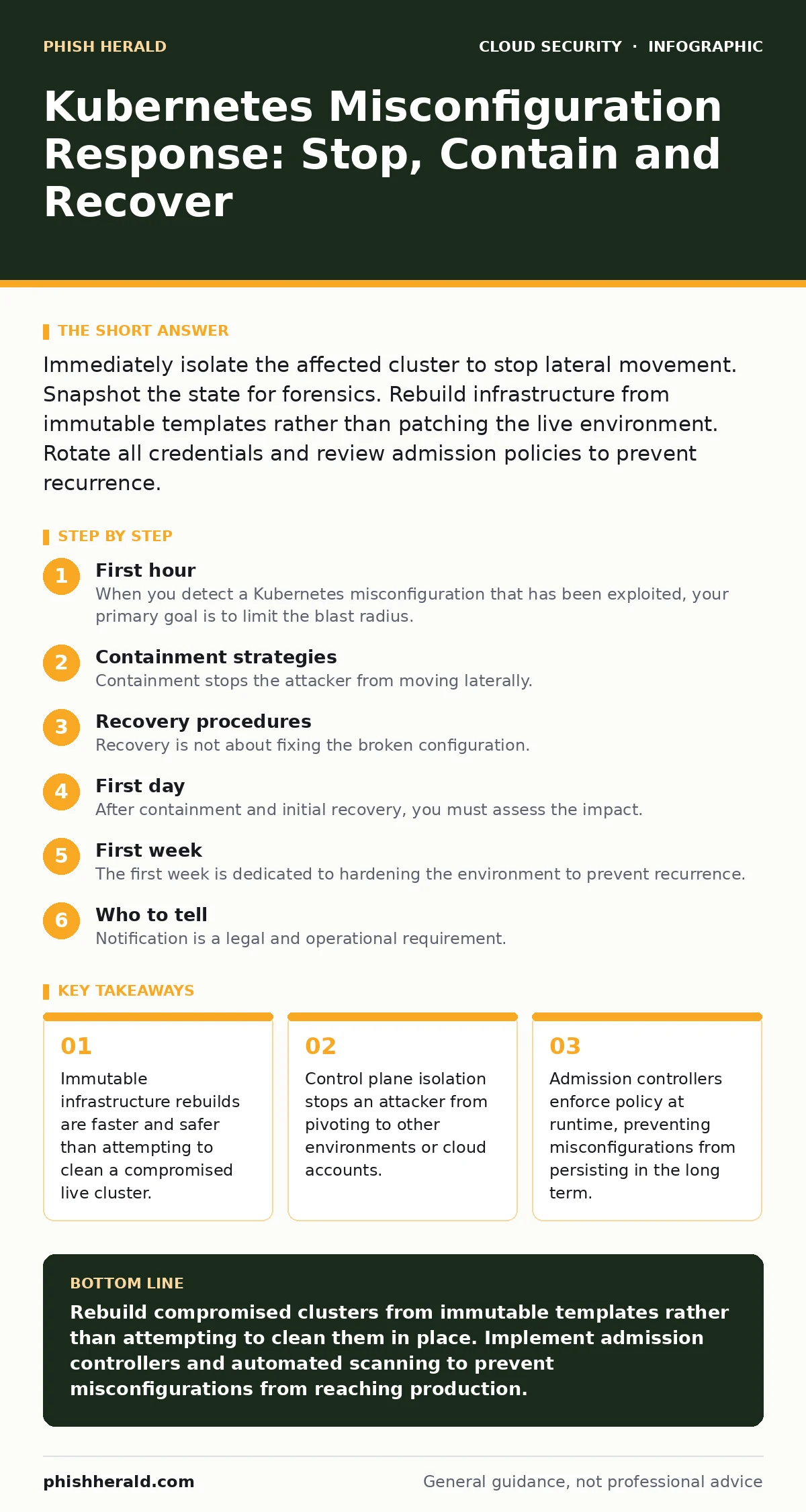
Containment strategies
Containment stops the attacker from moving laterally. In Kubernetes, lateral movement often occurs through shared secrets or overly permissive service accounts. You must sever these connections.
Isolate the control plane if the breach extends to it. The control plane manages the entire cluster. If an attacker controls it, they can create new admin users or export secrets from other clusters. Use network segmentation to restrict access to the API server. Only allow traffic from trusted management IPs.
Check for container escape vulnerabilities. A container escape allows a process to break out of its isolated environment and access the host operating system. If this occurs, the host node is compromised. You must treat the entire node as untrusted. Isolate the node from the cluster and the network.
Review your IAM roles. Misconfigured IAM roles often grant cloud-level permissions to Kubernetes service accounts. If an attacker gains access to a service account with cloud permissions, they can provision resources in your cloud account. Revoke these permissions immediately. See our guide on misconfigured IAM roles for details on mapping these permissions safely.
Recovery procedures
Recovery is not about fixing the broken configuration. It is about rebuilding the environment from a known good state. Patching a compromised cluster is risky because you cannot be sure the attacker has not left backdoors in the underlying system.
Use immutable infrastructure principles. Destroy the compromised cluster or namespace and recreate it from infrastructure-as-code templates. This ensures that the new environment matches the intended configuration exactly. It also removes any hidden artifacts the attacker may have planted.
Rotate all secrets. Even if you believe the attacker did not access secrets, you must assume they did. Rotate TLS certificates, database passwords, and API keys. If you use external key management, ensure your keys are rotated. See our guide on bring your own key encryption for best practices on managing these keys externally.
Verify container images. Ensure that the images you deploy are from trusted sources and have not been tampered with. Insecure container images are a common entry point. Use image signing and verification to ensure integrity. See our guide on insecure container images for methods to validate image provenance.
First day
After containment and initial recovery, you must assess the impact. This involves reviewing logs and determining what data was accessed or modified.
Analyse audit logs. Kubernetes audit logs record every request made to the API server. Look for unusual patterns, such as requests from unexpected IP addresses or for sensitive resources. Correlate these logs with network traffic logs to build a timeline of the attack.
Check for data exfiltration. If the attacker accessed databases or object storage, determine what data was taken. This is critical for regulatory compliance and customer notification. Use data classification tags to identify sensitive information.
Review code repositories. Attackers often modify application code to maintain access or exfiltrate data. Check your public code repositories for changes that were not approved. See our guide on public code repository leaks for methods to detect and prevent code tampering.
First week
The first week is dedicated to hardening the environment to prevent recurrence. This involves implementing technical controls and reviewing processes.
Implement admission controllers. Admission controllers intercept requests to the Kubernetes API before they are persisted. They can enforce policies such as requiring read-only root filesystems or blocking privileged containers. See our guide on Kubernetes admission controllers for implementation details. This prevents misconfigurations from being applied in the first place.
Adopt just-in-time access. Permanent admin access increases the risk of credential theft. Use just-in-time access to grant temporary privileges only when needed. This reduces the window of opportunity for an attacker. See our guide on just-in-time access for methods to implement dynamic privilege elevation.
Deploy cloud-native application protection platforms. CNAPP solutions provide continuous monitoring and automated remediation of Kubernetes misconfigurations. They integrate with your CI/CD pipeline to shift security left. See our guide on cloud-native application protection platforms (CNAPP) for an overview of these capabilities.
See also: Alert Triage Checklist: Stop False Positives Before They Stop You · Threat Hunting vs Incident Response: Distinct Roles in Defence
Who to tell
Notification is a legal and operational requirement. You must inform relevant stakeholders promptly.
Internal stakeholders include legal, compliance, and executive leadership. They need to understand the scope and impact to make informed decisions. External stakeholders include customers, partners, and regulators. The timing and content of these notifications depend on local laws and industry regulations.
Document everything. Keep a detailed record of the incident, including timeline, actions taken, and lessons learned. This documentation is essential for post-incident reviews and potential legal proceedings.
How to stop a repeat
Prevention requires a combination of technical controls and cultural change.
Automate security checks. Integrate security scanning into your CI/CD pipeline. Check for misconfigurations, vulnerabilities, and compliance violations before deployment. This shifts security left and reduces the risk of misconfigurations reaching production.
Conduct regular reviews. Review your Kubernetes configurations and policies regularly. Ensure they align with best practices and your security requirements. Use tools to automate this review process.
Train your teams. Educate developers and operators on Kubernetes security best practices. Ensure they understand the risks of misconfigurations and how to avoid them. This cultural shift is critical for long-term security.
Key takeaways
- Immutable infrastructure rebuilds are faster and safer than attempting to clean a compromised live cluster.
- Control plane isolation stops an attacker from pivoting to other environments or cloud accounts.
- Admission controllers enforce policy at runtime, preventing misconfigurations from persisting in the long term.
Rebuild compromised clusters from immutable templates rather than attempting to clean them in place. Implement admission controllers and automated scanning to prevent misconfigurations from reaching production.
Frequently asked questions
How long should I keep logs after a Kubernetes breach?
Retain logs for at least one year to support forensic analysis and regulatory compliance. Store them in an immutable, secure location.
Can I reuse the same cluster ID after a breach?
No. Reuse of cluster IDs can cause confusion in logs and monitoring. Create a new cluster with a unique ID to ensure clear separation.
What is the difference between a misconfiguration and a vulnerability?
A misconfiguration is an incorrect setting that exposes a system. A vulnerability is a flaw in the software code. Misconfigurations are often easier to exploit and more common.
Should I use privileged containers in production?
No. Privileged containers have full access to the host system. Use them only for specific maintenance tasks and never for application workloads.
How this guide was produced: written by the Phish Herald editorial team with AI assistance, checked against the public references listed below, and reviewed when the facts change. See our editorial policy or report an error.