Multi-region failover: 6 common misconceptions corrected
Multi-region failover is a complex engineering discipline, not a simple backup switch, and treating it as such exposes your organisation to silent data loss and compliance breaches.
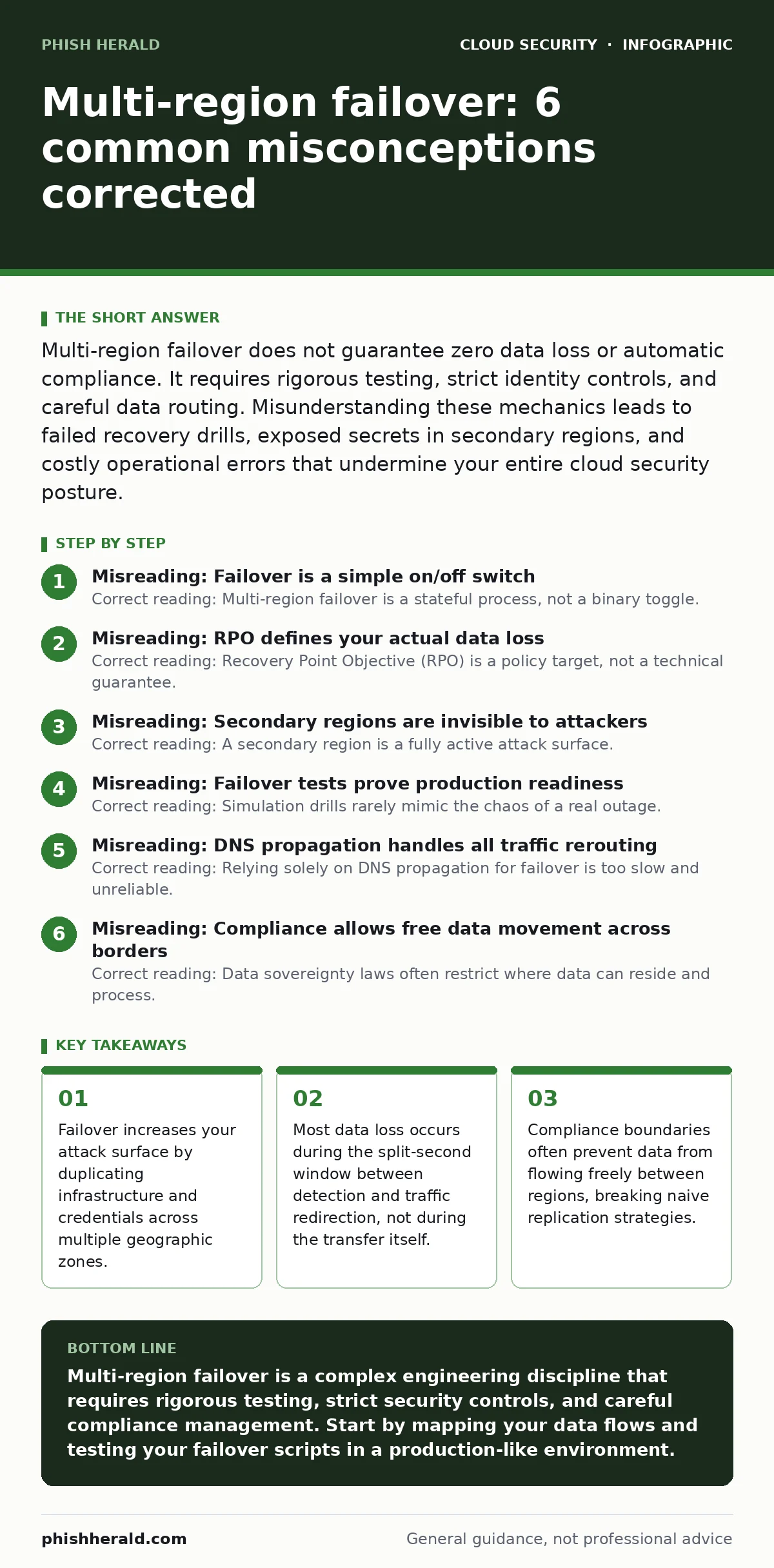
Multi-region failover does not guarantee zero data loss or automatic compliance. It requires rigorous testing, strict identity controls, and careful data routing. Misunderstanding these mechanics leads to failed recovery drills, exposed secrets in secondary regions, and costly operational errors that undermine your entire cloud security posture.
Misreading: Failover is a simple on/off switch
Correct reading: Multi-region failover is a stateful process, not a binary toggle. You cannot simply flip a switch to move services from Region A to Region B without considering the state of in-flight transactions, open database connections, and cached sessions. The mechanism involves detecting failure, validating the health of the target region, and rerouting DNS or load balancer traffic.
This process takes time. During this interval, users experience errors. If you assume the switch is instant, you will design your application timeouts too aggressively, causing premature failures before the failover completes. The complexity lies in synchronising the state of the primary system with the secondary system in real time.
Misreading: RPO defines your actual data loss
Correct reading: Recovery Point Objective (RPO) is a policy target, not a technical guarantee. RPO represents the maximum acceptable amount of data loss measured in time. Replication mechanisms, such as asynchronous database replication, always have a lag. If your primary region suffers a catastrophic failure, you will lose the data created during that lag window.
This window can range from milliseconds to minutes depending on network latency and replication architecture. Assuming your RPO is zero is a dangerous misconception. Even with synchronous replication, which blocks writes until all regions confirm receipt, you face higher latency for end users. You must accept that some data loss is inevitable and design your business logic to handle inconsistent states gracefully.
Misreading: Secondary regions are invisible to attackers
Correct reading: A secondary region is a fully active attack surface. Many organisations configure their disaster recovery region with reduced security monitoring, assuming it is cold storage. This is a critical error. Attackers who compromise the primary region often pivot to the secondary region to access replicated data or escalate privileges.
If your secondary region lacks the same intrusion detection systems, network segmentation, and logging as the primary, it becomes a blind spot. You must apply the principle of least privilege in the cloud equally across all regions. Credentials used to manage the failover process must be secured with bring your own key encryption to prevent attackers from decrypting data in the secondary region even if they gain access.
Misreading: Failover tests prove production readiness
Correct reading: Simulation drills rarely mimic the chaos of a real outage. Most tests are scheduled in advance, giving teams time to prepare and coordinate. In a real incident, stress levels are high, and communication channels may be disrupted. Furthermore, many tests use synthetic data or limited subsets of services. This fails to reveal performance bottlenecks that only appear under full production load.
Imagine a scenario where the database replication lag spikes because of a hidden dependency on a third-party service. Your test might pass, but the real failover fails. You need to conduct chaos engineering exercises that inject random failures into your production environment. This approach reveals hidden dependencies and validates that your automated failover scripts work under unexpected conditions.
Misreading: DNS propagation handles all traffic rerouting
Correct reading: Relying solely on DNS propagation for failover is too slow and unreliable. DNS changes can take hours to propagate globally due to caching by intermediate resolvers and end-user devices. During this period, users will continue to attempt connections to the failed primary region, resulting in errors. Modern architectures use global server load balancing that operates at the edge, directing traffic based on real-time health checks.
This method reroutes traffic in seconds. However, this introduces complexity in session management. If a user’s session is tied to the primary region, the secondary region must be able to validate or recreate that session. Without proper session replication, users will be logged out during failover, which can be unacceptable for high-availability applications.
See also: Alert Triage Checklist: Stop False Positives Before They Stop You · Threat Hunting vs Incident Response: Distinct Roles in Defence
Misreading: Compliance allows free data movement across borders
Correct reading: Data sovereignty laws often restrict where data can reside and process. You cannot simply replicate data to a secondary region in a different jurisdiction without violating regulations like GDPR or local data residency laws. This constraint limits your choice of failover regions. You may need to maintain a secondary region in the same country or legal zone, which reduces geographic diversity and resilience against regional disasters.
Additionally, you must ensure that your cloud data exfiltration controls are strict enough to prevent accidental data leakage during the failover process. If your application logic inadvertently sends data to a non-compliant region during a failover, you face significant legal and reputational risk. You must map your data flows carefully and implement strict egress filtering.
Misreading: Automated failover eliminates human error
Correct reading: Automation amplifies both efficiency and mistakes. If your failover script contains a bug, it will execute that bug at scale and speed. For example, a misconfigured script might open security groups to the public internet in the secondary region, exposing sensitive data. Or it might fail to rotate credentials, leaving old, potentially compromised keys active.
You must treat your failover scripts as critical infrastructure code. They require the same rigorous testing, code review, and security scanning as your application code. Additionally, you should implement just-in-time access for operators who need to intervene during a manual failover. This reduces the risk of insider threats or compromised credentials being used to manipulate the failover process.
Misreading: Failover covers all types of cloud failures
Correct reading: Multi-region failover protects against regional outages, but not against application-level bugs or misconfigurations. If your application has a critical bug that causes it to crash, that bug exists in both the primary and secondary regions. Failing over to the secondary region will simply replicate the failure.
Similarly, if you have Kubernetes misconfigurations or insecure container images, these vulnerabilities are present in all regions. You must complement failover with robust application testing, security scanning, and continuous monitoring. Failover is a last resort for infrastructure failure, not a fix for poor software quality. You need a layered defence strategy that includes secure coding practices, regular penetration testing, and real-time anomaly detection.
Misreading: Failover costs are predictable and low
Correct reading: Running a hot standby in a secondary region doubles your infrastructure costs. You pay for compute, storage, and network bandwidth in both regions, even if the secondary region is idle. Additionally, data transfer costs between regions can be significant, especially if you are replicating large datasets frequently.
You must factor these costs into your budget and design your architecture to minimise unnecessary data replication. Consider using warm standby architectures, where some services are scaled down in the secondary region, to reduce costs. However, this increases failover time, as you must scale up services during an incident. You must balance cost, performance, and resilience based on your business requirements.
Key takeaways
- Failover increases your attack surface by duplicating infrastructure and credentials across multiple geographic zones.
- Most data loss occurs during the split-second window between detection and traffic redirection, not during the transfer itself.
- Compliance boundaries often prevent data from flowing freely between regions, breaking naive replication strategies.
Multi-region failover is a complex engineering discipline that requires rigorous testing, strict security controls, and careful compliance management. Start by mapping your data flows and testing your failover scripts in a production-like environment.
Frequently asked questions
How do I choose the right secondary region for failover?
Choose a region that meets your compliance requirements, has sufficient infrastructure capacity, and is geographically distant enough to avoid regional disasters. Consider network latency and data transfer costs.
What is the difference between hot, warm, and cold standby?
Hot standby runs all services in the secondary region, offering fast failover but high cost. Warm standby runs critical services, balancing cost and speed. Cold standby stores data only, requiring full deployment during failover, which is slow but cheap.
How do I test failover without disrupting production?
Use chaos engineering tools to inject failures into your production environment. Alternatively, create a shadow environment that mirrors production and run failover drills there. Ensure your tests cover all critical paths and dependencies.
Can I use multi-region failover for small applications?
Multi-region failover is often overkill for small applications. Consider single-region high availability with multiple availability zones. This provides resilience against zone failures at a lower cost and complexity.
How this guide was produced: written by the Phish Herald editorial team with AI assistance, checked against the public references listed below, and reviewed when the facts change. See our editorial policy or report an error.