Indicators of compromise: how to detect hidden threats
Static indicators of compromise often fail against modern adversaries because they only record what happened, not how the attacker achieved their goal.

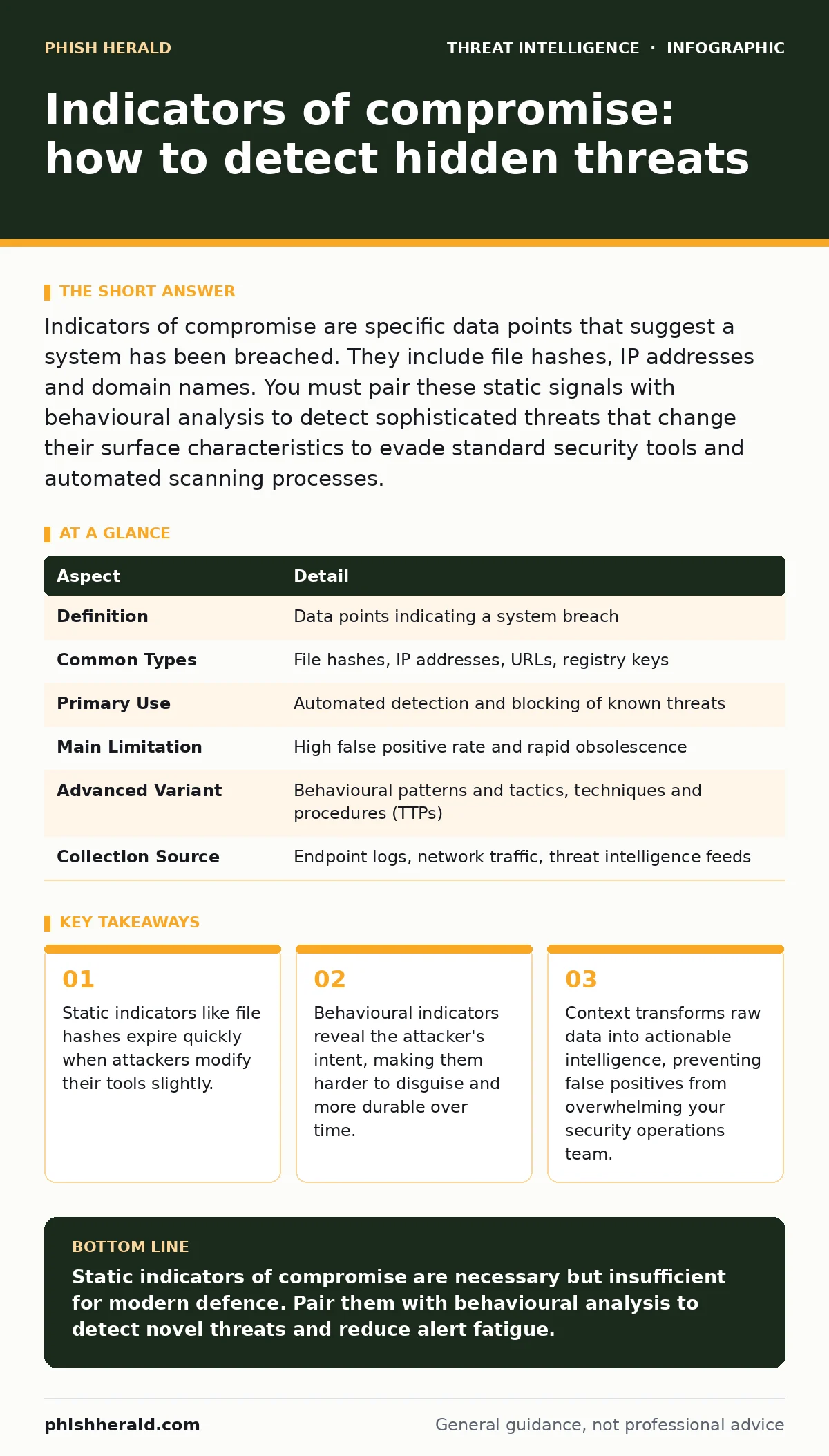
Indicators of compromise are specific data points that suggest a system has been breached. They include file hashes, IP addresses and domain names. You must pair these static signals with behavioural analysis to detect sophisticated threats that change their surface characteristics to evade standard security tools and automated scanning processes.
Understanding the core concept
Indicators of compromise are digital footprints left behind by malicious activity on a network or endpoint. Imagine you find muddy footprints on your clean kitchen floor. The mud itself is the indicator. It tells you someone entered, but it does not tell you who they were, what they stole, or whether they are still inside. In cybersecurity, these footprints are data points such as file hashes, domain names, IP addresses and registry keys. They signal that a security boundary has been crossed.
The value of these indicators lies in their ability to trigger automated responses. Security tools scan systems for these known bad patterns. When a match occurs, the system can isolate the device or block the connection. This automation is necessary because human analysts cannot manually inspect every packet of data moving through a large enterprise network. However, relying solely on these static markers creates a blind spot. Attackers know these lists exist and modify their tools to change their digital signature, rendering old indicators useless.
| Aspect | Detail |
|---|---|
| Definition | Data points indicating a system breach |
| Common Types | File hashes, IP addresses, URLs, registry keys |
| Primary Use | Automated detection and blocking of known threats |
| Main Limitation | High false positive rate and rapid obsolescence |
| Advanced Variant | Behavioural patterns and tactics, techniques and procedures (TTPs) |
| Collection Source | Endpoint logs, network traffic, threat intelligence feeds |
How detection mechanisms work
Security information and event management systems ingest logs from across your infrastructure. They compare these logs against threat intelligence feeds containing known indicators of compromise. If a host contacts a known malicious IP address, the system generates an alert. This process is fast and scalable. It allows you to block millions of connections without human intervention. The mechanism relies on exact matching. The file hash must be identical to the one in the database. The IP address must match precisely.
This exact matching is both a strength and a weakness. It is strong because it is unambiguous. There is no room for interpretation. It is weak because it is brittle. An attacker can change a single byte in a malicious script, creating a new hash that your system does not recognise. This is why static indicators are reactive. They only detect threats that have already been seen and catalogued by someone else. You are running behind the attacker, cleaning up footprints they left hours or days ago.
Who is affected by this approach
Every organisation with a digital presence faces the risk of compromise. Small businesses often lack the resources to maintain large threat intelligence feeds, leaving them vulnerable to automated attacks that use common indicators. Large enterprises face a different problem. They generate so much noise that analysts suffer from alert fatigue. The sheer volume of matches from static indicators buries the few genuine breaches. The attacker does not need to hide perfectly. They only need to hide among the noise.
Critical infrastructure operators face the highest stakes. A false positive can shut down a production line or a power grid. A false negative can allow a nation-state cyber attack to persist for months. The balance between sensitivity and specificity is delicate. You must tune your systems to catch the signal without drowning in the noise. This requires constant adjustment and a deep understanding of your normal network behaviour.
The hidden cost of static data
Most security teams focus on collecting more indicators. They subscribe to multiple feeds and aggregate thousands of new hashes every day. This creates a hidden cost: maintenance overhead. You must constantly update your rules, test them for false positives and retire old indicators that are no longer relevant. This work consumes analyst time that could be spent on proactive hunting. It also creates a false sense of security. You feel protected because your tools are busy, but you are only checking for the past.
This error is common and dangerous. It ignores the reality that new attacks leave no historical footprint. Suppose an attacker uses a custom-built tool that has never been seen before. Your system will not flag it. The attacker can move laterally, steal data and exfiltrate it without triggering a single static indicator. You are blind to the novel threat. This is why you must look beyond the footprint and observe the movement.
Moving from indicators to behaviour
To address the limitations of static data, you must adopt a behavioural approach. Instead of looking for a specific file hash, you look for specific actions. For example, a process that encrypts files rapidly is suspicious, regardless of its hash. A user logging in from two distant countries within minutes is suspicious, regardless of their password. These are behavioural indicators. They describe what the attacker is doing, not what they are using.
This shift aligns with the Unified Kill Chain model. You stop looking for the weapon and start looking for the intent. Tactics, techniques and procedures (TTPs) are the standard language for describing this behaviour. By mapping your alerts to TTPs, you can detect an attacker even if they change their tools. If they use a different script to perform the same lateral movement, your behavioural rules will still catch them. This requires a more sophisticated detection engine, often involving network detection and response capabilities.
See also: Alert Triage Checklist: Stop False Positives Before They Stop You · Implement User and Entity Behavior Analytics: A Practical Step-by-Step Approach
What people usually get wrong
Many teams treat indicators of compromise as a silver bullet. They believe that if they just collect enough data, they will catch every threat. This is incorrect. Data without context is noise. An IP address might be malicious in one context and benign in another. A file hash might be part of a legitimate software update in one environment and a trojan in another. You must enrich your indicators with context. Where did the data come from? What is the baseline behaviour for this user or device?
Another common error is ignoring the internal threat. Most indicators come from external threat feeds. These feeds are excellent for catching widespread malware. They are poor at catching insider threats or compromised credentials. An insider does not need to download a malicious file. They can simply access data they are authorised to see, but should not. Static indicators will not catch this. You need user and entity behaviour analytics to spot deviations from the norm.
Integrating with broader security strategy
Indicators of compromise are one piece of a larger puzzle. They work best when combined with other security disciplines. For instance, breach and attack simulation allows you to test whether your detection rules actually work. You can simulate an attack using known indicators and see if your system catches it. This validates your defences without risking real data. It also helps you identify gaps in your coverage.
You must also consider attacker reconnaissance. Before an attack, adversaries often scan your network for vulnerabilities. These scans leave indicators of their own. By detecting these early, you can harden your defences before the actual breach occurs. This proactive stance reduces the likelihood of a successful compromise. It shifts your focus from reaction to prevention.
Practical steps for implementation
Start by auditing your current detection rules. Identify which ones rely solely on static indicators. Group these by the type of threat they target. Then, add behavioural layers to these rules. For example, if you have a rule for a specific malware hash, add a rule for the process creation pattern associated with that malware. This dual approach increases your detection rate and reduces false negatives.
Next, improve your context enrichment. Ensure your security tools can correlate indicators with user identity, device health and network location. This allows you to prioritise alerts based on risk. A match on a critical server is more urgent than a match on a guest device. Finally, train your analysts to think in terms of TTPs. Encourage them to ask not just what was found, but how it was found and why it matters. This mindset shift is the key to effective threat hunting.
Key takeaways
- Static indicators like file hashes expire quickly when attackers modify their tools slightly.
- Behavioural indicators reveal the attacker's intent, making them harder to disguise and more durable over time.
- Context transforms raw data into actionable intelligence, preventing false positives from overwhelming your security operations team.
Static indicators of compromise are necessary but insufficient for modern defence. Pair them with behavioural analysis to detect novel threats and reduce alert fatigue.
Frequently asked questions
How long do indicators of compromise remain valid?
Static indicators like file hashes can become invalid within hours or days as attackers modify their tools. Behavioural indicators remain valid much longer because they describe persistent attacker strategies.
Can indicators of compromise detect insider threats?
Static indicators are poor at detecting insider threats. You need behavioural analytics to identify unusual access patterns or data exfiltration by authorised users who are acting maliciously.
What is the difference between an indicator of compromise and an indicator of attack?
An indicator of compromise suggests a breach has already occurred. An indicator of attack suggests active malicious activity, even if a breach has not yet been confirmed. The latter allows for earlier intervention.
How do I reduce false positives from indicator matching?
Enrich indicators with context such as user role, device type and network location. Tune your rules to ignore matches that are known to be benign in your specific environment.
How this guide was produced: written by the Phish Herald editorial team with AI assistance, checked against the public references listed below, and reviewed when the facts change. See our editorial policy or report an error.