Tactics, Techniques and Procedures (TTPs) for Security Decisions
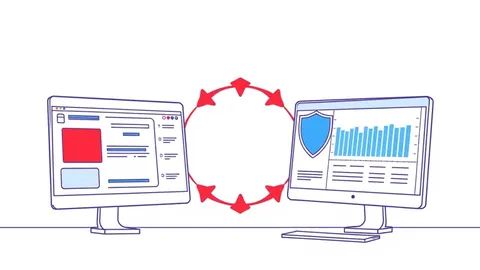
Tracking how attackers behave rather than what tools they use allows teams to detect threats that change their digital fingerprints daily.
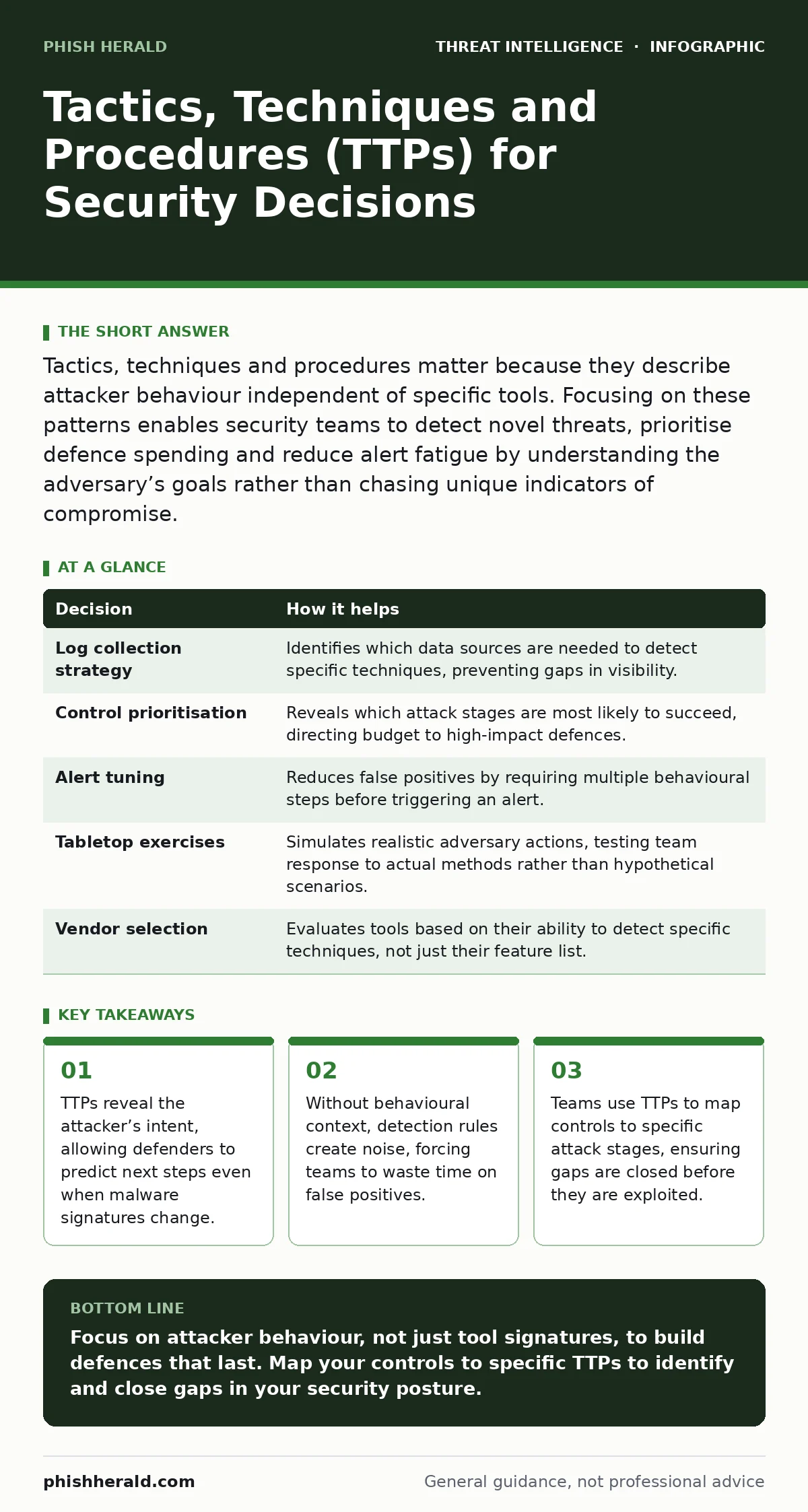
Tactics, techniques and procedures matter because they describe attacker behaviour independent of specific tools. Focusing on these patterns enables security teams to detect novel threats, prioritise defence spending and reduce alert fatigue by understanding the adversary’s goals rather than chasing unique indicators of compromise.
Why Behaviour Beats Signatures
Security operations often focus on indicators of compromise, which are specific digital fingerprints like file hashes or IP addresses. These indicators expire quickly because attackers change their code daily. Tactics, techniques and procedures describe how an attacker achieves their goals. This behavioural description remains valid for years. You defend against the method, not the tool. This shift changes how you view every alert.
Imagine a team that blocks known malicious domains. An attacker simply registers a new domain and the attack succeeds. Now imagine a team that detects the behaviour of downloading scripts from external sources. The attacker changes domains, but the behaviour remains the same. The detection triggers. You stop the attack by understanding the pattern, not the specific address.
The Cost of Missing Context
Without TTPs, security teams react to symptoms rather than causes. You see an alert for unusual network traffic. Without knowing the technique, you cannot determine if this is a data exfiltration attempt or a legitimate software update. You must investigate every instance. This process drains resources. Teams burn through their budget on tooling that generates noise. They hire more staff to triage alerts that lead nowhere.
The hidden cost is delayed detection. When you lack a framework for attacker behaviour, you build rules for known attacks. Novel attacks slip through. You assume silence means safety. In reality, the attacker is operating below your detection threshold. They have adapted their technique to avoid your specific signatures. You are blind to the method because you only watch for the previous version of the tool.
Decisions Informed by Behavioural Data
TTPs provide a structured way to evaluate risk. They inform where you invest in controls. They tell you which logs to collect. They guide your incident response playbooks. Below is how specific decisions change when you anchor them in behavioural data.
| Decision | How it helps |
|---|---|
| Log collection strategy | Identifies which data sources are needed to detect specific techniques, preventing gaps in visibility. |
| Control prioritisation | Reveals which attack stages are most likely to succeed, directing budget to high-impact defences. |
| Alert tuning | Reduces false positives by requiring multiple behavioural steps before triggering an alert. |
| Tabletop exercises | Simulates realistic adversary actions, testing team response to actual methods rather than hypothetical scenarios. |
| Vendor selection | Evaluates tools based on their ability to detect specific techniques, not just their feature list. |
How Teams Use Tactical Frameworks
Security teams use structured frameworks to translate raw data into actionable intelligence. These frameworks categorise attacker actions into phases. You map your controls to these phases. This reveals gaps. For example, you might have strong perimeter defences but weak monitoring for lateral movement. You identify this gap by seeing which techniques lack corresponding detection rules.
Teams also use these frameworks to share context. When a threat is identified, you describe it using standard terminology. Other teams can immediately understand the risk. They do not need to reverse-engineer the malware. They know the technique and can check their own environments for similar behaviour. This standardisation speeds up collective defence.
The Trap of Indicator Fatigue
Chasing indicators of compromise creates a cycle of constant updating. You block a hash. The attacker changes the hash. You block the new hash. This race is unwinnable. The attacker has infinite variations. You have finite resources. This dynamic forces teams into a reactive posture. You are always behind.
The non-obvious consequence is that indicator-based defence gives a false sense of security. You feel safe because you blocked the threat. In reality, you only blocked one instance. The underlying vulnerability remains. The attacker simply tries a different path. You have treated the symptom, not the disease. This illusion delays the necessary investment in behavioural monitoring.
See also: Attacker Reconnaissance Myths: What Your Defenders Actually See · Purple Teaming Misconceptions: Fix Your Security Testing Strategy
Integrating with Detection Engineering
Detection engineering builds rules that identify specific TTPs. You start with the technique. You determine what data is needed to see it. You write the rule. You test it against historical data. You refine it. This process ensures that every rule has a clear purpose. It prevents the accumulation of useless alerts.
This approach requires deep knowledge of your environment. You must understand how normal behaviour looks. You must know how the attacker’s technique differs. For instance, pass-the-ticket attacks reuse authentication tokens. Detecting this requires monitoring for unusual token usage patterns, not just checking for known malware. You need endpoint telemetry that captures process creation and authentication events. Without this data, you cannot see the technique.
Handling Advanced Persistent Threats
Advanced persistent threats operate slowly and carefully. They blend in with normal activity. Signature-based detection fails because their tools are often custom-built. They leave no known fingerprints. You must detect their behaviour. You look for slow data exfiltration. You look for unusual login times. You look for privilege escalation attempts.
These groups often perform attacker reconnaissance to map your network. They look for weak points. They test defences. If you only monitor for known malware, you miss this phase. You miss the opportunity to disrupt them before they steal data. You must detect the reconnaissance itself. This requires analysing network flows and user behaviour for anomalies. It requires patience and precision.
Building a Behavioural Defence
Defending against TTPs requires a shift in mindset. You stop asking "what is this?" and start asking "what is this trying to do?". You collect logs that reveal behaviour. You build rules that detect patterns. You train your team to think like attackers. You understand their goals. You anticipate their moves.
This approach takes time. It requires continuous refinement. You must update your rules as attackers adapt. You must test your defences regularly. You must stay informed about new techniques. But the payoff is resilience. You protect your organisation against the unknown. You stop threats that have no known signature. You build a defence that lasts.
Key takeaways
- TTPs reveal the attacker’s intent, allowing defenders to predict next steps even when malware signatures change.
- Without behavioural context, detection rules create noise, forcing teams to waste time on false positives.
- Teams use TTPs to map controls to specific attack stages, ensuring gaps are closed before they are exploited.
Focus on attacker behaviour, not just tool signatures, to build defences that last. Map your controls to specific TTPs to identify and close gaps in your security posture.
Frequently asked questions
How do I start implementing TTP-based detection?
Begin by selecting a common attack technique relevant to your industry. Identify the data sources needed to detect it. Write a simple detection rule and test it against your historical logs. Refine the rule to reduce false positives.
What is the difference between tactics and techniques?
Tactics describe the high-level goal, such as initial access. Techniques describe the specific method used to achieve that goal, such as phishing emails. One tactic can have many techniques.
Do I need expensive tools to track TTPs?
No. You need the right data and a structured approach. Many open-source tools can detect behavioural patterns. The key is knowing what to look for and how to interpret the data.
How often should I update my TTP mappings?
Review them regularly, especially after major security incidents or changes in your environment. Attacker methods evolve. Your defences must evolve with them. Stay current with emerging trends.
How this guide was produced: written by the Phish Herald editorial team with AI assistance, checked against the public references listed below, and reviewed when the facts change. See our editorial policy or report an error.