Attacker Reconnaissance Myths: What Your Defenders Actually See
Reconnaissance occurs silently on your internal networks long before any external perimeter breach, rendering traditional perimeter alerts useless against modern adversaries.

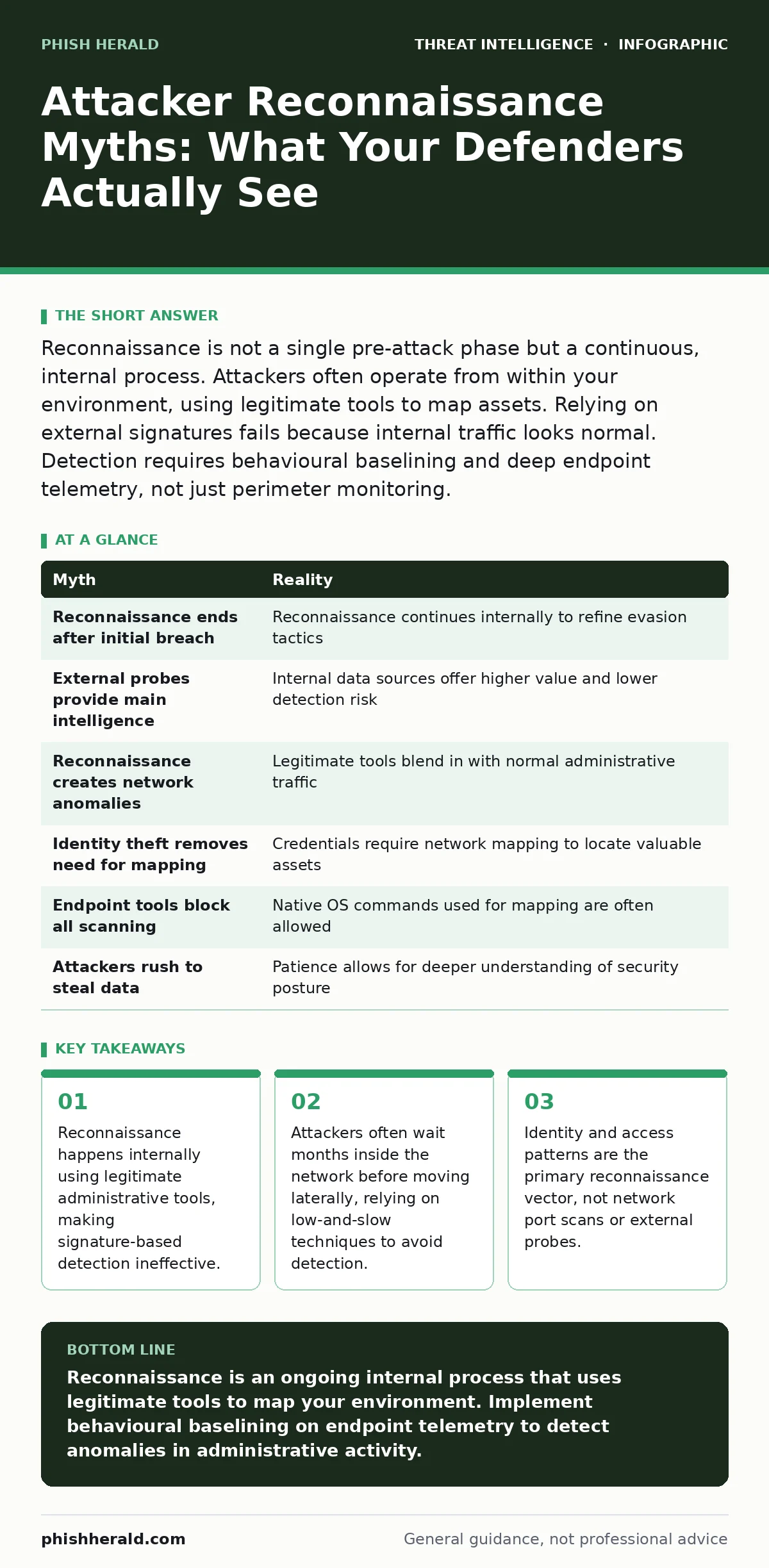
Reconnaissance is not a single pre-attack phase but a continuous, internal process. Attackers often operate from within your environment, using legitimate tools to map assets. Relying on external signatures fails because internal traffic looks normal. Detection requires behavioural baselining and deep endpoint telemetry, not just perimeter monitoring.
Myth: Reconnaissance Happens Only Before the Breach
Reality: Reconnaissance is a continuous activity that often occurs after an attacker has already established a foothold. Many organisations assume that once an initial compromise is mitigated, the reconnaissance phase ends. This assumption ignores the reality of persistent threats. Attackers frequently pause active exploitation to observe how your detection systems respond to their initial actions.
This observational period is critical for refining their tactics. They test which alerts trigger and which remain silent. This feedback loop allows them to adjust their behaviour to stay below your detection thresholds. The initial breach is merely the entry point for deeper intelligence gathering.
Myth: External Probes Are the Main Source of Threat Intelligence
Reality: External scanning represents a small fraction of the intelligence an attacker collects. While port scans and web application fuzzing are visible, they are often noisy and easily blocked. Sophisticated attackers prioritise internal data sources that are harder to monitor. They harvest credentials, email headers, and internal directory structures.
These sources provide rich context about organisational hierarchy, project timelines, and critical infrastructure. External probes tell an attacker what services you run. Internal data tells them who matters and what you value. Focusing solely on perimeter logs misses the high-value intelligence gathered from within your own systems.
Myth: Reconnaissance Always Generates Detectable Network Anomalies
Reality: Modern reconnaissance techniques are designed to blend in with normal business traffic. Attackers use legitimate remote management protocols and standard administrative tools to query systems. These tools are signed, trusted, and expected to communicate across your network. A system administrator checking server status looks identical to an attacker performing the same action.
Signature-based detection fails here because the protocol usage is correct. The malicious intent lies in the volume, timing, or target selection, not the protocol itself. Detecting this requires behavioural analysis rather than pattern matching. You must understand what normal administrative activity looks like to spot deviations.
Myth: Identity Theft Replaces the Need for Network Mapping
Reality: Stealing credentials is insufficient without understanding the scope of accessible assets. An attacker with valid credentials still needs to know which systems hold sensitive data. They cannot simply guess the location of critical databases or intellectual property. This necessitates active mapping of network topology and user permissions.
They use these credentials to query internal directories and scan for accessible shares. This mapping process reveals the path of least resistance to high-value targets. Without this structural understanding, stolen identities are merely keys to empty rooms. Network mapping transforms identity theft from a static risk into a dynamic threat.
Myth: Endpoint Security Solutions Block All Internal Scanning
Reality: Endpoint detection and response tools often miss internal reconnaissance because it involves passive data collection. Many attackers use native operating system commands to gather system information. These commands are built into the OS and are required for system maintenance. Blocking them would break normal business operations.
Attackers execute these commands slowly, spreading them over time to avoid triggering volume-based alerts. They collect data about installed software, running processes, and network connections. This data allows them to identify unpatched systems or misconfigured services. Endpoint agents focused on malware signatures rarely flag these benign-looking system queries.
See also: Tactics, Techniques and Procedures (TTPs) for Security Decisions · Purple Teaming Misconceptions: Fix Your Security Testing Strategy
Myth: Attackers Rush to Exfiltrate Data Immediately
Reality: Patience is a strategic advantage in advanced persistent threats. Attackers often dwell in networks for extended periods, gathering intelligence before attempting data theft. This long dwell time allows them to understand your security posture thoroughly. They identify which alerts are correlated and which are isolated. By observing your incident response team’s behaviour, they learn how to evade detection. Rushing to exfiltrate data increases the risk of triggering high-fidelity alerts. A slow, methodical approach minimises noise. This behaviour contradicts the assumption that attackers act quickly. Their goal is stealth, not speed.
Myth: Purple Teaming Eliminates Reconnaissance Blind Spots
Reality: Purple teaming exercises often simulate known attack paths, missing novel reconnaissance techniques. These exercises rely on predefined scenarios and expected outcomes. Attackers in the wild do not follow scripts. They adapt to your specific environment and detection capabilities. Purple teaming can create a false sense of security by validating only what is tested. It rarely covers the full breadth of internal data sources available to an adversary. To close these gaps, you need continuous, unscripted monitoring of internal traffic. Relying on periodic tests leaves windows of vulnerability between exercises.
| Myth | Reality |
|---|---|
| Reconnaissance ends after initial breach | Reconnaissance continues internally to refine evasion tactics |
| External probes provide main intelligence | Internal data sources offer higher value and lower detection risk |
| Reconnaissance creates network anomalies | Legitimate tools blend in with normal administrative traffic |
| Identity theft removes need for mapping | Credentials require network mapping to locate valuable assets |
| Endpoint tools block all scanning | Native OS commands used for mapping are often allowed |
| Attackers rush to steal data | Patience allows for deeper understanding of security posture |
Key takeaways
- Reconnaissance happens internally using legitimate administrative tools, making signature-based detection ineffective.
- Attackers often wait months inside the network before moving laterally, relying on low-and-slow techniques to avoid detection.
- Identity and access patterns are the primary reconnaissance vector, not network port scans or external probes.
Reconnaissance is an ongoing internal process that uses legitimate tools to map your environment. Implement behavioural baselining on endpoint telemetry to detect anomalies in administrative activity.
Frequently asked questions
How do I distinguish between normal admin activity and attacker reconnaissance?
Look for unusual timing, high-frequency command execution, or access patterns that deviate from the user’s role.
Can network detection and response tools catch internal mapping?
Yes, if configured to monitor internal lateral movement and unusual protocol usage, not just external threats.
Why is alert fatigue a problem during reconnaissance detection?
High volumes of low-fidelity alerts from normal activity bury the subtle signals of internal mapping.
Does breach and attack simulation help with reconnaissance detection?
It helps validate controls but may not cover all novel internal data gathering techniques used by adversaries.
How this guide was produced: written by the Phish Herald editorial team with AI assistance, checked against the public references listed below, and reviewed when the facts change. See our editorial policy or report an error.