Signature Based Detection in Cyber Security: Mechanisms and Blind Spots
Signature based detection in cyber security identifies known threats with high precision but fails completely against novel code that lacks a recorded fingerprint.

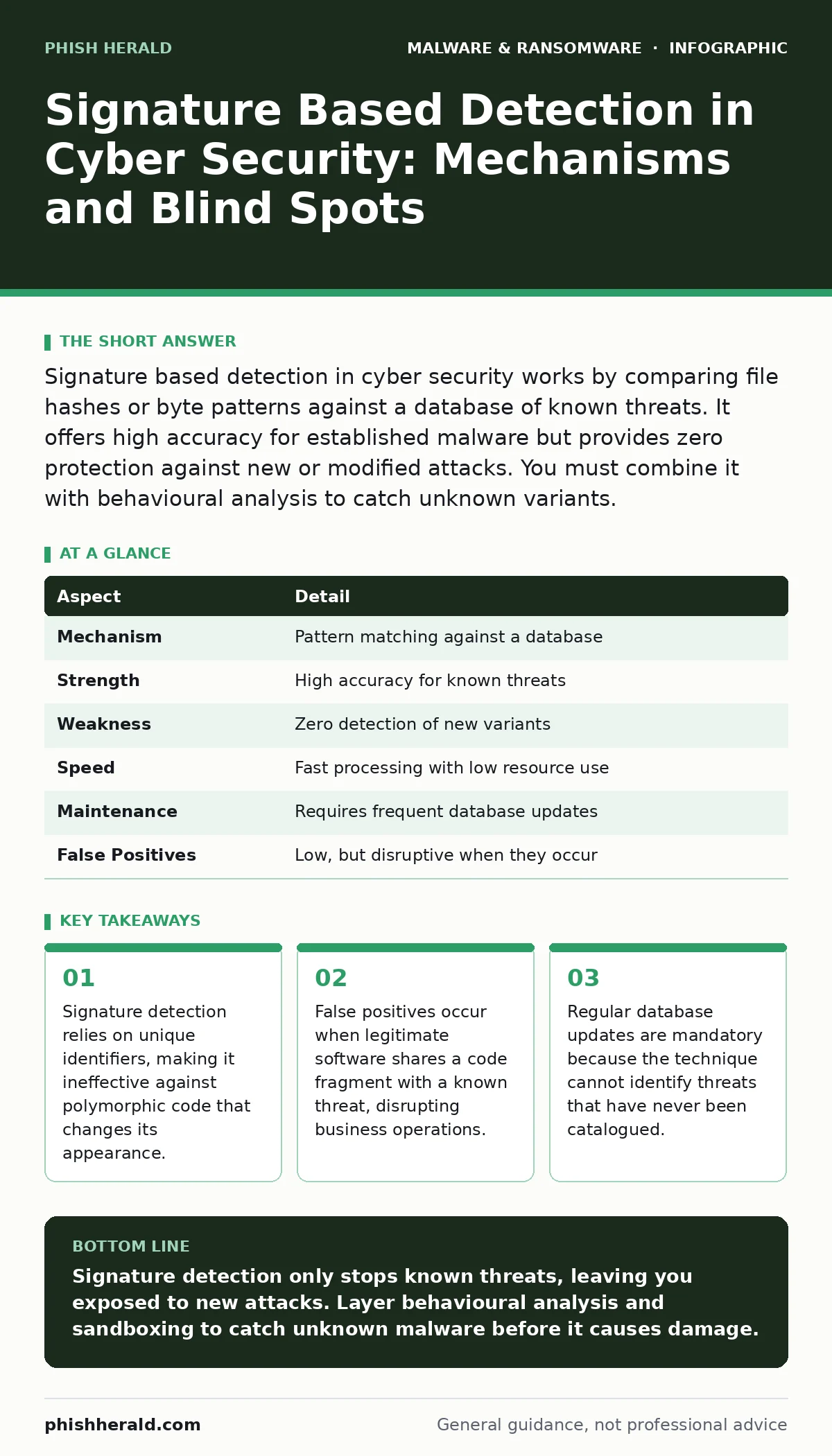
Signature based detection in cyber security works by comparing file hashes or byte patterns against a database of known threats. It offers high accuracy for established malware but provides zero protection against new or modified attacks. You must combine it with behavioural analysis to catch unknown variants.
How Signature Based Detection Works
Signature based detection in cyber security functions like a digital fingerprint scanner. Security tools extract specific characteristics from a file, such as its cryptographic hash or a unique sequence of bytes. The system then compares these characteristics against a central database of known malicious patterns. If the file matches a recorded signature, the tool blocks or quarantines it. This method relies entirely on prior knowledge of the threat.
The process begins when an endpoint agent scans incoming data or resident files. It calculates a hash value, which is a fixed-length string of characters representing the file's content. Even a single bit change in the file alters the hash completely. The agent sends this hash to the security engine. The engine checks the hash against the signature database. A match triggers an immediate response.
This approach is deterministic. It does not guess. It does not analyse intent. It simply checks for identity. If the file exists in the database, it is blocked. If it does not, it is allowed to proceed. This binary logic provides clarity but creates significant blind spots.
| Aspect | Detail |
|---|---|
| Mechanism | Pattern matching against a database |
| Strength | High accuracy for known threats |
| Weakness | Zero detection of new variants |
| Speed | Fast processing with low resource use |
| Maintenance | Requires frequent database updates |
| False Positives | Low, but disruptive when they occur |
The Everyday Analogy
Imagine a border control officer who only stops travellers on a specific watchlist. The officer holds a tablet displaying photos of known criminals. When a person approaches, the officer checks their face against the photos. If there is a match, the person is detained. If the person is not on the list, they pass through immediately.
This system works perfectly for the criminals on the list. It is fast and accurate. It does not require the officer to understand criminal behaviour. It only requires a reliable photo database. However, a new criminal who has never been photographed will walk right past. A known criminal who wears a convincing mask will also pass. The officer has no way to judge intent or suspicious behaviour. They only recognise what they have seen before.
Who It Affects
Organisations rely on this method because it is computationally cheap. Endpoint detection and response tools use signatures to filter out the bulk of known malware. This reduces the load on more expensive analytical engines. IT teams appreciate the low rate of false positives. Legitimate software rarely matches a malicious signature, so business applications run without interruption.
Developers also benefit from this clarity. When a file is flagged, the reason is explicit. The signature ID points to a specific known threat. This aids in forensic investigations and incident response. Teams can quickly identify the strain of malware and apply known remediation steps. The predictability of signature detection simplifies reporting and compliance audits.
However, the reliance on signatures creates a false sense of security. Teams may assume that if the scanner is quiet, the environment is safe. This assumption ignores the vast majority of modern attacks. Advanced adversaries do not use known malware. They write custom code or modify existing tools to avoid detection. Signature detection affects these teams by leaving them exposed to sophisticated threats.
What People Usually Get Wrong
Many professionals believe that keeping their signature database updated is sufficient. They assume that if the vendor updates the definitions daily, they are protected. This is incorrect. Updates only add new known threats. They do not improve the ability to detect unknown threats. A fresh attack will always bypass signature detection until someone analyses it and creates a signature.
Another common mistake is ignoring false positives. When a legitimate application is blocked, teams often whitelist the file to restore functionality. This creates a permanent blind spot. If an attacker later injects malicious code into that application, the security tool will ignore it. Whitelisting based on file path rather than hash is particularly dangerous. It allows any code in that location to run unchecked.
Teams also fail to understand the limit of hash-based detection. Attackers can easily change a file's hash by adding a single byte of data. This breaks the signature match. Polymorphic malware engines automate this process. They generate a new variant with a unique hash for every infection. Signature detection cannot track these shifting targets.
The Hidden Costs
The primary cost of signature detection is the delay between threat emergence and protection. This is known as the dwell time. An attacker can operate freely until a researcher identifies the malware, extracts its signature, and distributes the update. For a global campaign, this window can be critical.
There is also a maintenance cost. Security operations centres must triage alerts. While false positives are rare, they do happen. Investigating a blocked financial transaction or a disabled system process takes time. Engineers must verify that the block was correct. This manual verification scales poorly as the volume of traffic increases.
The technique also consumes bandwidth. Endpoint agents must download updated signature databases. In large organisations with thousands of endpoints, these downloads can saturate network links. Centralised distribution servers are required to manage this load. This adds infrastructure complexity and cost.
See also: Endpoint Protection for Small Business: Budget Strategies That Work · Endpoint Detection and Response: Answers to Ten Critical Questions
Combining With Other Methods
To overcome these limitations, you must layer signature detection with other techniques. Behavioural analysis monitors how a program acts rather than what it looks like. It flags processes that attempt to encrypt files, disable security tools, or access sensitive directories. This catches unknown malware that mimics legitimate software.
Sandboxing executes suspicious files in an isolated environment. This allows analysts to observe the code's behaviour without risking the production network. If the file attempts to contact a command-and-control server, the sandbox flags it. This method complements signature detection by identifying threats that lack a known fingerprint.
Integrating these methods requires careful tuning. You must balance detection rates with operational stability. Too many behavioural rules will block legitimate activities. Too few will miss advanced threats. Start with strict signature rules and gradually introduce behavioural monitoring. Train your team to interpret the combined alerts.
Managing The Detection Gap
You must accept that signature detection will miss new threats. Plan for this gap. Implement network segmentation to limit the damage of an undetected breach. If malware bypasses endpoint controls, it cannot easily move laterally to critical systems.
Invest in threat intelligence. Subscribe to feeds that provide indicators of compromise. These feeds often contain new signatures before they reach general distribution. Integrate these feeds into your security tools. This reduces the dwell time for emerging threats.
Regularly test your defences. Use controlled simulations to verify that signature updates are applied correctly. Check that quarantined files are truly isolated. Verify that whitelisted applications are monitored for changes. These checks ensure that your baseline defence remains effective.
Consult related guides on malware analysis to understand how signatures are created. Review sandboxing techniques to see how unknown code is evaluated. Understand rootkits to recognise threats that hide from standard scans. Learn about zero-day malware to appreciate the limits of known-threat databases.
Study remote access tool abuse to identify legitimate tools used maliciously. Read about double extortion ransomware to prepare for data leakage. Examine ransom notes to recognise the final stage of an attack. Check malicious PyPI packages for supply chain risks.
Final Considerations
Signature based detection in cyber security remains a foundational layer. It handles the high volume of known threats efficiently. It provides a clean baseline for more advanced analytics. Do not discard it. Instead, treat it as the first line of defence.
Build additional layers on top of this foundation. Use behavioural monitoring to catch what signatures miss. Use sandboxing to analyse what behaviour flags. Use threat intelligence to stay ahead of emerging trends. This layered approach provides resilience against a wide range of attacks.
Key takeaways
- Signature detection relies on unique identifiers, making it ineffective against polymorphic code that changes its appearance.
- False positives occur when legitimate software shares a code fragment with a known threat, disrupting business operations.
- Regular database updates are mandatory because the technique cannot identify threats that have never been catalogued.
- Combining signatures with sandboxing provides a layered defence that catches both known and unknown malicious behaviour.
Signature detection only stops known threats, leaving you exposed to new attacks. Layer behavioural analysis and sandboxing to catch unknown malware before it causes damage.
Frequently asked questions
Does signature detection protect against ransomware?
It protects against known ransomware strains that have been catalogued. It will not stop new ransomware variants or custom-built encryption tools used by attackers.
How often should I update my signature database?
Updates should be automatic and frequent, ideally daily or hourly. Delaying updates leaves you vulnerable to threats that have been recently identified and catalogued.
Can attackers easily bypass signature detection?
Yes. Attackers can modify code slightly to change its hash. They can also use polymorphic techniques to generate unique variants that do not match existing signatures.
Is signature detection enough for a small business?
It is a good start but insufficient alone. Small businesses are common targets. Combining signatures with basic behavioural monitoring and regular backups provides better protection.
How this guide was produced: written by the Phish Herald editorial team with AI assistance, checked against the public references listed below, and reviewed when the facts change. See our editorial policy or report an error.