YARA Rules FAQ: Writing, Testing, and Tuning for Detection
YARA rules provide high-fidelity detection by matching structural patterns in files and memory, but they require constant tuning to avoid performance degradation and alert fatigue.

YARA is a tool that helps you identify and classify malware by matching specific patterns in files or memory. It uses a flexible syntax to define rules based on strings, hexadecimal sequences, and conditions. This guide answers common questions about writing, testing, and deploying YARA rules effectively for threat detection.
What is YARA and how does it work?
YARA is a tool that allows you to create rules to identify and classify files or memory dumps based on textual or binary patterns. It works by scanning targets for specific strings, hexadecimal sequences, or structural conditions you define. Unlike signature-based antivirus that relies on known hashes, YARA looks for the underlying characteristics of malicious code. This makes it effective against modified or obfuscated malware that changes its hash but retains its core functionality.
Why use YARA instead of standard antivirus?
Standard antivirus solutions often rely on known threat signatures, which can miss zero-day or custom malware. YARA allows you to define custom rules based on indicators of compromise (IoCs) or behaviour patterns specific to your environment. This gives you greater control over what you detect and reduces reliance on vendor updates. However, YARA does not replace antivirus; it complements it by catching threats that traditional signatures miss. You must maintain these rules yourself, which requires ongoing effort and expertise.
How do I write a basic YARA rule?
A basic YARA rule consists of a rule name, metadata, string definitions, and a condition section. You start by defining the strings you want to match, such as specific text or hexadecimal sequences. Then, you write a condition that specifies when these strings must appear together or in a certain order. For example, you might require two specific strings to be present in the same file. The syntax is straightforward, but precision is key to avoiding false positives.
How can I prevent false positives in YARA rules?
False positives occur when a rule matches benign files, leading to alert fatigue and wasted investigation time. To prevent this, you must test your rules against a large corpus of known good files before deployment. Use negative testing to ensure your rule does not match common software, system files, or legitimate applications. Refine your conditions by adding constraints, such as requiring multiple strings or specific file structures. Regular review and tuning are necessary as new software versions are released.
How do I test YARA rules effectively?
Testing YARA rules requires a controlled environment with both malicious and benign samples. You should run your rules against a diverse set of files to check for accuracy and performance. Automated testing frameworks can help validate rules against known datasets, ensuring they do not produce false positives or negatives. Manual testing is also valuable for edge cases, such as files with unusual structures or encodings. Document your test results to track rule effectiveness over time.
See also: Tor Browser Privacy Risks: How to Neutralise Them · Tactics, Techniques and Procedures (TTPs) for Security Decisions
What are common mistakes when writing YARA rules?
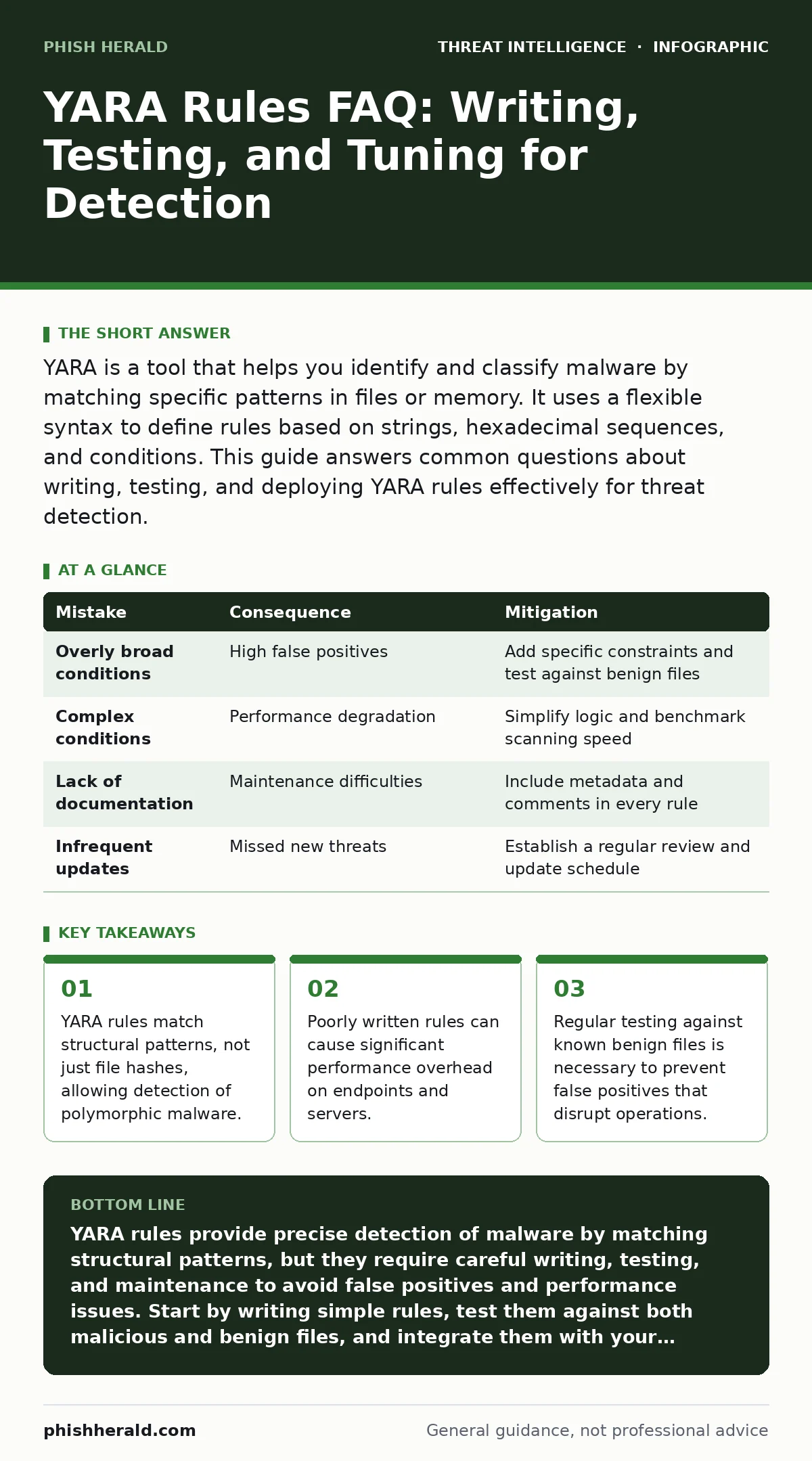
A common mistake is creating rules that are too broad, which leads to high false positive rates. Another error is ignoring performance implications, such as using complex conditions that slow down scanning. Failing to update rules as malware evolves renders them ineffective over time. Additionally, not documenting rules makes it difficult for others to understand or maintain them. Avoid these pitfalls by following best practices and regularly reviewing your rule set.
| Mistake | Consequence | Mitigation |
|---|---|---|
| Overly broad conditions | High false positives | Add specific constraints and test against benign files |
| Complex conditions | Performance degradation | Simplify logic and benchmark scanning speed |
| Lack of documentation | Maintenance difficulties | Include metadata and comments in every rule |
| Infrequent updates | Missed new threats | Establish a regular review and update schedule |
How does YARA integrate with other security tools?
YARA can be integrated with endpoint detection and response (EDR) platforms, security information and event management (SIEM) systems, and sandboxing tools. These integrations allow you to automate scanning and correlate YARA matches with other telemetry data. For example, you can trigger alerts in your SIEM when a YARA rule matches a file on an endpoint. This enhances your ability to detect and respond to threats in real time. Refer to our guide on endpoint telemetry for more on integrating detection data.
Can YARA detect memory-based threats?
Yes, YARA can scan memory dumps to identify threats that reside only in memory, such as fileless malware. This is particularly useful for detecting threats that do not write to disk, which traditional file-based scanning might miss. You can create rules that look for specific patterns in process memory or network buffers. However, scanning memory is resource-intensive and must be done carefully to avoid impacting system performance. Our guide on alert triage discusses how to prioritise these high-fidelity alerts.
How do I handle encrypted or packed malware with YARA?
Encrypted or packed malware obscures its true code, making pattern matching difficult. YARA can still detect these threats by looking for indicators in the packing routine or decryption stubs. You might create rules that match common packing algorithms or obfuscation techniques. Additionally, you can use YARA in conjunction with unpacking tools to analyse the decrypted code. This approach requires deep knowledge of malware packing methods and is not always straightforward.
What is the role of YARA in detection engineering?
YARA is a fundamental tool in detection engineering, allowing analysts to create precise, high-fidelity detections. It enables you to translate threat intelligence into actionable rules that can be deployed across your environment. By focusing on structural patterns, YARA helps detect novel threats that evade traditional signatures. Effective detection engineering involves continuous iteration, testing, and refinement of YARA rules. See our guide on detection engineering for broader strategies on building resilient detection capabilities.
Key takeaways
- YARA rules match structural patterns, not just file hashes, allowing detection of polymorphic malware.
- Poorly written rules can cause significant performance overhead on endpoints and servers.
- Regular testing against known benign files is necessary to prevent false positives that disrupt operations.
YARA rules provide precise detection of malware by matching structural patterns, but they require careful writing, testing, and maintenance to avoid false positives and performance issues. Start by writing simple rules, test them against both malicious and benign files, and integrate them with your existing security tools for automated scanning.
Frequently asked questions
Can YARA scan network traffic?
YARA is primarily designed for file and memory scanning, but some implementations allow it to analyse network packet captures for specific patterns.
How often should I update my YARA rules?
You should review and update your rules regularly, especially when new threats emerge or when software in your environment changes.
Is YARA free to use?
Yes, YARA is an open-source tool that is free to download and use for both commercial and non-commercial purposes.
Can YARA detect ransomware?
YARA can detect ransomware by matching patterns in the ransomware binary or its behaviour, but it must be specifically tuned to the threat.
How this guide was produced: written by the Phish Herald editorial team with AI assistance, checked against the public references listed below, and reviewed when the facts change. See our editorial policy or report an error.