Dark web monitoring services: finding credential leaks before attacks happen
Automated surveillance of hidden forums reveals stolen credentials long before attackers deploy payloads against your network.

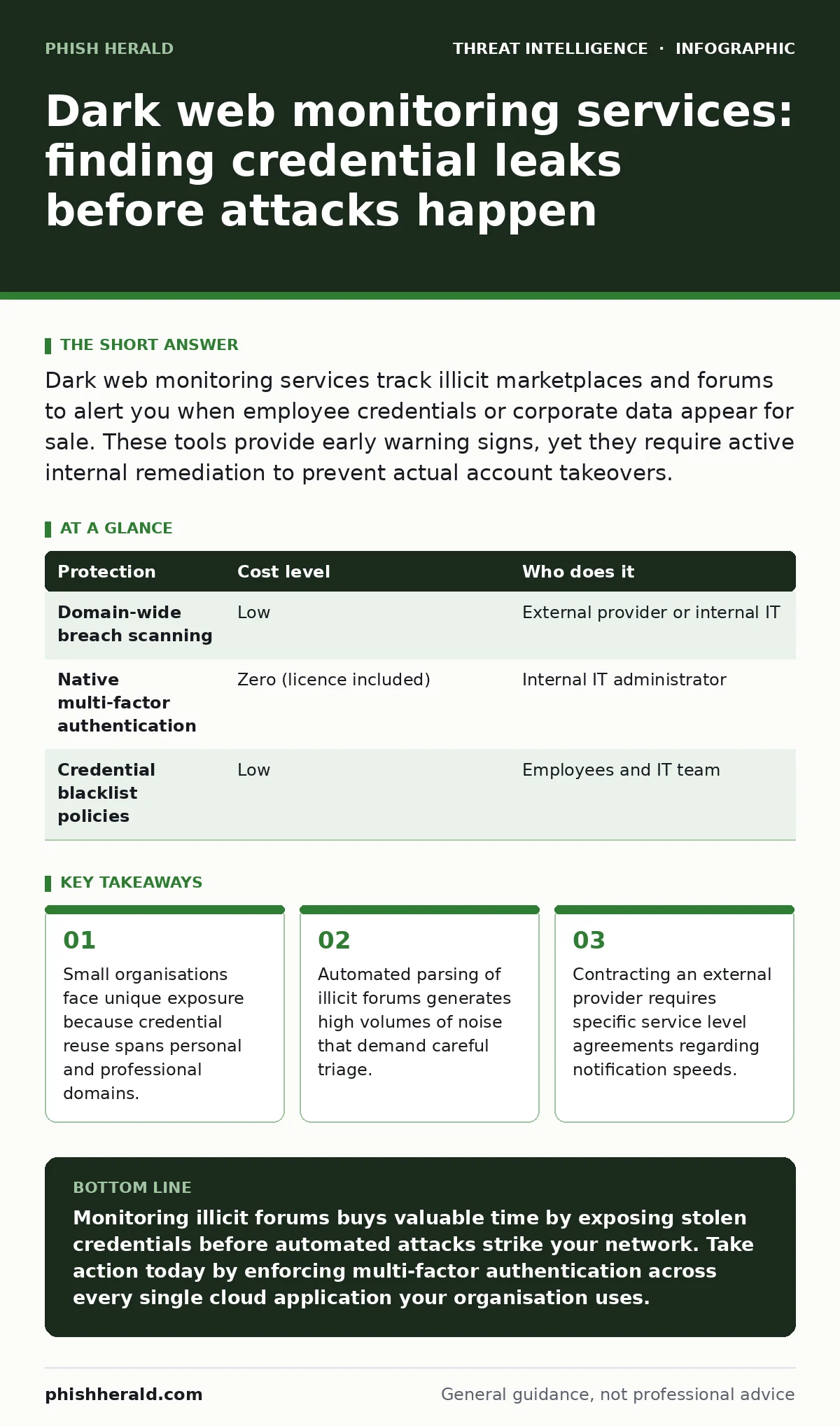
Dark web monitoring services track illicit marketplaces and forums to alert you when employee credentials or corporate data appear for sale. These tools provide early warning signs, yet they require active internal remediation to prevent actual account takeovers.
Why Small Organisations Face Unique Exposure
Small organisations face disproportionate risks online because employees frequently reuse corporate passwords across unsecured external web applications. Limited security budgets prevent many smaller firms from deploying advanced endpoint detection tools, leaving identity perimeters as the primary line of defence. Attackers know that staff members at compact enterprises often lack dedicated security awareness training.
Credential stuffing scripts automate the process of trying millions of leaked username and password combinations against login portals. Compact businesses rarely monitor authentication logs with the same diligence as multinational corporations, giving automated scripts ample time to succeed. External surveillance systems attempt to spot these traded credential lists before automated testing begins.
How Automated Surveillance Operates
Dark web monitoring services scan paste sites, hidden chat channels, and illicit marketplaces by deploying automated scrapers to index stolen databases. These scrapers extract email addresses, domain names, and plaintext or hashed passwords from newly published archives. Analysts then normalise the data, matching discovered strings against your registered corporate domain names.
Matching algorithms filter out noise by verifying whether the extracted email syntax belongs to an active staff member directory. Once a match is confirmed, the system generates an alert containing the affected user identity and the source leak context. Raw data feeds often supply indicators of compromise that link specific breach events to broader criminal campaigns.
The Hidden Cost of Alert Fatigue
Unfiltered monitoring feeds create severe operational friction through alert fatigue, a state of operational exhaustion caused by an overwhelming volume of notifications. Security teams waste countless hours investigating low-fidelity warnings that involve inactive accounts or test email addresses. Excessive false positives desensitise staff, causing them to ignore notifications that actually require immediate password resets.
Mitigating this friction requires establishing strict custom filtering rules that prioritise accounts with administrative privileges or active remote access sessions. You must tune the monitoring platform to suppress alerts regarding third-party vendor domains that do not impact your internal infrastructure security.
Low-Cost Protections for Tight Budgets
| Protection | Cost level | Who does it |
|---|---|---|
| Domain-wide breach scanning | Low | External provider or internal IT |
| Native multi-factor authentication | Zero (licence included) | Internal IT administrator |
| Credential blacklist policies | Low | Employees and IT team |
Enforcing multi-factor authentication across all cloud services neutralises the primary threat posed by leaked credentials, rendering stolen passwords useless without a secondary approval prompt. Native directory services often include built-in features that automatically block known compromised passwords during creation or modification attempts. Open-source intelligence feeds allow resource-constrained teams to check specific domain names against public breach archives without purchasing enterprise-tier software.
Evaluating Your IT Provider Capabilities
Contracting a managed service provider requires careful evaluation of their threat intelligence collection methodologies and reporting timeframes. Many providers merely resell generic threat feeds without offering actionable context regarding tactics, techniques and procedures (TTPs) used by the actors selling the data. You should demand transparency regarding how quickly raw scraped data is processed into customer-facing notifications.
3 critical questions to ask your prospective IT provider:
- How do you filter out defunct or duplicate records to prevent operational overload?
- What is the average time elapsed between a dataset appearing on an illicit forum and a customer notification?
- Can your platform integrate discovered credential anomalies directly into our existing incident response ticketing system?
See also: Attacker Reconnaissance Myths: What Your Defenders Actually See · Purple Teaming Misconceptions: Fix Your Security Testing Strategy
Integrating Threat Intelligence into Operations
Effective utilisation of surveillance data demands clear internal standard operating procedures that dictate exact remediation steps following a positive match. An IT administrator must immediately force a credential reset, revoke active session tokens, and review authentication logs for anomalous sign-in attempts. Integrating these steps into daily operations transforms passive threat data into active defensive hardening.
Security metrics help quantify the return on investment for your monitoring subscription by tracking metrics such as average time to remediate compromised accounts. Regular reviews of these metrics reveal whether employees continue poor credential hygiene habits, guiding future training initiatives. Threat intelligence remains merely a notification mechanism; actual security depends entirely on how swiftly your team acts on the warning.
Key takeaways
- Small organisations face unique exposure because credential reuse spans personal and professional domains.
- Automated parsing of illicit forums generates high volumes of noise that demand careful triage.
- Contracting an external provider requires specific service level agreements regarding notification speeds.
Monitoring illicit forums buys valuable time by exposing stolen credentials before automated attacks strike your network. Take action today by enforcing multi-factor authentication across every single cloud application your organisation uses.
Frequently asked questions
Can dark web monitoring services remove my stolen data from criminal forums?
Monitoring services cannot delete stolen data once criminals publish it across hidden networks or private chat channels. These tools only alert you to the exposure so you can invalidate the compromised credentials before attackers exploit them.
How often do surveillance platforms check for newly leaked corporate credentials?
Most platforms run continuous automated scrapers that ingest new data dumps within minutes of their publication on monitored illicit marketplaces. However, processing delays and verification queues can occasionally extend the time it takes for an alert to reach your inbox.
Does purchasing a monitoring service replace the need for employee security training?
Monitoring services cannot prevent employees from reusing passwords on insecure external websites or falling victim to sophisticated social engineering. Training remains essential to reduce the frequency of credential creation mistakes at the source.
What happens if an attacker accesses an account before the monitoring service sends an alert?
You must immediately isolate the affected device, revoke all active session cookies, and inspect audit logs for unauthorized data access. Rapid containment limits the operational impact while forensic investigation determines the scope of the breach.
How this guide was produced: written by the Phish Herald editorial team with AI assistance, checked against the public references listed below, and reviewed when the facts change. See our editorial policy or report an error.