Security Metrics PCI Compliance: Track What Auditors Actually Verify
Most organisations measure control existence rather than control effectiveness, leaving critical detection gaps invisible to standard compliance checklists.

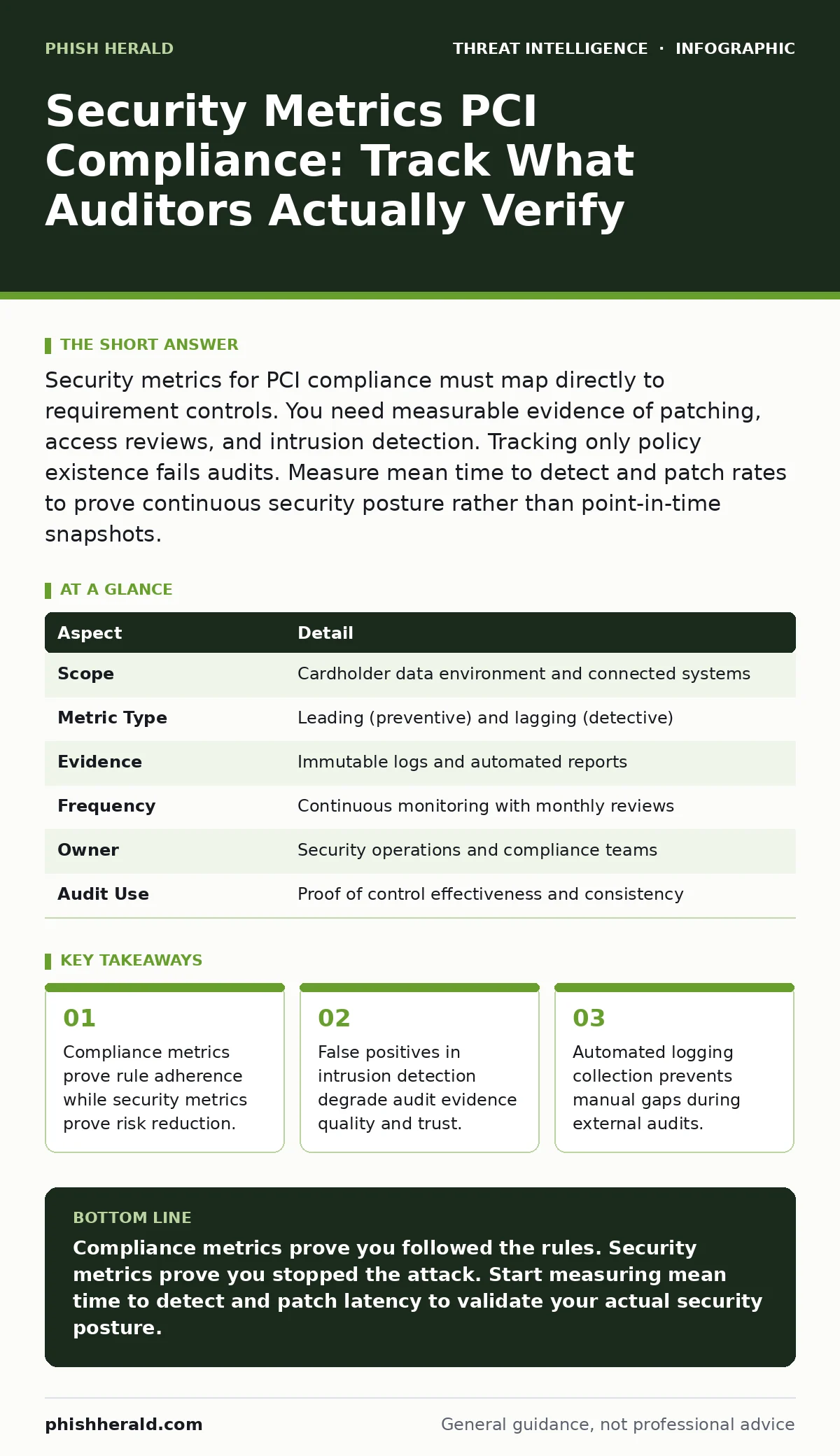
Security metrics for PCI compliance must map directly to requirement controls. You need measurable evidence of patching, access reviews, and intrusion detection. Tracking only policy existence fails audits. Measure mean time to detect and patch rates to prove continuous security posture rather than point-in-time snapshots.
The Thermometer Analogy
Imagine checking a furnace. You can verify the thermostat is set to 20 degrees, but that tells you nothing about whether the room is actually warm. Security metrics work the same way. Checking that a firewall exists is like checking the thermostat setting. Measuring how quickly you detect an intruder is like measuring the room temperature. One is a static configuration. The other is a dynamic reality. Auditors want to see the warmth, not just the dial.
Security Metrics PCI Compliance
Security metrics for PCI compliance bridge the gap between regulatory checkboxes and actual security posture. The Payment Card Industry Data Security Standard (PCI DSS) requires specific controls. Metrics provide the evidence that these controls function continuously. You must track data that proves ongoing adherence. This includes logging volume, patch latency, and access review completion. Without these metrics, you cannot demonstrate that security is active rather than dormant.
| Aspect | Detail |
|---|---|
| Scope | Cardholder data environment and connected systems |
| Metric Type | Leading (preventive) and lagging (detective) |
| Evidence | Immutable logs and automated reports |
| Frequency | Continuous monitoring with monthly reviews |
| Owner | Security operations and compliance teams |
| Audit Use | Proof of control effectiveness and consistency |
How Metrics Prove Control Effectiveness
Controls fail silently. A firewall rule might block traffic, but if logging is disabled, you have no proof. Metrics capture this proof. You must measure the time between vulnerability discovery and patch application. These numbers show whether your processes work in practice. They also highlight where automation is missing. Manual checks create gaps in the evidence trail. Automation ensures continuous data collection. This data feeds into your security operations centre for real-time visibility.
Who Metrics Affect in Your Organisation
Metrics change how teams interact with risk. The security operations team relies on detection rates to prioritise alerts. Without clear metrics, they suffer from alert fatigue. They cannot distinguish signal from noise. The compliance team uses metrics to prepare for audits. They need consistent data to prove adherence. The executive team uses metrics to understand risk exposure. They require high-level dashboards that translate technical data into business risk. Each group needs different views of the same underlying data. Siloed metrics create confusion and conflicting priorities.
What People Usually Get Wrong
Many organisations mistake activity for achievement. They measure the number of scans run rather than the number of vulnerabilities closed. They measure the volume of logs collected rather than the quality of analysis. This creates a false sense of security. Another common error is measuring only lagging indicators. Breach counts and incident resolutions tell you what went wrong. They do not help you prevent the next incident. You must balance leading indicators, such as patch rates, with lagging ones. Also, do not ignore the cost of measurement. Complex metrics require expensive tools and skilled staff. If the cost of measurement exceeds the risk reduction, the metric is worthless.
See also: Tactics, Techniques and Procedures (TTPs) for Security Decisions · Attacker Reconnaissance Myths: What Your Defenders Actually See
Integrating Detection and Response Metrics
Your intrusion detection systems generate massive data. You must measure their effectiveness. Mean time to detect (MTTD) is a critical metric. It measures how long an attacker remains undetected. Mean time to respond (MTTR) measures how quickly you contain the threat. These metrics directly relate to PCI DSS requirements for intrusion detection. You must also measure false positive rates. High false positive rates lead to ignored alerts. Ignored alerts hide real attacks. Tune your detection tools to reduce noise. This improves both security and compliance evidence. See our guide on network detection and response for tuning strategies.
Aligning with Advanced Threats
Standard compliance checks often miss sophisticated attacks. Adversaries who understand PCI DSS can mimic compliant behaviour. They move laterally within the network without triggering basic alerts. You need metrics that capture unusual behaviour, not just rule violations. Look for anomalies in user activity and data flows. This requires behavioural analytics. Compare current activity to baseline norms. Deviations from the baseline become your metrics. This approach complements traditional signature-based detection. It helps you spot advanced persistent threats that evade standard controls. Review the Diamond Model of intrusion analysis to structure your behavioural metrics.
Building Your Measurement Program
Start by mapping metrics to PCI DSS requirements. Identify the control. Define the metric. Set the target. Automate the collection. Review the data monthly. Adjust the targets as your environment changes. Involve all relevant teams in the process. Share the metrics across the organisation. Transparency builds accountability. Use these metrics to drive improvement, not just compliance. If a metric fails, investigate the root cause. Fix the process, not just the number. Continuous improvement is the goal. Compliance is the baseline. Security is the outcome. Read our guide on endpoint telemetry to improve your visibility into device behaviour.
Key takeaways
- Compliance metrics prove rule adherence while security metrics prove risk reduction.
- False positives in intrusion detection degrade audit evidence quality and trust.
- Automated logging collection prevents manual gaps during external audits.
Compliance metrics prove you followed the rules. Security metrics prove you stopped the attack. Start measuring mean time to detect and patch latency to validate your actual security posture.
Frequently asked questions
What is the difference between compliance and security metrics?
Compliance metrics verify that controls are in place as required by standards. Security metrics measure how well those controls prevent or detect threats in real time. Compliance is static. Security is dynamic.
How often should security metrics be reviewed?
Review critical detection and response metrics daily. Review compliance and posture metrics weekly or monthly. Continuous monitoring allows for immediate response to anomalies. Regular reviews ensure long-term trend analysis.
Can automated tools replace manual metric collection?
Automated tools are essential for scale and accuracy. They reduce human error and ensure consistent data. However, humans must interpret the data and define the metrics. Automation collects the data. People define the meaning.
What happens if metrics show poor performance?
Poor metrics indicate control failures or process gaps. Investigate the root cause. Update procedures or tools. Retrain staff if necessary. Do not ignore the data. Use it to drive remediation and improve security outcomes over time.
How this guide was produced: written by the Phish Herald editorial team with AI assistance, checked against the public references listed below, and reviewed when the facts change. See our editorial policy or report an error.