How Network Detection and Response Works: The Hidden Mechanics
Network detection tools often miss insider threats because they cannot read encrypted payloads without breaking trust, creating a blind spot in your perimeter.

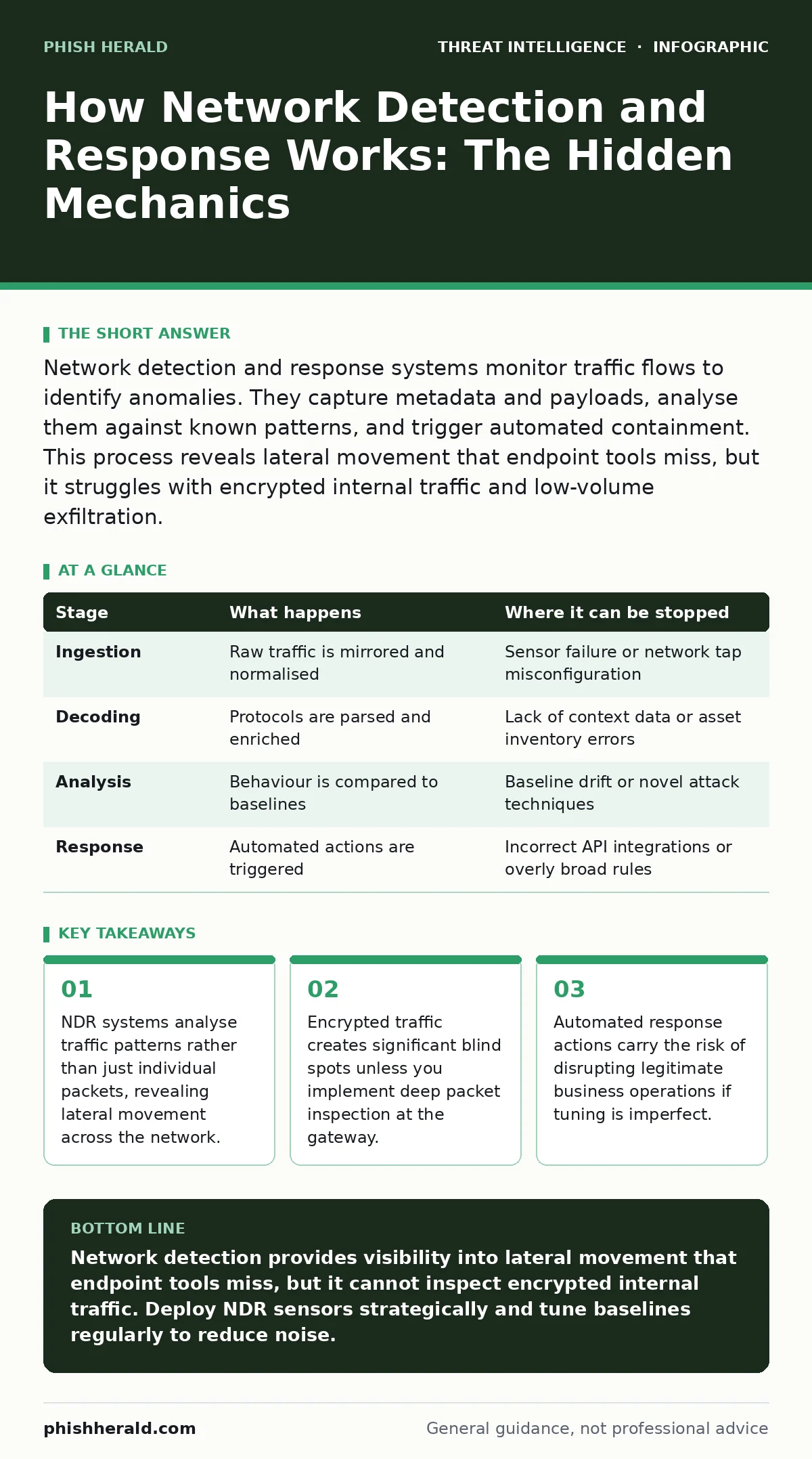
Network detection and response systems monitor traffic flows to identify anomalies. They capture metadata and payloads, analyse them against known patterns, and trigger automated containment. This process reveals lateral movement that endpoint tools miss, but it struggles with encrypted internal traffic and low-volume exfiltration.
The Invisibility of Internal Traffic
Most organisations focus heavily on securing the entry points. Firewalls and gatekeepers inspect inbound and outbound connections. However, once a threat actor bypasses the perimeter, they often move laterally within the internal network. This movement is invisible to traditional boundary security. Network detection and response (NDR) addresses this gap by monitoring the internal fabric.
You cannot protect what you cannot see. NDR systems deploy sensors or use tap points to mirror network traffic. This allows them to observe communications between servers, workstations, and cloud instances. The system does not rely on agents installed on devices. This makes it effective against compromised endpoints that have disabled local logging.
### Stage 1: Traffic Ingestion and Normalisation
The first step involves capturing raw data. The sensor receives a copy of the packets passing through a specific segment. This is often done via a network tap or a port mirror configuration on a switch. The system must handle high volumes of data without dropping packets.
Raw network data is messy and inconsistent. The ingestion engine strips away unnecessary noise. It normalises the data into a consistent format. This standardisation allows the analysis engine to compare traffic from different protocols and sources. Without this step, the sheer volume of data would overwhelm the system.
### Stage 2: Protocol Decoding and Context Enrichment
Once ingested, the system decodes the protocols. It understands DNS, HTTP, SMB, and other common standards. This decoding reveals the structure of the communication. It identifies who is talking to whom and what they are saying at a high level.
The system then enriches this data with context. It checks the source and destination against known asset inventories. It determines if a server is supposed to be communicating with a specific external IP. This contextual layer transforms raw data into meaningful events. It answers the question of whether this activity is expected.
### Stage 3: Behavioural Analysis and Threat Hunting
This stage relies on behavioural baselines. The system learns what normal traffic looks like for each device and user. It establishes patterns for volume, timing, and destinations. Any deviation from these patterns triggers an alert. This is where NDR shines against novel threats.
The system also checks for known indicators of compromise. It compares traffic against threat intelligence feeds. This includes known malicious IP addresses and domains. It looks for specific patterns associated with command and control channels. This combination of behavioural and signature-based detection increases accuracy.
### Stage 4: Alert Correlation and Triage
Individual alerts are often noisy. A single anomaly might be benign. NDR systems correlate multiple alerts to identify complex attacks. They link disparate events into a single incident. This reduces alert fatigue for your security team.
The system prioritises incidents based on risk. It considers the criticality of the affected asset and the severity of the behaviour. This prioritisation helps you focus on the most dangerous threats first. It integrates with alert triage workflows to streamline the investigation process.
See also: Eavesdropping Attacks Prevention Checklist for Secure Networks · Network segmentation examples: how to isolate threats and limit damage
### Stage 5: Automated Response and Containment
Once a threat is confirmed, the system can take action. It can send an API request to your firewall to block a malicious IP. It can isolate a compromised endpoint from the network. This automated response reduces the time to containment.
However, automation carries risks. Incorrect rules can block legitimate traffic. You must test response actions in a controlled environment. Ensure that the system has clear boundaries for what it can do. Manual oversight remains necessary for high-impact actions.
The Limits of Network Visibility
NDR is not a silver bullet. It cannot see what is encrypted. If you use TLS for internal communications, the NDR system only sees the handshake. It cannot inspect the payload. This creates a blind spot for sophisticated attackers who use encryption to hide their tracks.
It also struggles with low-and-slow attacks. If an exfiltrates data at a rate that falls within normal behavioural baselines, the system may not detect it. You need complementary controls to catch these slow bleed scenarios.
| Stage | What happens | Where it can be stopped |
|---|---|---|
| Ingestion | Raw traffic is mirrored and normalised | Sensor failure or network tap misconfiguration |
| Decoding | Protocols are parsed and enriched | Lack of context data or asset inventory errors |
| Analysis | Behaviour is compared to baselines | Baseline drift or novel attack techniques |
| Response | Automated actions are triggered | Incorrect API integrations or overly broad rules |
Integrating with Broader Security
NDR works best as part of a layered defence. It complements endpoint detection and response tools. While EDR sees what happens on a device, NDR sees how devices talk to each other. This dual visibility provides a more complete picture.
You can use detection engineering principles to improve your NDR rules. By understanding how attackers use PowerShell abuse or token theft, you can create specific network signatures. This proactive approach enhances your ability to detect emerging threats.
The Cost of Complexity
Implementing NDR adds complexity to your network. You must manage sensor placement and data retention policies. The system generates large volumes of data that must be stored and analysed. This requires significant storage and processing resources.
You also need skilled analysts to interpret the alerts. Without proper training, your team may miss subtle indicators. The cost of false positives can be high, leading to alert fatigue. Ensure that your team is trained in the nuances of network traffic analysis.
Key takeaways
- NDR systems analyse traffic patterns rather than just individual packets, revealing lateral movement across the network.
- Encrypted traffic creates significant blind spots unless you implement deep packet inspection at the gateway.
- Automated response actions carry the risk of disrupting legitimate business operations if tuning is imperfect.
Network detection provides visibility into lateral movement that endpoint tools miss, but it cannot inspect encrypted internal traffic. Deploy NDR sensors strategically and tune baselines regularly to reduce noise.
Frequently asked questions
Does network detection replace endpoint security?
No, it complements it. Endpoint tools see local activity, while network tools see communication patterns. Both are needed for full coverage.
How do I handle encrypted traffic with NDR?
You must decrypt traffic at the gateway before it reaches the sensor. This requires installing certificates on all endpoints, which has privacy implications.
Can NDR detect insider threats?
Yes, by identifying unusual data transfers or access patterns. However, it struggles if the insider acts within normal behavioural baselines.
What is the difference between NDR and IDS?
IDS focuses on known signatures. NDR focuses on behavioural anomalies and context, making it better at detecting novel or unknown threats.
How this guide was produced: written by the Phish Herald editorial team with AI assistance, checked against the public references listed below, and reviewed when the facts change. See our editorial policy or report an error.