How DDoS Protection Works: Traffic Filtering Mechanics and Limits
DDoS protection relies on separating legitimate users from attack traffic by analysing behavioural patterns before data reaches your servers.
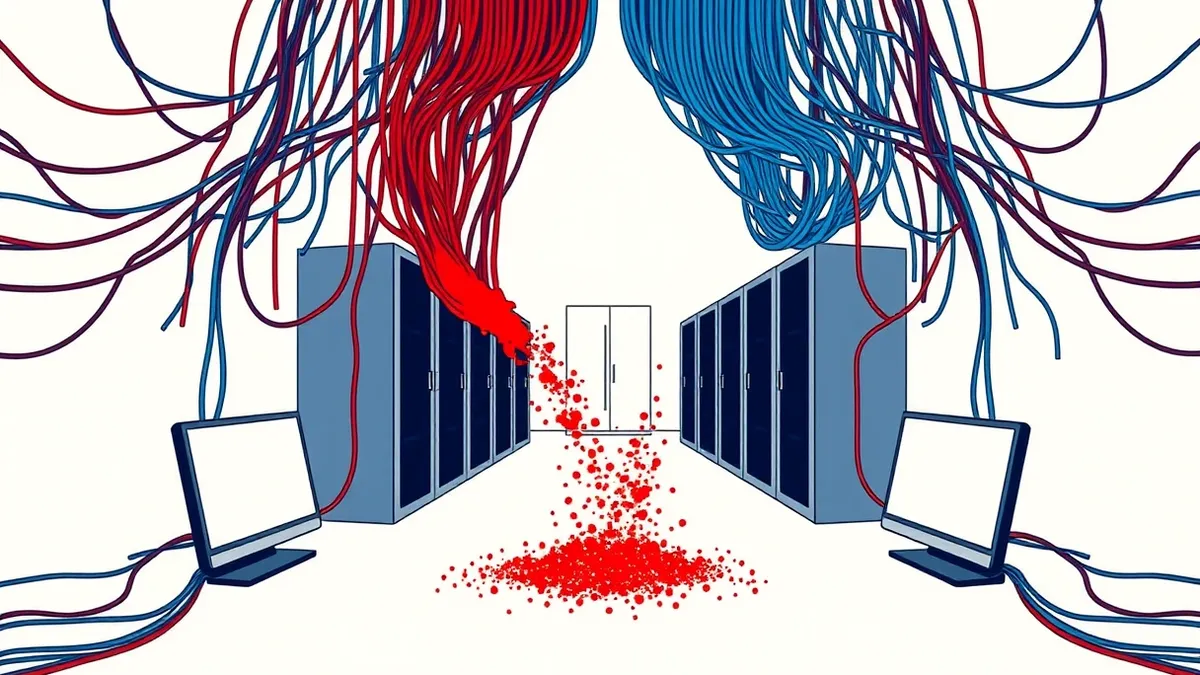
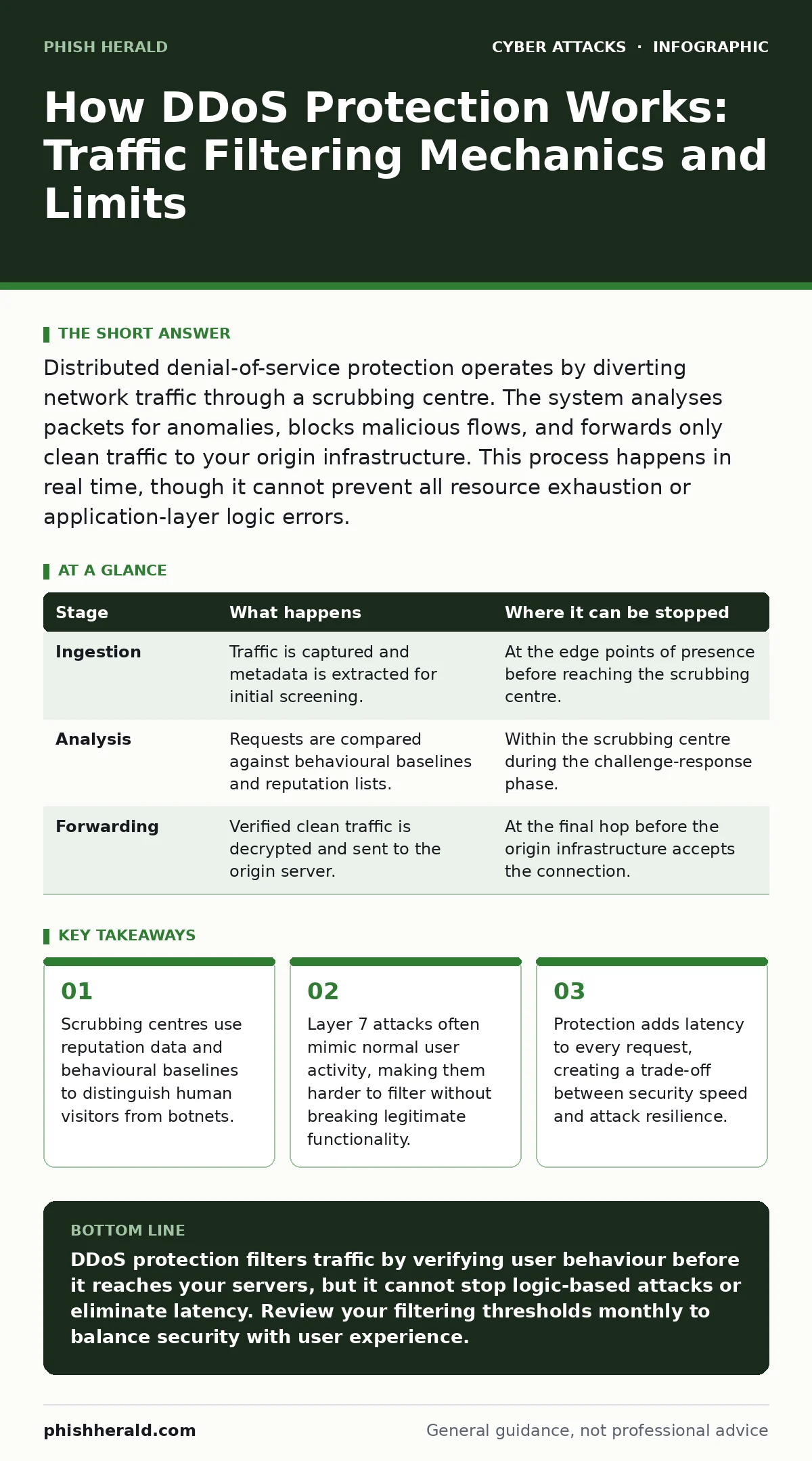
Distributed denial-of-service protection operates by diverting network traffic through a scrubbing centre. The system analyses packets for anomalies, blocks malicious flows, and forwards only clean traffic to your origin infrastructure. This process happens in real time, though it cannot prevent all resource exhaustion or application-layer logic errors.
The Traffic Diversion Mechanism
DDoS protection begins before traffic reaches your servers. Your domain name system records point to a proxy infrastructure rather than your origin IP address. This redirection is the first line of defence. When a user requests your service, the request hits the edge of the protection network. The system then decides whether to forward the request or drop it. This decision relies on continuous analysis of packet headers and payload content. You must understand that your origin server becomes invisible to the public internet during this process.
The protection provider maintains a global network of points of presence. These locations absorb the initial impact of volumetric attacks. By spreading the load across multiple geographic regions, the infrastructure prevents any single location from becoming overwhelmed. This distribution ensures that even massive floods are diluted before they concentrate on your specific asset. The mechanism works like a funnel, wide at the top to catch all traffic and narrow at the bottom to pass only verified requests.
Stage 1: Ingestion and Baseline Comparison
The first stage involves ingesting the incoming traffic stream. The system captures metadata from every packet, including source addresses, destination ports, and protocol flags. It compares this data against a dynamic baseline of normal behaviour for your specific service. Baselines are not static; they evolve as your business grows or changes its operational patterns. The system learns what a typical Tuesday morning looks like for your application. Deviations from this pattern trigger deeper inspection.
Imagine a sudden spike in requests from a specific geographic region that rarely visits your site. The system flags this anomaly immediately. It does not block the traffic outright at this stage. Instead, it queues the requests for further analysis. This pause is critical because it prevents a single bad actor from shutting down your service while legitimate users from that region remain unaffected. The ingestion layer must be fast enough to handle terabits of data without dropping packets unnecessarily.
| Stage | What happens | Where it can be stopped |
|---|---|---|
| Ingestion | Traffic is captured and metadata is extracted for initial screening. | At the edge points of presence before reaching the scrubbing centre. |
| Analysis | Requests are compared against behavioural baselines and reputation lists. | Within the scrubbing centre during the challenge-response phase. |
| Forwarding | Verified clean traffic is decrypted and sent to the origin server. | At the final hop before the origin infrastructure accepts the connection. |
Stage 2: Challenge and Verification
Not all suspicious traffic is malicious. Legitimate users may experience network congestion or use outdated software. The second stage employs challenge mechanisms to verify the source. Common methods include JavaScript challenges, CAPTCHAs, or cookie-based verification. Bots and simple scripts typically fail these challenges because they lack the capability to execute complex code or solve visual puzzles. Human users pass through with minimal friction, often without noticing the check.
This stage addresses application-layer attacks, which are more subtle than volumetric floods. Attackers here use real browser sessions to exhaust server resources. The protection system detects slowloris attacks or API abuse by monitoring session duration and resource consumption. If a request behaves like a human but consumes excessive resources, the system throttles or blocks it. This precision prevents collateral damage to legitimate high-traffic users who might otherwise be rate-limited.
Stage 3: Scrubbing and Forwarding
Once traffic passes verification, the system performs final scrubbing. This step removes any remaining malicious payloads or malformed packets. The infrastructure ensures that only well-formed, protocol-compliant requests reach your origin. It also decrypts SSL/TLS traffic if your protection plan includes application delivery control. Decryption allows the system to inspect the actual content of the request, not just the headers. This visibility is vital for detecting hidden threats embedded in seemingly normal HTTP requests.
The cleaned traffic is then forwarded to your origin server. The protection network acts as a reverse proxy, terminating the connection at the edge and establishing a new one with your server. This separation means your origin only sees clean, manageable traffic. However, this process adds latency. Every packet must travel to the scrubbing centre and back, increasing the time to first byte. You must account for this delay in your performance expectations.
Limits of Network-Level Protection
DDoS protection is not a universal shield. It excels at stopping volumetric floods and obvious application-layer abuse. It struggles with logic bombs or attacks that exploit specific business logic flaws. If an attacker finds a way to trigger expensive database queries through valid API calls, the protection system may allow it through. The system sees valid requests, not the intent behind them. This limitation requires complementary measures such as input validation and rate limiting at the application level.
Another limit is the cost of false positives. Aggressive filtering can block legitimate users, leading to revenue loss and reputational damage. Balancing security and availability is an ongoing challenge. You must monitor your block rates and adjust policies based on real-world feedback. Protection providers often offer dashboards to help you tune these settings, but the responsibility for configuration remains with you.
See also: Network segmentation examples: how to isolate threats and limit damage
Integration with Other Security Layers
DDoS protection operates at the network and application layers. It does not replace endpoint security or identity management. Attackers often combine DDoS with other techniques to bypass defences. For instance, a distributed denial-of-service attack might distract security teams while an adversary performs initial access via a separate vector. Understanding how DDoS fits into your broader strategy is necessary for holistic defence.
You should integrate DDoS protection with your network segmentation strategy. Isolating critical assets limits the blast radius if an attacker manages to bypass the perimeter. Additionally, consider how domain spoofing might facilitate social engineering attacks that lead to credential theft. DDoS protection cannot stop a user from handing over their password to a fake login page. Combining these controls creates a layered defence that is harder to penetrate.
Operational Considerations and Trade-offs
Implementing DDoS protection requires careful planning. You must test your failover procedures regularly. If the protection provider goes offline, your service must remain accessible, even if it means accepting some risk. This involves maintaining direct IP access for emergency maintenance and having clear runbooks for incident response. The trade-off between convenience and control is significant. Using a proxy adds a dependency on a third party for your service availability.
Latency is another operational concern. High-quality protection adds minimal delay, but cheaper options may introduce noticeable lag. Monitor your performance metrics closely. If users complain about slow load times, investigate whether the scrubbing process is the culprit. Sometimes, optimizing your application code yields better performance gains than tweaking protection settings. Remember that no solution is perfect. You are managing risk, not eliminating it.
Key takeaways
- Scrubbing centres use reputation data and behavioural baselines to distinguish human visitors from botnets.
- Layer 7 attacks often mimic normal user activity, making them harder to filter without breaking legitimate functionality.
- Protection adds latency to every request, creating a trade-off between security speed and attack resilience.
DDoS protection filters traffic by verifying user behaviour before it reaches your servers, but it cannot stop logic-based attacks or eliminate latency. Review your filtering thresholds monthly to balance security with user experience.
Frequently asked questions
Does DDoS protection stop all types of cyber attacks?
No. It primarily mitigates volumetric and application-layer floods. It does not protect against data breaches, malware, or social engineering attacks.
How long does it take to detect and mitigate a DDoS attack?
Modern systems detect and begin mitigating attacks within seconds. Full mitigation depends on the attack size and complexity, but most are handled in under a minute.
Can DDoS protection cause false positives?
Yes. Legitimate traffic that resembles bot behaviour may be blocked. Proper tuning and challenge mechanisms help reduce this risk.
Is cloud-based DDoS protection better than on-premise appliances?
Cloud-based solutions offer greater capacity and global distribution, making them more effective against large-scale attacks. On-premise appliances provide better latency control for small, localised threats.
How this guide was produced: written by the Phish Herald editorial team with AI assistance, checked against the public references listed below, and reviewed when the facts change. See our editorial policy or report an error.