Cybercrime-as-a-Service FAQ: Mechanics, Economics and Hidden Risks
The modular nature of criminal services allows attackers to swap components instantly, making signature-based detection largely ineffective against evolving threats.
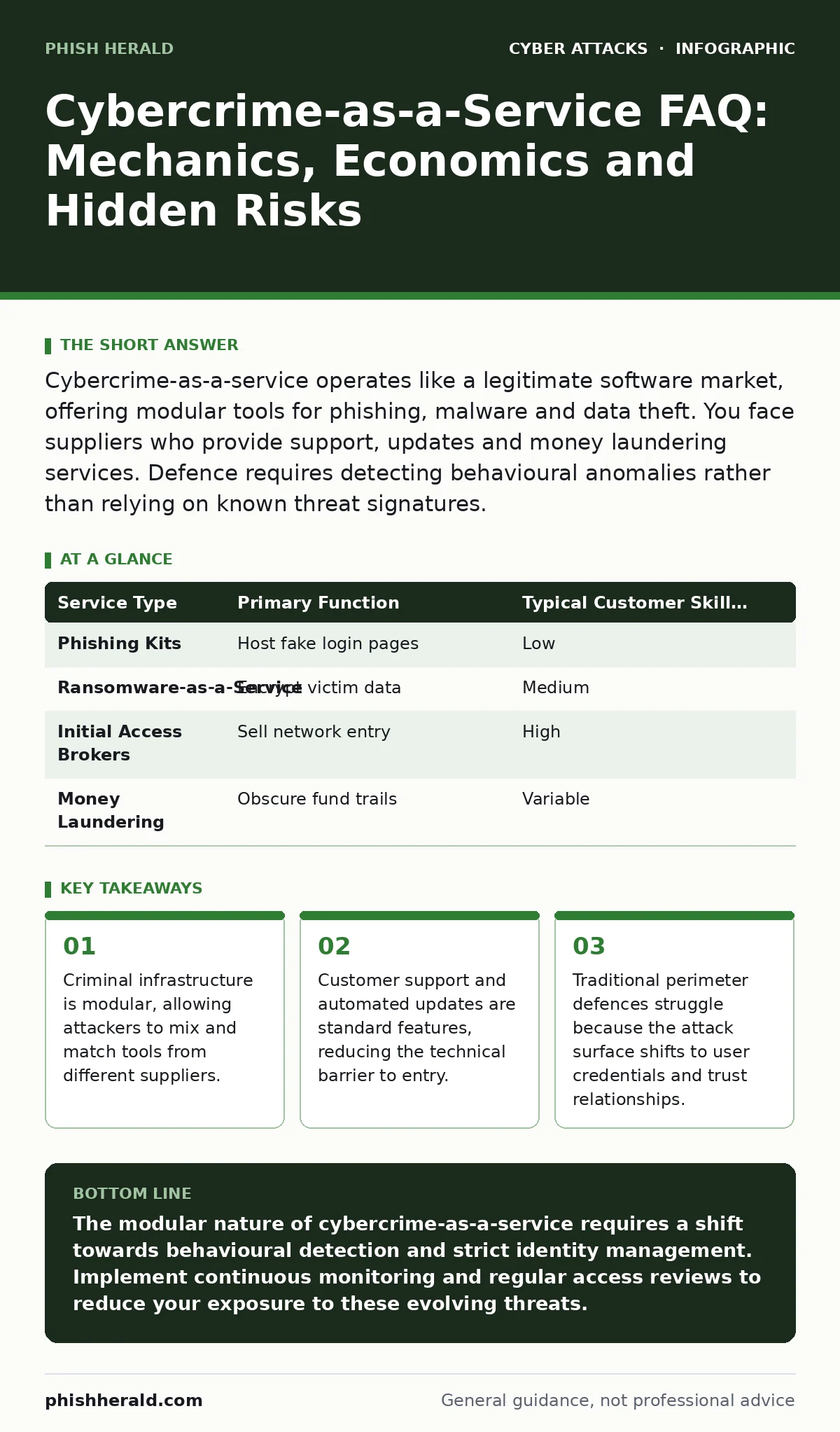
Cybercrime-as-a-service operates like a legitimate software market, offering modular tools for phishing, malware and data theft. You face suppliers who provide support, updates and money laundering services. Defence requires detecting behavioural anomalies rather than relying on known threat signatures.
What exactly is cybercrime-as-a-service?
It is a business model where cybercriminals provide malicious tools and services to other criminals on a subscription or pay-per-use basis. Just as legitimate software companies offer customer support and updates, these criminal markets provide technical assistance, hosting and payment processing. This structure allows individuals with minimal technical skill to launch sophisticated attacks by purchasing ready-made components.
Why do attackers prefer this model over building their own tools?
The primary driver is the reduction of risk and effort. Developing reliable malware or phishing infrastructure requires significant time and expertise, increasing the chance of detection during the development phase. By purchasing pre-built tools, attackers can deploy campaigns immediately. Furthermore, the service provider handles infrastructure maintenance, allowing the buyer to focus solely on targeting victims.
How does this ecosystem handle payments and money laundering?
Suppliers often integrate with cryptocurrency mixers or offer their own laundering services to obscure the trail of funds. Some platforms accept payment in untraceable digital currencies, while others facilitate the conversion of stolen data into cash through underground banking networks. This financial infrastructure is as critical as the technical tools, ensuring that both the supplier and the buyer can profit without immediate exposure.
What types of services are available in these markets?
The catalogue ranges from simple password sprays to complex ransomware operations. Common offerings include credential stuffing bots, phishing kit subscriptions and remote access trojans. More advanced services include initial access brokers who sell verified entry into corporate networks.
How does this model impact the sophistication of attacks?
It democratises high-level cyberattacks, allowing less skilled individuals to execute complex strategies. Attackers no longer need to understand code; they only need to understand the service interface. This leads to a higher volume of attacks, as the barrier to entry is lowered significantly. The result is a flood of automated, low-effort attacks that overwhelm traditional security teams.
Why is detection so difficult for security teams?
The modular nature of these services means that components change frequently. A phishing kit may use a new domain daily, while the malware payload is updated to evade signature detection. Security teams often look for specific indicators of compromise, but these indicators become obsolete quickly. The constant churn of infrastructure makes static defence measures ineffective.
| Service Type | Primary Function | Typical Customer Skill Level |
|---|---|---|
| Phishing Kits | Host fake login pages | Low |
| Ransomware-as-a-Service | Encrypt victim data | Medium |
| Initial Access Brokers | Sell network entry | High |
| Money Laundering | Obscure fund trails | Variable |
How do attackers use social engineering in this model?
Suppliers often provide templates for phishing emails and social media messages. These templates are tested for effectiveness, ensuring high open and click rates. Attackers can customise these templates with minimal effort, targeting specific industries or roles. The effectiveness of these campaigns relies on the psychological manipulation of the victim, not technical exploits.
What role does initial access play in this ecosystem?
Initial access brokers act as intermediaries who gain entry into networks and sell that access to other criminals. They use various techniques, including OAuth consent phishing or adversary-in-the-middle phishing, to bypass multi-factor authentication. This service allows downstream attackers to skip the difficult entry phase and focus on lateral movement and data theft. The broker earns a fee for each successful breach.
How can an organisation defend against these modular threats?
Defence requires a shift from signature-based detection to behavioural analysis. You must monitor for anomalous user behaviour, such as unusual data access or login times. Implementing strict least-privilege access limits the damage if credentials are compromised. Regularly reviewing access logs and integrating threat intelligence can help identify new tactics before they cause significant harm.
What is the long-term outlook for this criminal model?
The trend towards specialisation and automation will continue to grow. Attackers will focus on high-value targets, using tailored services to maximise profit. The ease of access to these tools means that the volume of attacks will likely increase. Organisations must adapt by improving their detection capabilities and reducing their attack surface through robust identity management.
How does this relate to zero-click attacks?
While zero-click attacks are rare and expensive, the service model allows for the distribution of such exploits. Suppliers may offer these capabilities to high-paying clients who target specific individuals. This makes advanced threats more accessible than previously thought. However, the high cost and complexity mean these remain niche services compared to broader phishing campaigns.
What steps should you take immediately?
Start by auditing your identity and access management policies. Ensure that multi-factor authentication is enforced across all services, particularly for administrative accounts. Review your logging and monitoring capabilities to ensure you can detect unusual activity. Consider the implications of HTML smuggling in your email filtering rules, as this technique is often used to deliver malware.
How do you stay ahead of evolving threats?
Continuous education and testing are necessary to keep pace with new techniques. Regularly update your security awareness training to include the latest phishing tactics. Conduct red team exercises to test your detection capabilities. Engage with industry peers to share insights on emerging threats and defence strategies. The goal is to create a resilient environment that can adapt to new attack vectors.
Key takeaways
- Criminal infrastructure is modular, allowing attackers to mix and match tools from different suppliers.
- Customer support and automated updates are standard features, reducing the technical barrier to entry.
- Traditional perimeter defences struggle because the attack surface shifts to user credentials and trust relationships.
The modular nature of cybercrime-as-a-service requires a shift towards behavioural detection and strict identity management. Implement continuous monitoring and regular access reviews to reduce your exposure to these evolving threats.
Frequently asked questions
Is cybercrime-as-a-service legal to use for testing?
No, using these services for any purpose, including testing, is illegal and exposes you to significant legal and security risks.
Can antivirus software detect these threats?
Traditional antivirus may detect known signatures, but it often fails against new or customised malware delivered through these services.
How do I report a cybercrime-as-a-service platform?
Report any suspicious activity to your national cybercrime unit or relevant law enforcement agency immediately.
Are small businesses targeted by these services?
Yes, small businesses are often targeted because they may have weaker defences and are seen as easy entry points to larger networks.
How this guide was produced: written by the Phish Herald editorial team with AI assistance, checked against the public references listed below, and reviewed when the facts change. See our editorial policy or report an error.