Adversary-in-the-Middle Phishing: Mechanics, Risks and Defences
AiTM phishing captures live session tokens rather than passwords, rendering traditional multi-factor authentication largely ineffective against this specific attack vector.
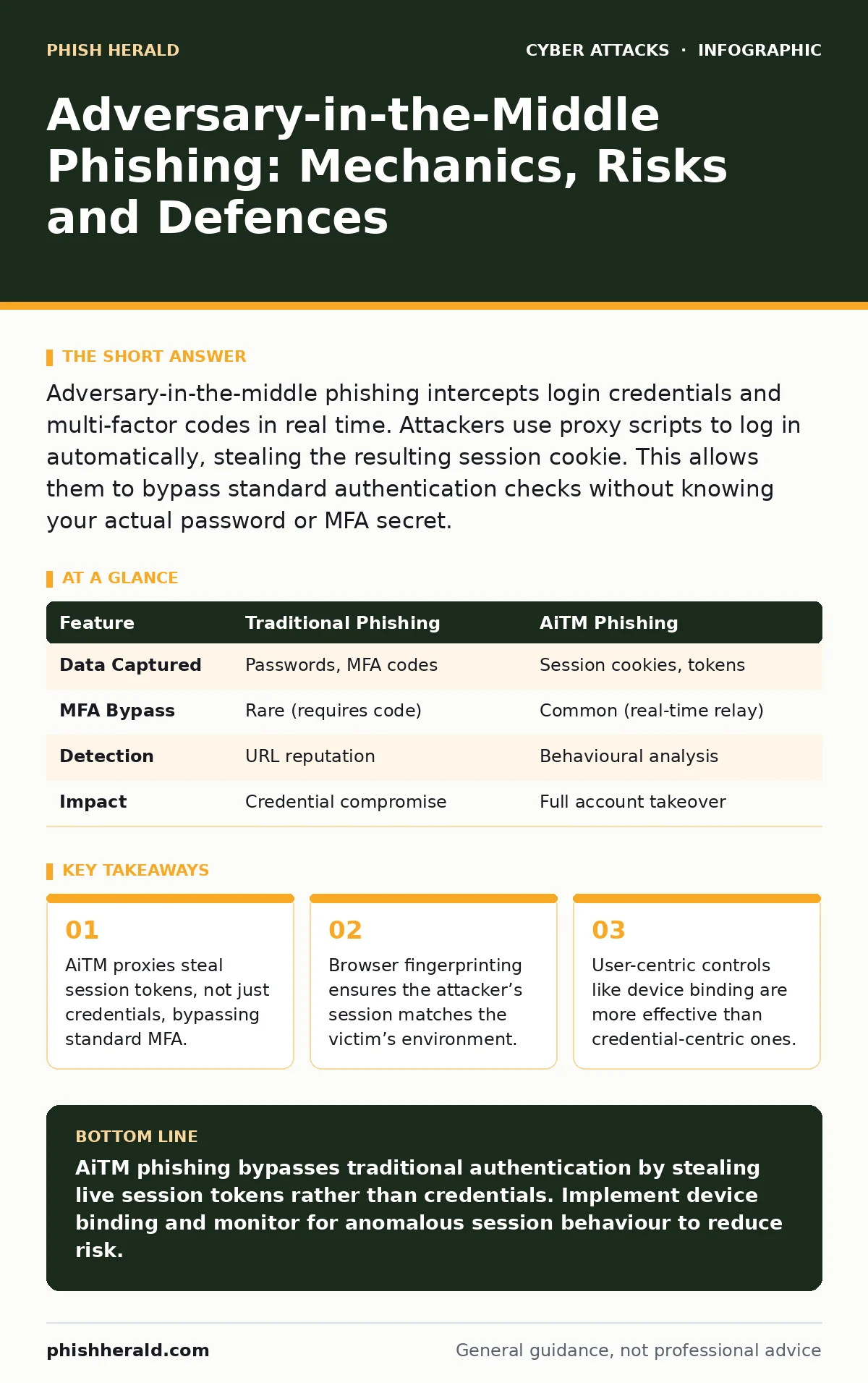
Adversary-in-the-middle phishing intercepts login credentials and multi-factor codes in real time. Attackers use proxy scripts to log in automatically, stealing the resulting session cookie. This allows them to bypass standard authentication checks without knowing your actual password or MFA secret.
What is adversary-in-the-middle phishing?
Adversary-in-the-middle (AiTM) phishing is an attack where the attacker positions themselves between the victim and the legitimate login page. Unlike static phishing pages that simply record what you type, AiTM uses a live proxy server. This server forwards your data to the real site in real time, capturing the resulting authentication token. The attacker then uses this token to access your account without ever needing your password.
How does it bypass multi-factor authentication?
Standard multi-factor authentication (MFA) relies on verifying a password and a second factor, such as a code from an authenticator app. AiTM phishing defeats this by capturing the MFA code as you enter it and forwarding it to the legitimate service. The service accepts the login and issues a session cookie, which the proxy intercepts. The attacker reuses this cookie to access the account, making the MFA check appear successful to the backend systems.
Why do traditional URL filters fail to stop it?
Security solutions often rely on blacklisting known malicious domains or inspecting URL structures for typos. AiTM phishing kits are frequently hosted on legitimate infrastructure, such as compromised websites or cloud hosting services. The initial landing page may look identical to the real service, using valid SSL certificates. Because the domain is not inherently malicious until the script executes, static reputation checks often allow the traffic to pass through.
What role do session cookies play in the breach?
A session cookie is a small piece of data that identifies your browser session to the web server. Once you log in, the server issues this cookie so you do not need to re-authenticate on every page load. AiTM phishing targets this cookie specifically. By stealing the valid cookie, the attacker inherits your authenticated state. The server sees the request as coming from you, regardless of the attacker’s location or device.
How do attackers mimic the victim’s environment?
To prevent the target service from detecting a login from a new device, attackers use browser fingerprinting. This technique gathers details about your browser version, operating system, screen resolution, and installed fonts. The AiTM proxy replicates these headers in its requests to the legitimate service. This consistency reduces the likelihood of triggering anomaly detection alerts based on device characteristics.
Can device binding prevent these attacks?
Device binding is a security measure that ties a user’s session to a specific hardware identifier or trusted device. If an attacker steals a session cookie, they cannot use it from a different device if binding is enforced. This breaks the chain of AiTM phishing because the stolen token becomes invalid outside the original context. Implementing device attestation adds a layer of security that credential theft alone cannot bypass.
| Feature | Traditional Phishing | AiTM Phishing |
|---|---|---|
| Data Captured | Passwords, MFA codes | Session cookies, tokens |
| MFA Bypass | Rare (requires code) | Common (real-time relay) |
| Detection | URL reputation | Behavioural analysis |
| Impact | Credential compromise | Full account takeover |
Why are password managers insufficient here?
Password managers excel at generating and storing complex, unique passwords. However, they typically autofill credentials into the username and password fields. AiTM proxies capture these autofilled values instantly and forward them. The password manager does not protect the session token generated after login. Therefore, relying solely on strong passwords does not mitigate the risk of session hijacking.
How does this relate to OAuth consent phishing?
OAuth consent phishing tricks users into authorising malicious applications to access their accounts. AiTM phishing is distinct because it hijacks the login process itself rather than seeking permission. However, both attacks aim to obtain persistent access without credentials. Understanding the difference helps in tailoring detection rules; OAuth attacks trigger permission requests, while AiTM attacks mimic standard authentication flows.
What is the connection to cybercrime-as-a-service?
Cybercrime-as-a-service provides pre-built phishing kits, including AiTM proxies, to attackers with little technical skill. These kits are updated frequently to match new login page designs and security patches. This commercialisation lowers the barrier to entry, increasing the volume of sophisticated attacks. Defenders must assume that attackers have access to professional-grade tools rather than simple scripts.
How does initial access change with AiTM?
Initial access refers to the first point where an attacker gains entry to a network or account. AiTM shifts this point from credential guessing to session theft. Traditional defences focus on strengthening the login gate, but AiTM walks through the open door after you have entered. This necessitates a shift towards monitoring post-authentication behaviour and session integrity rather than just pre-authentication inputs.
Does domain spoofing make AiTM harder to detect?
Domain spoofing involves registering domains that visually resemble legitimate ones. AiTM attacks often combine this with proxy technology. Even if you spot a slight variation in the URL, the proxy may redirect you to the real site after capturing initial data. This hybrid approach makes visual inspection unreliable. Automated security checks must analyse the traffic flow, not just the destination address.
What about HTML smuggling in this context?
HTML smuggling uses JavaScript to assemble malicious payloads in the browser, evading email filters. While distinct from AiTM, both techniques exploit client-side processing. AiTM relies on the browser to maintain the session state, while HTML smuggling relies on it to construct the attack. Defences that restrict JavaScript execution or sandbox browser activity can mitigate both, though usability trade-offs exist.
Key takeaways
- AiTM proxies steal session tokens, not just credentials, bypassing standard MFA.
- Browser fingerprinting ensures the attacker’s session matches the victim’s environment.
- User-centric controls like device binding are more effective than credential-centric ones.
AiTM phishing bypasses traditional authentication by stealing live session tokens rather than credentials. Implement device binding and monitor for anomalous session behaviour to reduce risk.
Frequently asked questions
Can I detect AiTM phishing after it happens?
Yes, by analysing session logs for unusual patterns, such as multiple sessions active simultaneously or logins from unexpected geographic locations.
Does 2FA prevent AiTM attacks?
No, because AiTM captures the 2FA code in real time and uses it to obtain a session token that bypasses further checks.
Should I disable cookies to stop this?
No, disabling cookies breaks most web applications; instead, use cookie attributes like SameSite and HttpOnly to limit exposure.
Is this attack limited to web logins?
Primarily, yes, but similar proxy techniques can be adapted for API authentication tokens if the attack surface includes API endpoints.
How this guide was produced: written by the Phish Herald editorial team with AI assistance, checked against the public references listed below, and reviewed when the facts change. See our editorial policy or report an error.