Initial Access Misconceptions That Leave Your Network Exposed
Most breaches succeed not because of weak firewalls, but because defenders misinterpret how initial access actually bypasses perimeter controls and identity layers.
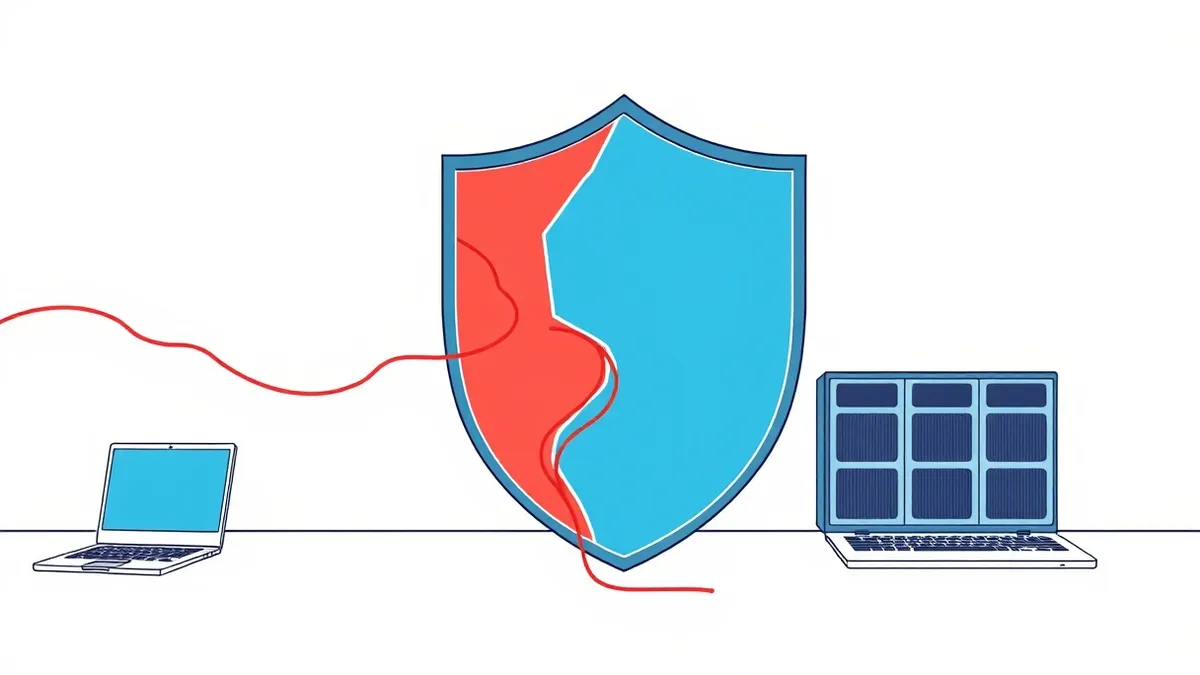
Initial access is rarely a single technical failure. It usually combines social engineering with misconfigured identity settings. You must stop viewing it as a perimeter breach and start treating it as an identity and trust validation problem.
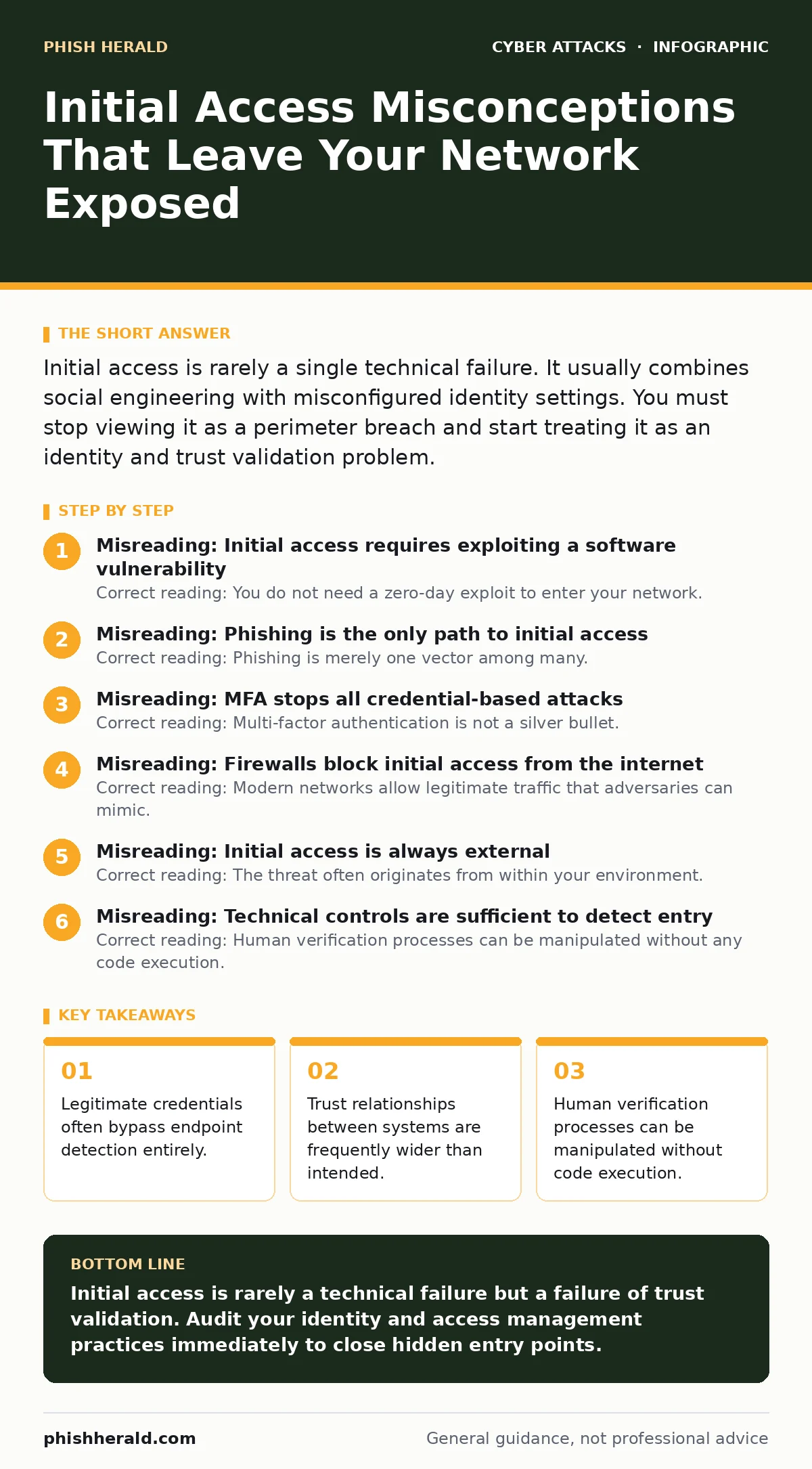
Misreading: Initial access requires exploiting a software vulnerability
Correct reading: You do not need a zero-day exploit to enter your network. The most common entry point is a valid set of credentials obtained through deception. When an adversary uses stolen passwords, they appear as a legitimate user to your security tools. This means your endpoint detection platforms may ignore their activity entirely. The threat is not the code; it is the trust you place in those credentials.
This misunderstanding leads you to invest heavily in patching while neglecting identity hygiene. You must treat credentials as high-value assets that can be stolen. Implementing multi-factor authentication reduces this risk but does not eliminate it if the second factor is compromised. See our guide on password managers for methods to secure credential storage and rotation.
Misreading: Phishing is the only path to initial access
Correct reading: Phishing is merely one vector among many. Adversaries often use supply chain compromises to reach you indirectly. If a vendor you trust is breached, their access to your systems becomes your entry point. You may also face threats through compromised third-party software updates. This means your security boundary extends beyond your own infrastructure.
Focusing solely on email filtering leaves you blind to other vectors. You must map your dependencies and understand the security posture of your partners. A breach in a small supplier can grant an adversary direct access to your core systems. This approach requires continuous validation of partner security practices, not just annual audits.
Misreading: MFA stops all credential-based attacks
Correct reading: Multi-factor authentication is not a silver bullet. Adversaries use techniques to bypass MFA by intercepting the authentication session. In some cases, they trick users into approving a login request on their device. This is known as real-time relay or session hijacking. The user believes they are logging in, but they are actually granting access to an attacker.
You must consider the context of the authentication request. Location anomalies and device reputation should trigger additional scrutiny. Simply having a second factor is insufficient if the factor can be socially engineered. Our guide on OAuth consent phishing explains how attackers abuse legitimate authorization flows to bypass traditional MFA challenges.
Misreading: Firewalls block initial access from the internet
Correct reading: Modern networks allow legitimate traffic that adversaries can mimic. If your services are exposed to the internet, a firewall alone cannot distinguish between a user and an attacker. Adversaries use legitimate protocols to move laterally once they have a foothold. They may also use cloud misconfigurations to access data directly.
You must assume the perimeter is porous. Focus on limiting what a compromised account can do. Principle of least privilege ensures that even if access is gained, the damage is contained. This requires rigorous access reviews and automated removal of unused permissions. See our guide on account lockout policies to understand how to balance security with usability.
Misreading: Initial access is always external
Correct reading: The threat often originates from within your environment. Insider threats, whether malicious or negligent, provide immediate access. A lost laptop or an unsecured developer environment can serve as the entry point. Additionally, compromised accounts from previous breaches may remain dormant for years.
You must monitor internal traffic for anomalies. Lateral movement often starts from a compromised internal host. Segmentation limits the blast radius of such compromises. Regular audits of user privileges help identify accounts that have accumulated excessive access over time.
Misreading: Technical controls are sufficient to detect entry
Correct reading: Human verification processes can be manipulated without any code execution. Business email compromise relies on convincing a human to perform an action. The adversary may impersonate a CEO and request a wire transfer. No malware is involved, so technical controls see nothing wrong.
You must validate high-risk requests through out-of-band communication. Establish clear procedures for financial transactions and data releases. Training staff to recognise subtle signs of impersonation is vital. Our guide on business email compromise details the specific tactics used to manipulate human decision-making.
Misreading: Cloud services are secure by default
Correct reading: Cloud environments often require explicit configuration to be secure. Default settings may allow public access to storage buckets or databases. Adversaries scan for these misconfigurations continuously. A single exposed file can provide the credentials needed for full network access.
You must enforce strict access controls on all cloud resources. Regular audits of permissions and configurations are necessary. Automate the detection of misconfigurations to reduce human error. See our guide on domain spoofing for related risks in email and DNS configurations.
Misreading: Initial access is a one-time event
Correct reading: Adversaries often maintain access through persistence mechanisms. They may create backdoor accounts or modify system configurations. These changes allow them to return even if you change passwords. Detecting these subtle modifications requires continuous monitoring.
You must establish a baseline of normal system behaviour. Deviations from this baseline can indicate compromise. Regular integrity checks help identify unauthorized changes. Our guide on adversary-in-the-middle phishing highlights how attackers intercept communications to maintain access.
Misreading: Endpoint protection detects all malicious activity
Correct reading: Endpoint detection and response tools focus on known threats. They may miss fileless attacks or living-off-the-land techniques. Adversaries use legitimate system tools to perform malicious actions. These tools are signed and trusted by the operating system.
You must monitor for unusual behaviour rather than just signatures. Analyze process chains and network connections for anomalies. User and entity behaviour analytics can help identify these subtle threats. Our guide on HTML smuggling explains how attackers hide payloads in seemingly benign documents.
Misreading: Initial access is only about technology
Correct reading: The human element is often the weakest link. Social engineering exploits trust and urgency. Adversaries craft messages that bypass rational thinking. They may impersonate IT support or colleagues in distress.
You must build a culture of security awareness. Encourage staff to verify unusual requests. Simulate phishing campaigns to test and improve resilience. Our guide on website defacement illustrates how attackers use public-facing sites to launch further attacks.
Key takeaways
- Legitimate credentials often bypass endpoint detection entirely.
- Trust relationships between systems are frequently wider than intended.
- Human verification processes can be manipulated without code execution.
- Default configurations in cloud services often allow anonymous access.
Initial access is rarely a technical failure but a failure of trust validation. Audit your identity and access management practices immediately to close hidden entry points.
Frequently asked questions
How do I know if my MFA is being bypassed?
Monitor for unusual login locations and times. Check for session hijacking indicators in your identity provider logs.
What is the most common initial access vector?
Credential theft via phishing remains the most prevalent method. It exploits human error rather than technical vulnerabilities.
Can I prevent all initial access attacks?
No, but you can limit the impact. Focus on detection and containment strategies to reduce dwell time.
How often should I review access permissions?
Regularly, at least quarterly. Automated tools can help identify unused or excessive privileges.
How this guide was produced: written by the Phish Herald editorial team with AI assistance, checked against the public references listed below, and reviewed when the facts change. See our editorial policy or report an error.