Detecting Cisco IOS XE Vulnerabilities: Signals, Tools and Blind Spots
Most IOS XE flaws manifest through subtle telemetry anomalies rather than obvious system crashes or immediate network outages, requiring persistent monitoring.
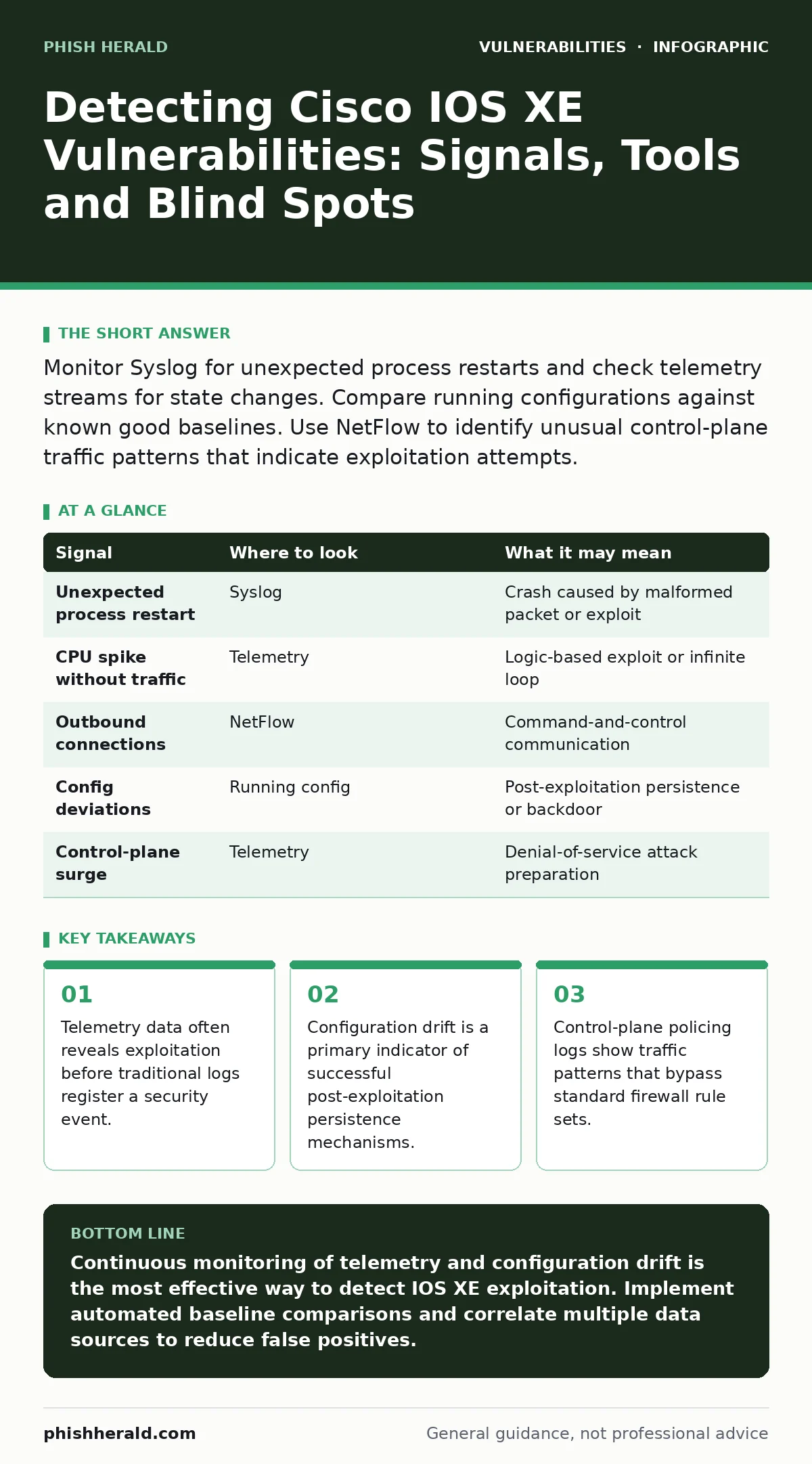
Monitor Syslog for unexpected process restarts and check telemetry streams for state changes. Compare running configurations against known good baselines. Use NetFlow to identify unusual control-plane traffic patterns that indicate exploitation attempts.
Identifying Anomalies in System Logs
Syslog entries provide the first line of defence for detecting compromise on network devices. You must look beyond standard authentication failures. Successful exploitation often leaves traces in process management logs rather than access control lists. Watch for unexpected restarts of critical daemons or services. These restarts may indicate a crash caused by malformed packets or a deliberate reset by an attacker to clear memory.
The severity level of log messages can be misleading. Attackers often craft payloads that trigger low-severity warnings to avoid alerting automated monitoring systems. You should correlate low-severity messages with high-impact events. A sudden spike in warning-level messages from the same source IP address warrants immediate investigation. This pattern suggests a scanning or fuzzing activity preceding a targeted attack.
Analysing Telemetry and Performance Metrics
Telemetry streams offer granular visibility into device health that logs cannot match. You can detect resource exhaustion attacks by monitoring CPU and memory utilisation trends. A gradual increase in resource usage without a corresponding increase in traffic volume indicates a logic-based exploit. This exploit may cause the device to process packets inefficiently or enter a loop.
Control-plane telemetry reveals how the device handles management traffic. You should monitor the rate of packets directed to the control plane. A sudden surge in control-plane traffic often precedes a denial-of-service attack. This traffic may not trigger traditional intrusion detection systems because it uses valid protocol headers. The volume itself becomes the signal of malicious intent.
Detecting Configuration Drift and Changes
Configuration changes are a clear indicator of post-exploitation activity. Attackers often modify configurations to maintain access or exfiltrate data. You must compare the running configuration against a known good baseline regularly. Any deviation from the baseline, especially in routing protocols or access lists, requires verification. Unauthorised changes to neighbour relationships in routing protocols can redirect traffic.
Hidden configurations are a specific risk in IOS XE. Attackers may add entries that are not visible in standard display commands. You should export the full configuration for analysis. Look for obfuscated strings or unusual character sequences in access control lists. These sequences may represent encoded commands or backdoors that standard text searches miss.
Monitoring Network Traffic Patterns
NetFlow and IPFIX data reveal communication patterns that logs miss. You should look for unusual outbound connections from network devices. IOS XE devices should not initiate connections to unknown external hosts. Any outbound traffic to non-standard ports or unexpected destinations indicates potential command-and-control communication. This traffic may use encrypted channels to evade inspection.
Inbound traffic analysis helps identify reconnaissance activities. You should monitor for scans targeting management interfaces. These scans often use fragmented packets or unusual protocol combinations. Detecting these patterns early allows you to block the source before exploitation occurs. Correlate traffic spikes with log entries to confirm the source of the attack.
| Signal | Where to look | What it may mean |
|---|---|---|
| Unexpected process restart | Syslog | Crash caused by malformed packet or exploit |
| CPU spike without traffic | Telemetry | Logic-based exploit or infinite loop |
| Outbound connections | NetFlow | Command-and-control communication |
| Config deviations | Running config | Post-exploitation persistence or backdoor |
| Control-plane surge | Telemetry | Denial-of-service attack preparation |
Addressing Common Blind Spots
Many security teams focus exclusively on the data plane. This focus creates a blind spot in the management plane. Attackers often target management interfaces because they are less protected than data interfaces. You must apply the same security controls to management traffic as you do to user traffic. This includes authentication, encryption and rate limiting.
Another blind spot is the assumption that internal traffic is safe. Lateral movement within the network often goes undetected. You should monitor traffic between network devices for anomalies. Internal attacks may use legitimate credentials, making them harder to detect. Behavioural analysis is required to identify deviations from normal administrative patterns.
See also: Network segmentation examples: how to isolate threats and limit damage
Utilising Detection Tools Effectively
Standard intrusion detection systems are insufficient for network device security. You need tools that understand network protocols deeply. Protocol-aware parsers can identify malformed packets that standard IDS miss. These parsers validate packet headers and payloads against protocol specifications. Invalid packets are flagged for further analysis.
Security information and event management platforms aggregate data from multiple sources. You should integrate syslog, telemetry and flow data into a single platform. This integration allows for correlation of events across different data types. A correlation rule might link a syslog warning with a telemetry CPU spike and a flow anomaly. This combined view increases detection accuracy.
Integrating with Broader Security Practices
Detecting vulnerabilities is only part of the solution. You must combine detection with prevention and response strategies. Regular patching reduces the attack surface but does not eliminate risk. Threat modeling helps you identify likely attack vectors for your specific network topology. This process ensures you monitor the right signals.
Input validation is critical for web-based management interfaces. Many IOS XE vulnerabilities stem from insufficient input validation. You should ensure that all management interfaces enforce strict input checks. This practice prevents injection attacks that could lead to remote code execution. For related insights on application-layer risks, see the guide on input validation.
Key takeaways
- Telemetry data often reveals exploitation before traditional logs register a security event.
- Configuration drift is a primary indicator of successful post-exploitation persistence mechanisms.
- Control-plane policing logs show traffic patterns that bypass standard firewall rule sets.
Continuous monitoring of telemetry and configuration drift is the most effective way to detect IOS XE exploitation. Implement automated baseline comparisons and correlate multiple data sources to reduce false positives.
Frequently asked questions
How often should I check for configuration drift?
You should check for configuration drift in real-time using automated tools. Manual checks are too infrequent to catch transient exploitation attempts that leave minimal traces.
Can telemetry data reveal zero-day exploits?
Telemetry can reveal the behavioural impact of zero-day exploits, such as resource exhaustion. It does not identify the specific vulnerability but indicates abnormal device behaviour.
What is the difference between syslog and telemetry?
Syslog records discrete events, while telemetry provides continuous streams of performance data. Telemetry offers higher granularity and better visibility into resource usage trends.
Do firewalls protect IOS XE devices?
Firewalls protect against external traffic but do not prevent internal attacks or management plane exploitation. You must apply security controls to all interfaces, including management.
How this guide was produced: written by the Phish Herald editorial team with AI assistance, checked against the public references listed below, and reviewed when the facts change. See our editorial policy or report an error.