Advanced Persistent Threats: How They Operate and How to Detect Them
Advanced persistent threats bypass perimeter defences by mimicking legitimate traffic and remaining dormant for months before exfiltrating data.

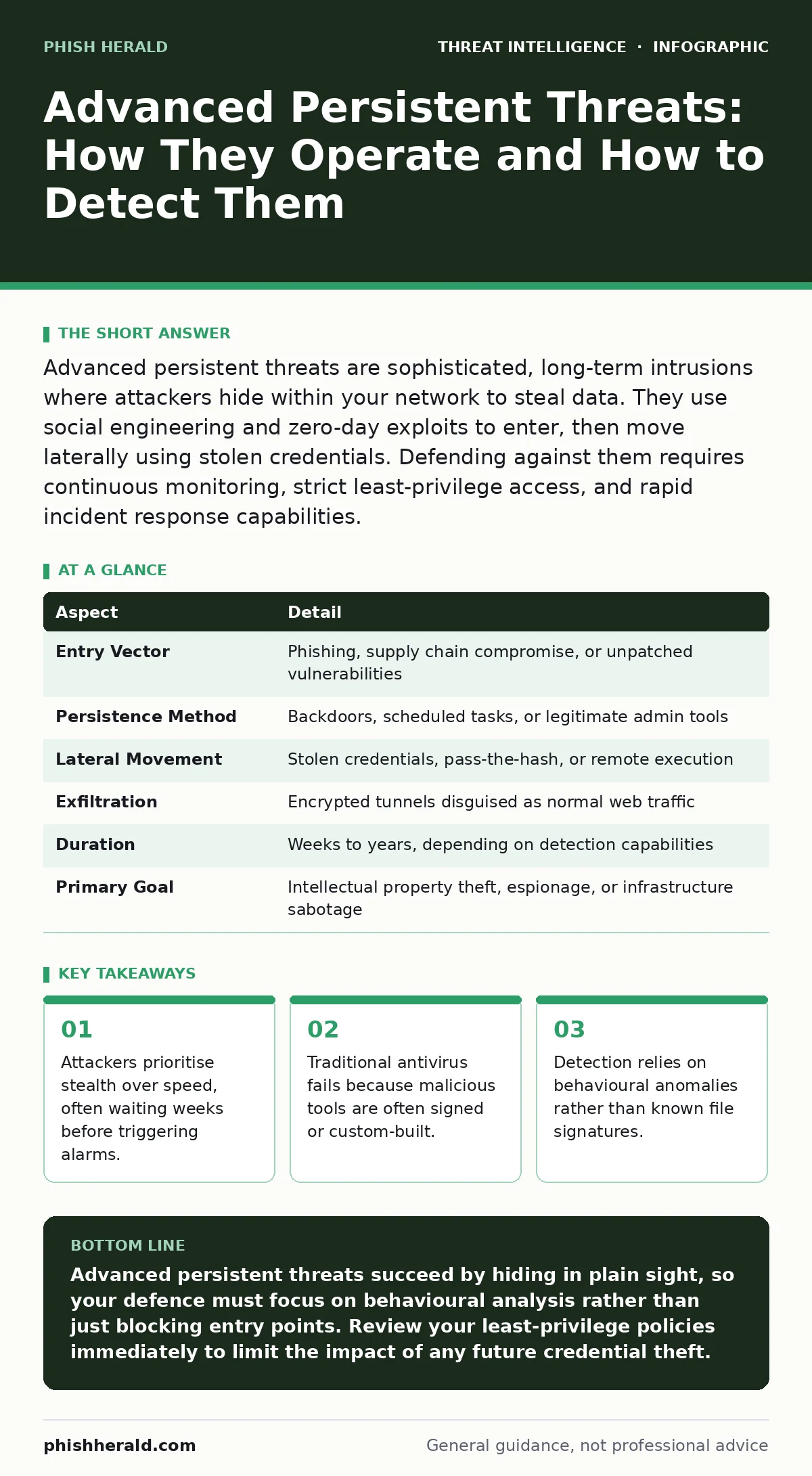
Advanced persistent threats are sophisticated, long-term intrusions where attackers hide within your network to steal data. They use social engineering and zero-day exploits to enter, then move laterally using stolen credentials. Defending against them requires continuous monitoring, strict least-privilege access, and rapid incident response capabilities.
Understanding the Core Mechanism
Advanced persistent threats represent a specific class of cyber intrusion defined by three characteristics: sophistication, persistence, and intent. Unlike opportunistic malware that spreads rapidly and loudly, these adversaries operate with surgical precision. They seek to establish a foothold, maintain access indefinitely, and achieve a specific strategic objective.
The term describes the method rather than a single piece of software. The attacker uses a combination of technical exploits and human manipulation to enter your environment. Once inside, they modify their tools to avoid detection by standard security controls. This requires a shift in perspective from stopping entry to detecting presence.
| Aspect | Detail |
|---|---|
| Entry Vector | Phishing, supply chain compromise, or unpatched vulnerabilities |
| Persistence Method | Backdoors, scheduled tasks, or legitimate admin tools |
| Lateral Movement | Stolen credentials, pass-the-hash, or remote execution |
| Exfiltration | Encrypted tunnels disguised as normal web traffic |
| Duration | Weeks to years, depending on detection capabilities |
| Primary Goal | Intellectual property theft, espionage, or infrastructure sabotage |
How Advanced Persistent Threats Work
The initial compromise often appears innocuous. An employee might click a link in a highly targeted email, or a vendor might deliver a compromised update. The attacker then installs a command-and-control agent. This agent communicates with the attacker’s server using encrypted channels that resemble standard HTTPS traffic.
Imagine a thief who steals a master key, changes the locks to look original, and waits for the owners to leave before moving valuables to a truck parked outside. The truck looks like a delivery vehicle. The thief does not rush. They observe routines, map the building, and ensure no alarms trigger. This patience distinguishes these threats from common cybercrime.
Who Is Most at Risk
Any organisation holding valuable data faces risk, but certain sectors attract more attention. Government bodies, defence contractors, and research institutions are frequent targets due to the strategic value of their information. Financial institutions and healthcare providers are also prioritised because of the monetary value of their records.
Smaller organisations are not immune. They often serve as stepping stones to larger partners. An attacker may compromise a small supplier to reach a major corporation through trusted vendor connections. This supply chain approach bypasses the strongest defences by entering through a weaker link. You must assess your risk based on your connections, not just your size.
Common Misconceptions About Threats
Many security teams believe that a strong firewall prevents these intrusions. This is incorrect. Firewalls control traffic flow based on rules, but they cannot inspect every packet for malicious intent. If an attacker uses a legitimate port and protocol, the firewall allows it.
Another error is assuming that detection equals resolution. Finding a threat does not mean you have removed it. Attackers often plant multiple backdoors. Removing one access point leaves others active. You must assume the environment is compromised until you have verified every system and credential.
Detection Beyond Signatures
Traditional security tools look for known bad patterns. Advanced persistent threats use custom code that has never been seen before. This renders signature-based detection useless. You must monitor for behavioural anomalies instead.
Look for unusual login times, impossible travel, or excessive data access. A user logging in from two countries within an hour is a red flag. A service account downloading large files at midnight is another. These behaviours indicate compromise even if the software is clean. Implementing network detection and response helps identify these patterns across the entire infrastructure.
See also: Alert Triage Checklist: Stop False Positives Before They Stop You · Implement User and Entity Behavior Analytics: A Practical Step-by-Step Approach
The Role of Reconnaissance
Before any technical attack, the adversary gathers information. This attacker reconnaissance phase can last months. They study your website, social media profiles, and public documents. They map your network topology and identify key personnel.
This phase is invisible to most technical controls. You cannot block what you cannot see. However, limiting public exposure reduces the information available to attackers. Remove unnecessary details from corporate profiles and restrict public access to internal directories. The less they know, the harder it is to tailor their attack.
Mitigation and Response Strategies
Prevention focuses on reducing the attack surface. Apply the principle of least privilege. Users should only have access to the data they need for their specific tasks. This limits the damage if credentials are stolen. Segment your network to prevent lateral movement. If one segment is breached, the attacker cannot easily reach others.
Regularly rotate credentials and use multi-factor authentication. This stops attackers from using stolen passwords. Monitor for indicators of compromise, but understand that these are often outdated by the time they are published. Focus on your own baseline of normal activity. Deviations from this baseline are your best early warning signs.
Integrating Frameworks for Defence
A single tool cannot stop these threats. You need a layered approach. Combine endpoint security, network monitoring, and identity management. Use the Unified Kill Chain to understand where your defences fail. This model breaks down the attack process into stages, allowing you to target specific phases.
While nation-state cyber attacks often drive the narrative, the techniques are increasingly available to criminal groups. You must prepare for both. Regularly test your incident response plans. Simulate breaches to identify gaps in your detection and response capabilities. Practice is as important as technology.
Key takeaways
- Attackers prioritise stealth over speed, often waiting weeks before triggering alarms.
- Traditional antivirus fails because malicious tools are often signed or custom-built.
- Detection relies on behavioural anomalies rather than known file signatures.
Advanced persistent threats succeed by hiding in plain sight, so your defence must focus on behavioural analysis rather than just blocking entry points. Review your least-privilege policies immediately to limit the impact of any future credential theft.
Frequently asked questions
How long can an advanced persistent threat remain undetected?
There is no fixed time limit, but intrusions often persist for months or even years before discovery. The duration depends entirely on the sophistication of your monitoring and the stealth of the attacker.
Can antivirus software stop an advanced persistent threat?
Standard antivirus is rarely sufficient because these threats use custom, unsigned code. You need behavioural analysis and endpoint detection platforms that look for suspicious actions rather than known file signatures.
What is the difference between APT and ransomware?
Ransomware aims for immediate financial gain by encrypting files. Advanced persistent threats aim for long-term access to steal data or sabotage operations. The intent and timeline are fundamentally different.
How do I know if I have been compromised?
Look for unexplained changes in system files, unusual network traffic, or disabled security logs. If you suspect a breach, engage incident response immediately and assume the environment is compromised.
How this guide was produced: written by the Phish Herald editorial team with AI assistance, checked against the public references listed below, and reviewed when the facts change. See our editorial policy or report an error.