Purple Teaming Misconceptions: Fix Your Security Testing Strategy
Purple teaming is not a single event but a continuous feedback loop that aligns attack simulation with detection engineering to close specific security gaps.
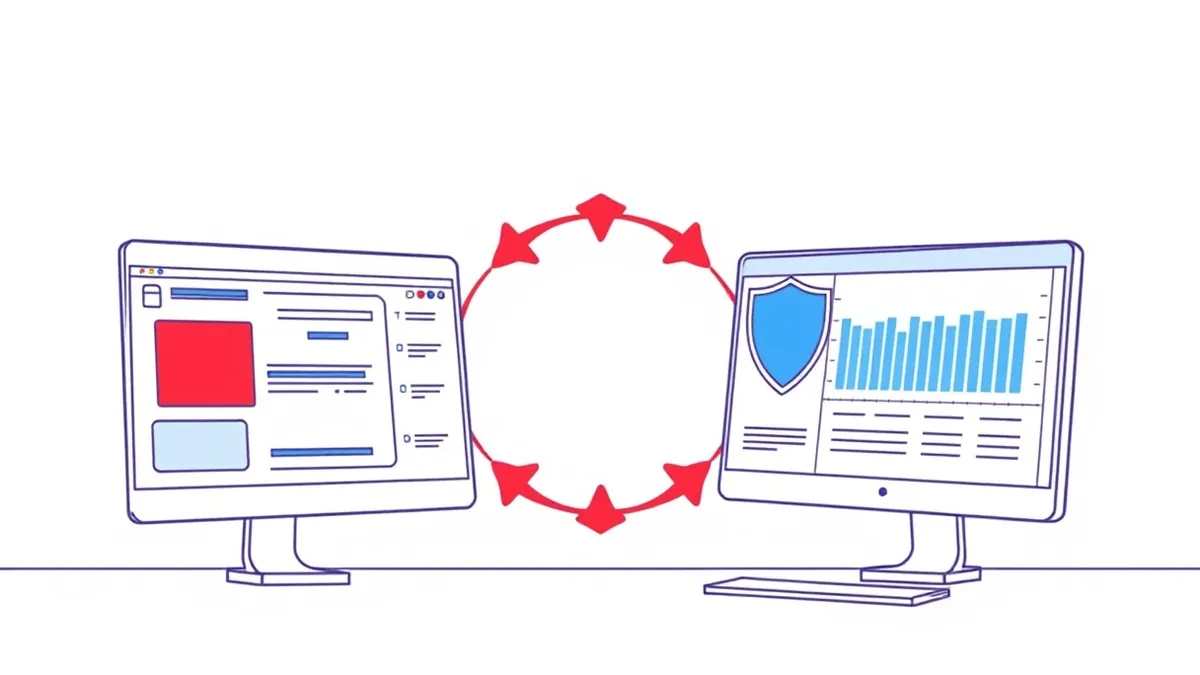
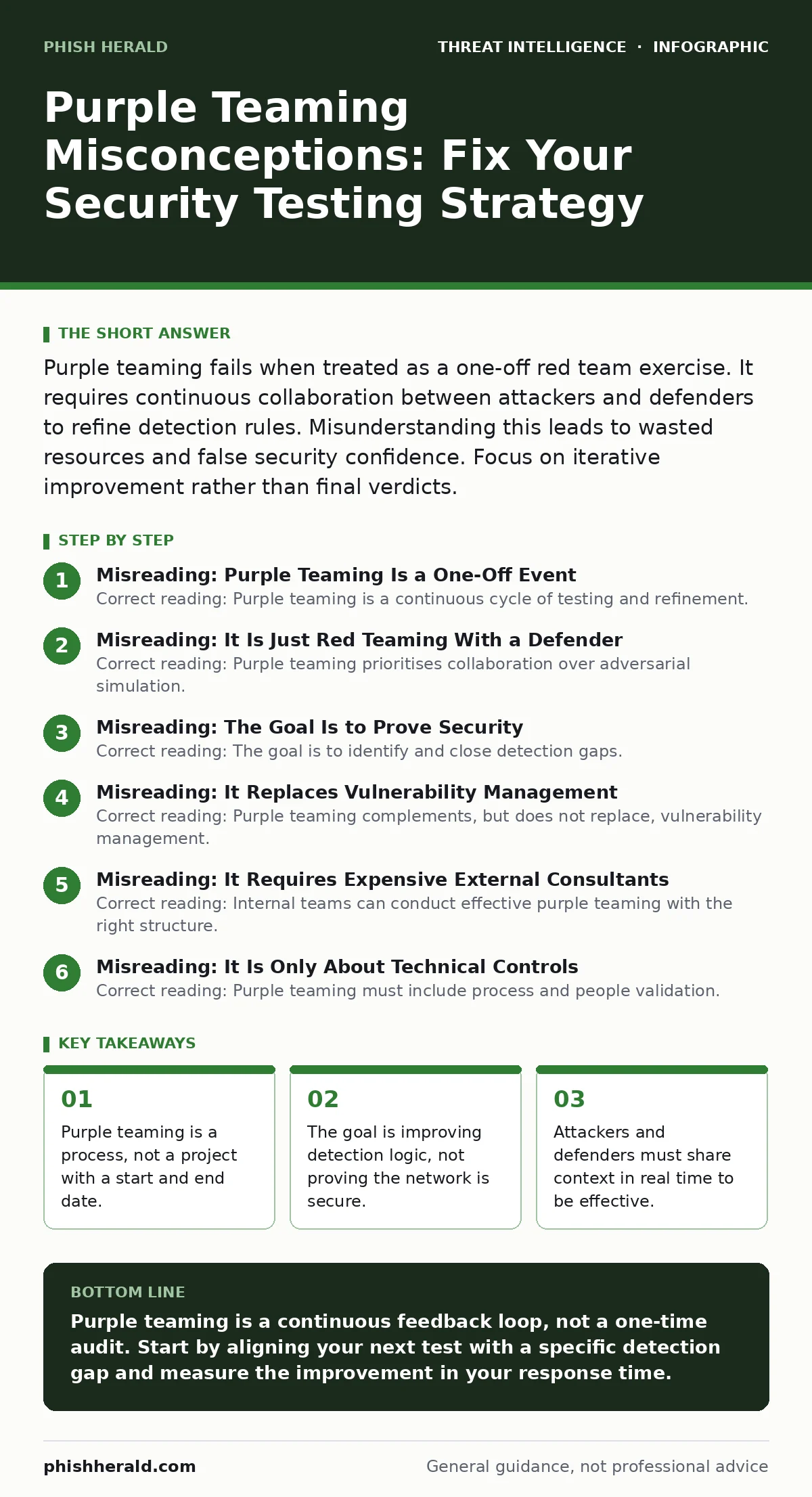
Purple teaming fails when treated as a one-off red team exercise. It requires continuous collaboration between attackers and defenders to refine detection rules. Misunderstanding this leads to wasted resources and false security confidence. Focus on iterative improvement rather than final verdicts.
Misreading: Purple Teaming Is a One-Off Event
Correct reading: Purple teaming is a continuous cycle of testing and refinement. Many organisations schedule a purple team exercise once a year, treating it like an audit. This approach misses the dynamic nature of threats. Attackers change tactics daily. Your detection rules degrade as systems update. A single event cannot cover the evolving attack surface. You need a rhythm of short, focused tests that feed directly into your detection engineering workflow. The value lies in the frequency of feedback, not the scale of the test.
Imagine a team that runs a massive simulation in June and waits until next June for results. By then, three new vulnerabilities have emerged. The previous test data is obsolete. Continuous purple teaming ensures you are always testing against current threats. It integrates with your daily operations. You test a specific hypothesis, measure the result, adjust the rule, and test again. This loop keeps your security posture aligned with reality. It prevents the stagnation that comes with annual reviews.
Misreading: It Is Just Red Teaming With a Defender
Correct reading: Purple teaming prioritises collaboration over adversarial simulation. Red teaming aims to breach the environment to find weaknesses. Purple teaming aims to improve the defender’s ability to see those weaknesses. In a red team exercise, the attacker hides their movements. In purple teaming, the attacker shares their techniques openly. This transparency allows the blue team to understand exactly how the attack bypassed controls. The focus shifts from "did we get in?" to "why didn't we see it?".
The presence of a defender does not automatically make it purple teaming. If the defender only watches the logs after the test, it is still red teaming. True purple teaming involves real-time dialogue. The attacker explains their method. The defender explains their detection logic. Together they identify the gap. This collaborative approach builds trust and accelerates learning. It turns a security failure into a shared improvement opportunity. The goal is not to win, but to fix the blind spot.
Misreading: The Goal Is to Prove Security
Correct reading: The goal is to identify and close detection gaps. Many leaders expect purple teaming to prove that their security is sufficient. This is a dangerous expectation. No test can prove complete security. It can only show what you missed. The metric of success is not a clean bill of health. It is the number of detection rules improved or created. If the purple team finds nothing, you may be testing the wrong things. You should expect to find gaps. Finding them is the point.
Suppose your test shows no alerts. This might mean your detections are strong. It might also mean your attack simulation was too simplistic. You must validate that the simulation mirrors real-world tactics. If you only test basic port scanning, you will miss sophisticated token theft attempts. The correct view accepts that finding failures is a success. It means you have identified a risk before an adversary exploits it. You then adjust your controls to catch that specific behaviour. The cycle repeats until the gap is closed.
Misreading: It Replaces Vulnerability Management
Correct reading: Purple teaming complements, but does not replace, vulnerability management. Vulnerability management identifies known software flaws. Purple teaming tests how well you detect the exploitation of those flaws. You can have a patched system that still lacks detection for the exploit attempt. Conversely, you can have strong detection for an old exploit that is no longer relevant. These are different disciplines. Vulnerability management is about hygiene. Purple teaming is about visibility. Both are necessary.
Relying on purple teaming to find unpatched servers is inefficient. Automated scanners do this better. Purple teaming should focus on the effectiveness of your security controls. It tests your incident response. It tests your logging coverage. It tests your analyst’s ability to triage an alert. You should use vulnerability management to keep your software current. You should use purple teaming to ensure you see the attempts to break that software. Combining both creates a layered defence. Neither works alone.
Misreading: It Requires Expensive External Consultants
Correct reading: Internal teams can conduct effective purple teaming with the right structure. Organisations often hire external firms for purple teaming, assuming internal staff lack objectivity. While external testers bring fresh perspectives, they lack context. They do not know your business logic. They do not understand your legacy systems. Internal teams can simulate attacks that are specific to your environment. They can test for insider threats. They can validate that your user and entity behavior analytics rules trigger on anomalous internal actions.
The cost of external consultants is high and recurring. Building internal purple teaming capability is a long-term investment. You train your red team members to think like defenders. You train your blue team members to think like attackers. This cross-pollination of skills raises the overall competency of your security team. You retain the knowledge within the organisation. You do not lose insights when the consultant leaves. Start with simple, internal simulations. Grow the complexity as your team learns. The depth of context you provide is an asset.
See also: File Integrity Monitoring Best Practices for Critical Infrastructure · Difference Between Broken Access Control and IDOR Explained
Misreading: It Is Only About Technical Controls
Correct reading: Purple teaming must include process and people validation. Technical controls are only one part of security. Your incident response plan is another. Your communication channels are another. A purple team exercise should test whether the right people are notified when an alert fires. It should test whether the response procedures are followed. It should test whether the analyst can distinguish a false positive from a real threat. Technical gaps are easier to fix than process gaps.
Imagine a scenario where the detection rule works perfectly. It triggers an alert. But the alert goes to an unmonitored queue. The incident goes unresolved. This is a process failure. Purple teaming reveals these breakdowns. It highlights where human error slows down response. It shows where documentation is unclear. You must measure the time to detect and the time to respond. You must validate that your staff knows what to do. Technical tools are useless if the process around them is broken. Focus on the entire chain of detection and response.
Misreading: It Is a Substitute for Threat Intelligence
Correct reading: Purple teaming uses threat intelligence to shape tests. Threat intelligence tells you what adversaries are doing. Purple teaming tests whether you can see those activities. You cannot effectively purple team without knowing what to look for. You should use intelligence feeds to select your attack scenarios. Test for the tactics used in recent nation-state cyber attacks. Test for the abuse of common protocols. Intelligence provides the context. Purple teaming provides the validation.
Without intelligence, your tests are generic. You might test for outdated techniques that no one uses. You might miss the latest trends. Use frameworks like STIX and TAXII to ingest structured threat data. Translate this data into actionable test cases. If intelligence shows a rise in PowerShell abuse, your purple team should simulate that specific abuse. Then measure if your endpoint telemetry catches it. This alignment ensures your testing is relevant. It keeps your defence focused on real risks. It turns data into defensive capability.
Key takeaways
- Purple teaming is a process, not a project with a start and end date.
- The goal is improving detection logic, not proving the network is secure.
- Attackers and defenders must share context in real time to be effective.
- Success is measured by reduced detection gaps, not by breach simulation.
Purple teaming is a continuous feedback loop, not a one-time audit. Start by aligning your next test with a specific detection gap and measure the improvement in your response time.
Frequently asked questions
How do I measure the success of a purple team exercise?
Measure success by the number of detection rules improved, the reduction in time to detect, and the closure of specific security gaps identified during the test.
Can I do purple teaming with a small team?
Yes, small teams can rotate roles between attacker and defender. Focus on narrow, high-impact scenarios rather than broad simulations to maximise learning within resource constraints.
What is the difference between purple teaming and red teaming?
Red teaming is adversarial and aims to breach systems. Purple teaming is collaborative, aiming to improve detection and response through shared insights between attackers and defenders.
How often should we conduct purple teaming?
Conduct it continuously or in short, regular cycles. Monthly or quarterly cycles allow for timely adjustments to detection rules based on evolving threats and system changes.
How this guide was produced: written by the Phish Herald editorial team with AI assistance, checked against the public references listed below, and reviewed when the facts change. See our editorial policy or report an error.