Difference Between Broken Access Control and IDOR Explained
Broken access control is a broad category of failure, while IDOR is a specific object-level flaw that often hides inside larger permission gaps.
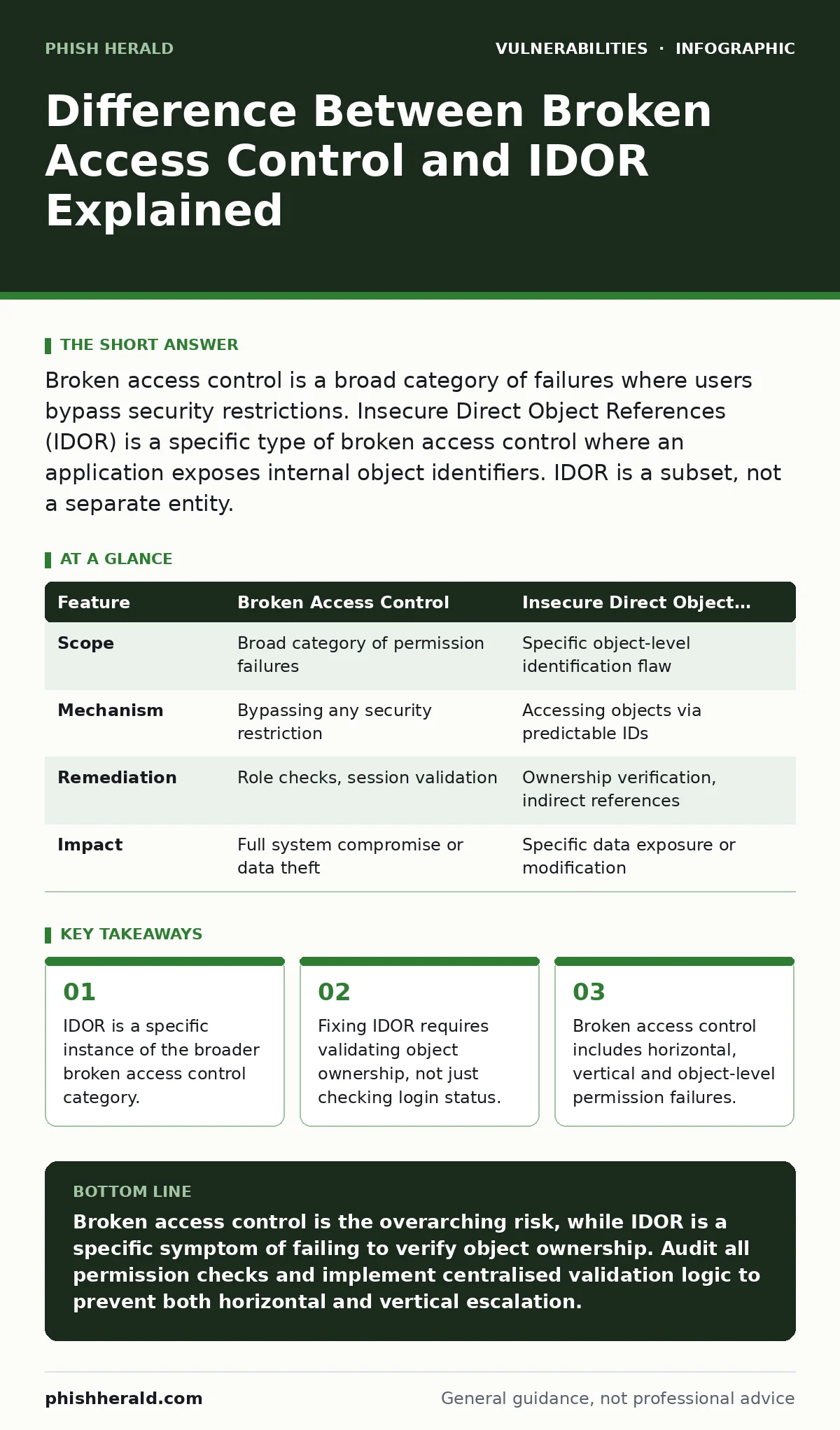
Broken access control is a broad category of failures where users bypass security restrictions. Insecure Direct Object References (IDOR) is a specific type of broken access control where an application exposes internal object identifiers. IDOR is a subset, not a separate entity.
What is the difference between broken access control and IDOR?
Broken access control is a broad category of failures where users bypass security restrictions to perform actions or access data without authorisation. Insecure Direct Object References (IDOR) is a specific type of broken access control where an application exposes internal object identifiers. IDOR is a subset, not a separate entity. You cannot have IDOR without broken access control, but you can have broken access control without IDOR. Understanding this hierarchy prevents you from treating them as equal threats.
How does broken access control manifest in systems?
Broken access control manifests in three distinct ways that threaten your infrastructure. Horizontal privilege escalation occurs when a user accesses data belonging to another user at the same level. Vertical privilege escalation happens when a standard user gains administrative capabilities. Object-level access control fails when the application does not verify if the current user owns the specific resource they request. Each type requires a different remediation strategy.
Why is IDOR considered a specific subset?
IDOR is considered a specific subset because it relies on predictable resource identifiers. The application accepts an identifier, such as an order number or user ID, and returns the associated data. If the application fails to verify that the requester owns that identifier, IDOR occurs. This is purely an object-level access control failure. It does not involve changing user roles or escalating privileges. It is a failure to check ownership of a specific item.
| Feature | Broken Access Control | Insecure Direct Object References |
|---|---|---|
| Scope | Broad category of permission failures | Specific object-level identification flaw |
| Mechanism | Bypassing any security restriction | Accessing objects via predictable IDs |
| Remediation | Role checks, session validation | Ownership verification, indirect references |
| Impact | Full system compromise or data theft | Specific data exposure or modification |
What conditions allow IDOR to persist undetected?
IDOR persists when developers assume the UI hides restricted data. The application logic relies on the front-end to filter results rather than the back-end. Attackers bypass the interface by crafting direct API requests. This happens frequently in single-page applications where the client-side code manages data display. The server trusts the client to request only authorised resources. This trust assumption is the root cause of the vulnerability.
When does fixing IDOR fail to secure the system?
Fixing IDOR fails to secure the system when other access control flaws remain. You might validate object ownership for user profiles but neglect administrative endpoints. An attacker can still exploit vertical privilege escalation to access management functions. Horizontal privilege escalation remains possible if session tokens are not properly scoped. Treating IDOR as the only access control risk leaves significant gaps. You must audit all permission checks, not just object references.
See also: How Accidental Data Disclosure Happens: Step-by-Step Mechanics · Prevent Third-Party Data Breaches: The Vendor Risk Framework
How do indirect references mitigate IDOR risks?
Indirect references mitigate IDOR risks by decoupling internal IDs from external requests. The application maps a random external token to the internal database key. An attacker cannot guess the next valid token because the sequence is non-sequential. This adds a layer of obscurity that complements proper ownership checks. It does not replace the need for authorisation logic. It simply makes enumeration attacks significantly harder to execute successfully.
What role does threat modeling play here?
Threat modeling identifies where access control checks are missing before code is written. It forces you to map every data flow and verify permissions at each step. You define who can access what and how the system verifies that right. This proactive approach prevents the assumption that the UI provides security. It ensures that back-end logic enforces restrictions regardless of the request source. Incorporate access control checks into your initial design phase.
How does least privilege access reduce exposure?
Least privilege access reduces exposure by limiting what each user can do. Even if an attacker exploits an IDOR, they can only access resources their account is permitted to see. They cannot modify data or access administrative functions. This containment strategy limits the blast radius of a successful attack. You must define granular permissions for every role in the system. Broad permissions increase the impact of any access control failure.
What steps should you take to remediate these flaws?
Remediate these flaws by implementing consistent access control patterns. Use a centralised library to check permissions rather than scattering logic across controllers. Validate object ownership on every request that accesses sensitive data. Conduct regular code reviews focusing on access control logic. Test your APIs with different user roles to ensure restrictions hold. Monitor logs for unusual access patterns that indicate enumeration attempts.
Key takeaways
- IDOR is a specific instance of the broader broken access control category.
- Fixing IDOR requires validating object ownership, not just checking login status.
- Broken access control includes horizontal, vertical and object-level permission failures.
Broken access control is the overarching risk, while IDOR is a specific symptom of failing to verify object ownership. Audit all permission checks and implement centralised validation logic to prevent both horizontal and vertical escalation.
Frequently asked questions
Is IDOR a separate vulnerability from broken access control?
No, IDOR is a specific type of broken access control. It falls under the object-level access control failure category within the broader broken access control framework.
Can fixing IDOR prevent all access control attacks?
No, fixing IDOR only addresses object-level identification flaws. You must also address horizontal and vertical privilege escalation to fully secure your access control mechanisms.
How do I test for IDOR in my application?
Test by accessing resources with different user accounts and modifying the object identifiers in the request. Verify that the application returns access denied for unauthorised objects.
Does using UUIDs eliminate IDOR risks?
Using UUIDs reduces the risk of enumeration but does not eliminate IDOR. You must still verify that the requesting user owns the resource identified by the UUID.
How this guide was produced: written by the Phish Herald editorial team with AI assistance, checked against the public references listed below, and reviewed when the facts change. See our editorial policy or report an error.