Prevent Third-Party Data Breaches: The Vendor Risk Framework
Most organisations focus on their own perimeter, yet the weakest link is invariably the supplier who holds your keys but not your standards.

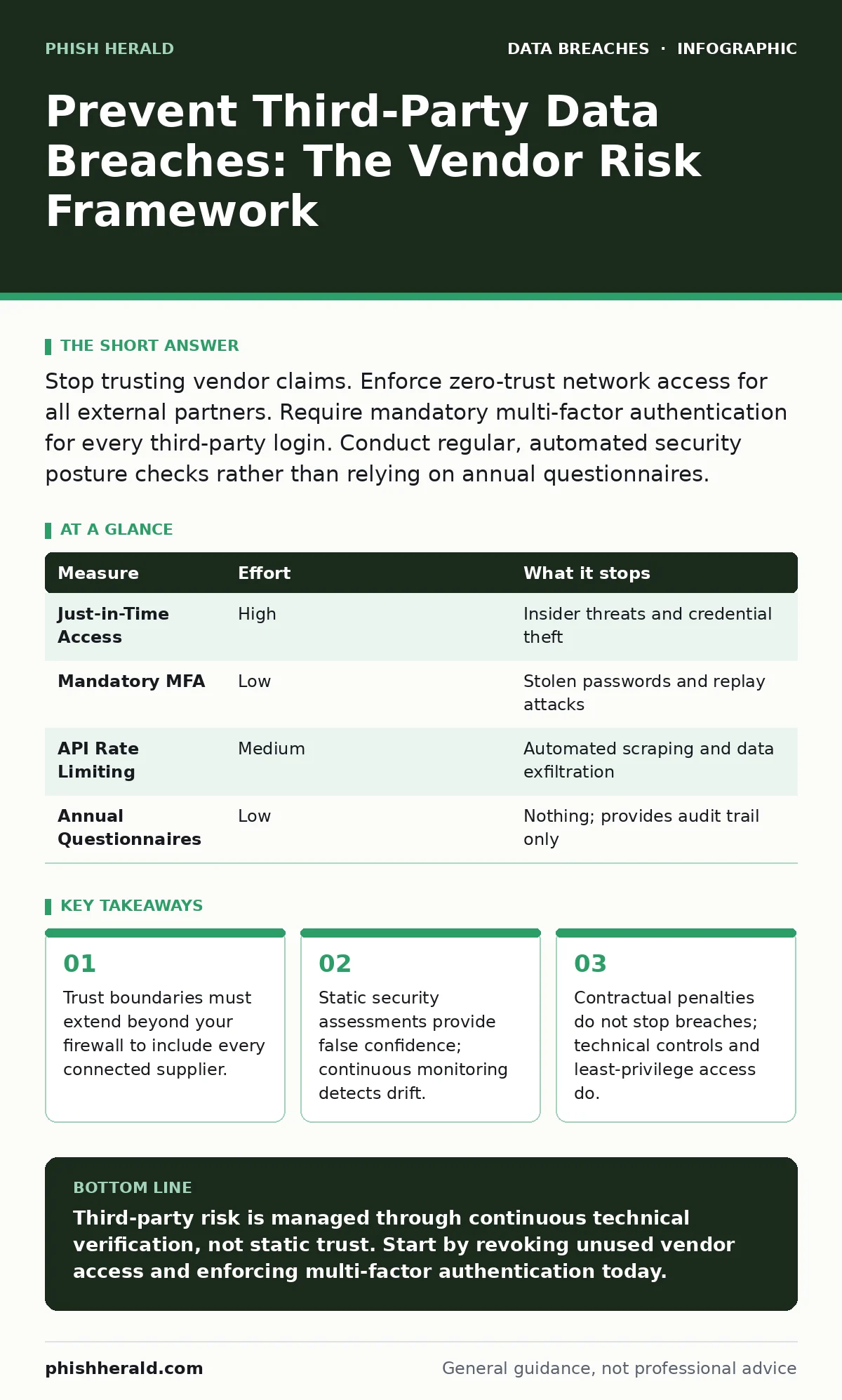
Stop trusting vendor claims. Enforce zero-trust network access for all external partners. Require mandatory multi-factor authentication for every third-party login. Conduct regular, automated security posture checks rather than relying on annual questionnaires.
The Illusion of Internal Security
You likely believe your defences are sound because your internal systems are hardened. This confidence is misplaced. Your security posture is only as strong as the weakest organisation connected to your data. When a supplier accesses your network, they create a new entry point that your internal controls may not govern.
Imagine a software vendor with remote access to your servers. If their own employee falls for a phishing email, that attacker now holds a valid ticket into your environment. You cannot patch a third party’s employee. You can only control what that party is allowed to do once inside.
Prioritise Access Over Assessment
Most organisations waste resources on lengthy security questionnaires. These documents are static snapshots that expire the moment they are signed. They do not prevent an attack in real time. Instead, you must prioritise technical controls that limit what a vendor can do, regardless of their internal hygiene.
The most effective measure is enforcing least-privilege access. This means granting vendors only the minimum permissions required to perform their specific task. If a support technician needs to fix a database, they should not have access to the file server or the user directory.
| Measure | Effort | What it stops |
|---|---|---|
| Just-in-Time Access | High | Insider threats and credential theft |
| Mandatory MFA | Low | Stolen passwords and replay attacks |
| API Rate Limiting | Medium | Automated scraping and data exfiltration |
| Annual Questionnaires | Low | Nothing; provides audit trail only |
Enforce Zero-Trust Network Access
Zero-trust network access (ZTNA) assumes no user or device is trustworthy by default, even if they are inside the network perimeter. For third parties, this is non-negotiable. You must verify every request as if it originated from the open internet.
ZTNA solutions inspect traffic at the application layer. They ensure that a vendor can only reach the specific application they are authorised to use. They cannot pivot to other systems. This containment strategy prevents lateral movement, where an attacker moves from a compromised vendor account to your critical infrastructure.
Automate Continuous Monitoring
Annual audits are too slow to catch emerging risks. A vendor may pass your security review in January but suffer a critical misconfiguration in March. By the time you review them next year, the breach has already occurred. You need automated, continuous monitoring of their external-facing assets.
Tools that scan for public file share exposure can detect when a vendor accidentally leaves sensitive data accessible to the internet. These scans run daily or weekly, providing immediate alerts. This shifts your strategy from reactive investigation to proactive remediation.
Consider the hidden cost of manual monitoring. Your team spends hours checking vendor portals. Automated tools do this instantly, freeing your staff to focus on response and strategy. The effort is low, but the visibility gain is significant.
Scrutinise Data Handling Practices
You must define how vendors handle your data, especially if it includes protected health information or financial records. Data minimisation is the key principle. Vendors should only retain the data they need for the duration of the service.
Require that vendors encrypt data at rest and in transit. While full disk encryption protects data on their devices, it does not protect data while it is being processed or transmitted. You need end-to-end encryption standards that you can verify.
See also: Least Privilege Access: Hidden Costs and Real Security Gains
What Does Not Work
Many organisations rely on insurance to cover third-party breaches. Insurance pays for damages after the fact. It does not prevent the breach, nor does it restore your reputation. It is a financial transfer, not a security control.
Another common failure is relying on password hashing and salting alone. While these techniques protect stored passwords, they do not stop an attacker from using a valid session cookie or a compromised API key. You must protect the active session, not just the stored credential.
Implementing Just-in-Time Access
Just-in-time (JIT) access grants temporary permissions that expire automatically. Instead of giving a vendor permanent admin rights, you grant access for a two-hour window during a scheduled maintenance task. After the window closes, the access revokes itself.
This approach eliminates the risk of dormant accounts. Attackers often look for old, unused accounts with high privileges. JIT access ensures that no such accounts exist. The effort to implement JIT is higher than standard access, but the risk reduction is substantial.
Closing Checklist for Today
You cannot overhaul your vendor risk program overnight. However, you can take three immediate steps to reduce your exposure. These actions require minimal resources but address the most common attack vectors.
- Review all active third-party accounts and disable any that have not been used in the last thirty days.
- Enforce multi-factor authentication for every vendor account that has access to your production environment.
- Audit your API keys and revoke any that were created for testing or development purposes.
These steps remove low-hanging fruit for attackers. They do not solve every problem, but they significantly raise the bar for entry.
Beyond Technical Controls
Technical controls are necessary but not sufficient. You must also consider the human element. Vendors may fall victim to social engineering attacks that bypass technical defences. This is where identity theft protection and awareness training for your own staff become relevant.
Your staff must know how to spot a vendor impersonation attempt. Attackers often pose as trusted suppliers to trick your employees into revealing credentials. This is a form of tax identity theft or data extortion in disguise.
Key takeaways
- Trust boundaries must extend beyond your firewall to include every connected supplier.
- Static security assessments provide false confidence; continuous monitoring detects drift.
- Contractual penalties do not stop breaches; technical controls and least-privilege access do.
Third-party risk is managed through continuous technical verification, not static trust. Start by revoking unused vendor access and enforcing multi-factor authentication today.
Frequently asked questions
How often should I review third-party access rights?
Review access rights quarterly or after any significant change in the vendor’s scope of work. Automated tools can help monitor for unusual activity in real time.
Is a security questionnaire enough to vet a new vendor?
No. A questionnaire provides a snapshot of their claims. You must verify these claims through technical testing and continuous monitoring of their external assets.
What if a vendor refuses to implement MFA?
If a vendor refuses multi-factor authentication, they should not have access to your critical systems. The risk of credential theft outweighs the convenience of the service.
How do I handle vendors that require broad access?
Negotiate a reduction in access scope. If broad access is unavoidable, implement strict session monitoring and time-limited access tokens to limit the window of exposure.
How this guide was produced: written by the Phish Herald editorial team with AI assistance, checked against the public references listed below, and reviewed when the facts change. See our editorial policy or report an error.