Protected Health Information: Answering Your Most Pressing Questions
Most protected health information breaches stem from misconfigured access controls rather than external hackers, requiring rigorous internal auditing.

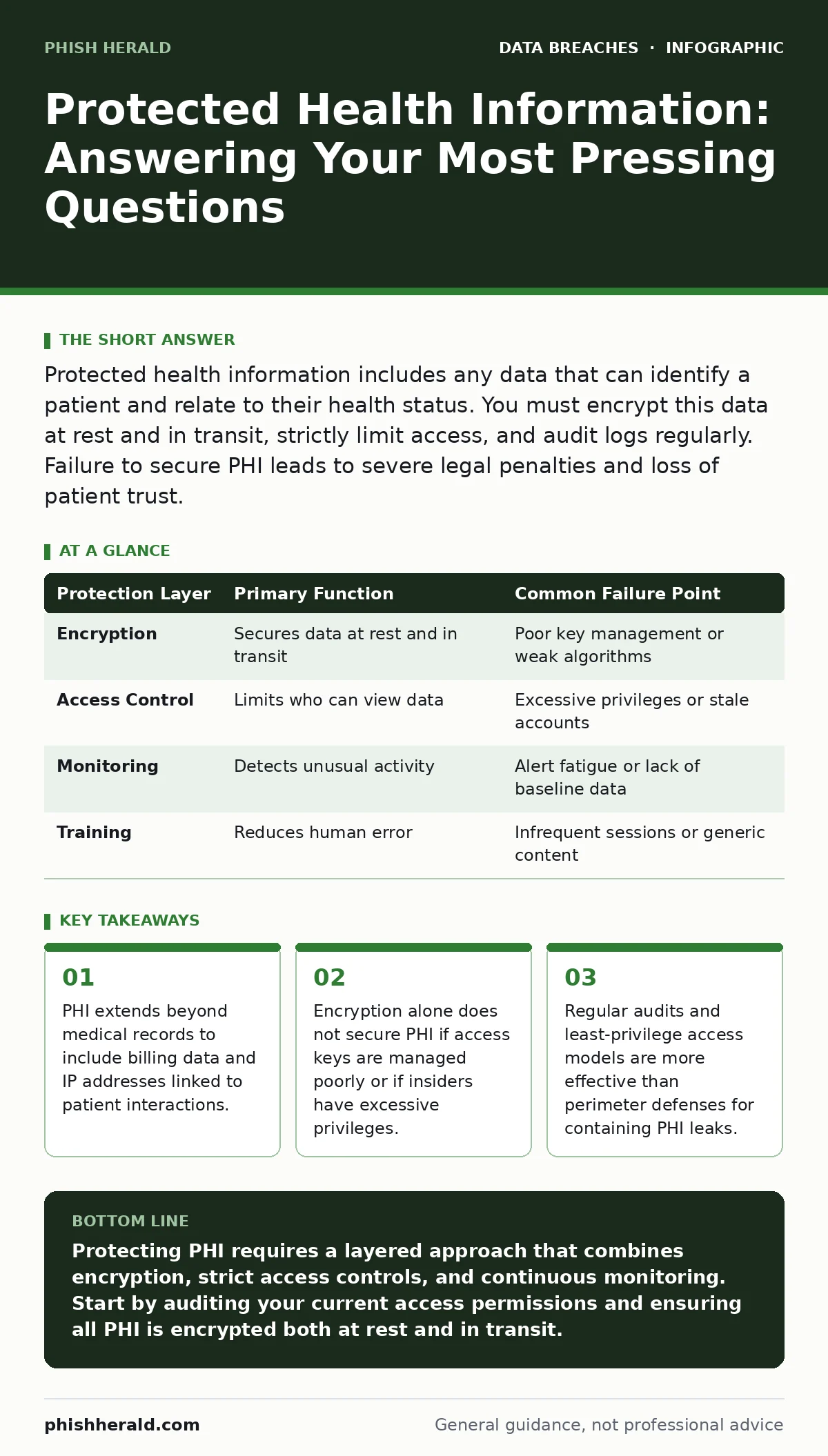
Protected health information includes any data that can identify a patient and relate to their health status. You must encrypt this data at rest and in transit, strictly limit access, and audit logs regularly. Failure to secure PHI leads to severe legal penalties and loss of patient trust.
What exactly constitutes protected health information?
Protected health information is any demographic, medical, or financial data that can identify an individual and relates to their past, present, or future health. This definition is broader than many assume, encompassing not just clinical notes but also billing records and social security numbers. Even seemingly innocuous data like a patient’s home address becomes PHI when linked to a medical record. You must treat any data element that can reasonably link back to a specific patient as sensitive.
Does de-identified data still require protection?
De-identified data that meets strict statistical standards generally falls outside the scope of PHI regulations. However, the process of de-identification must be rigorous to prevent re-identification through data linkage. If you strip names but retain precise dates of service and zip codes, malicious actors can often re-identify individuals using public records. Therefore, you must apply robust anonymisation techniques and validate the output against re-identification risks before sharing data.
How long must you retain protected health information?
Retention periods vary significantly depending on local laws and the type of data held. You cannot simply delete records immediately after patient discharge, as legal statutes often require keeping them for several years. Conversely, holding data longer than necessary increases your liability surface and storage costs. You should establish a clear retention schedule that aligns with legal requirements and automatically purges data that is no longer needed.
Who is authorised to access patient records?
Access to PHI should follow the principle of least privilege, meaning users only receive the minimum access necessary for their role. A billing clerk should not see clinical notes, and a researcher should not access live patient demographics. Role-based access control ensures that permissions are tied to job functions rather than individual identities. You must regularly review these permissions, especially when employees change roles or leave the organisation.
Is encryption sufficient for protecting stored data?
Encryption transforms readable data into unreadable ciphertext, protecting it if physical devices are stolen. However, encryption does not prevent authorised users from accessing and exfiltrating data while it is decrypted in use. You must also secure the encryption keys themselves, as compromised keys render the encryption useless. Implementing full disk encryption on all devices is a standard baseline, but it does not protect against insider threats or application-layer vulnerabilities.
How do you secure PHI during transmission?
Data in transit must be encrypted using strong protocols such as TLS to prevent interception by network eavesdroppers. Weak encryption algorithms or outdated protocol versions can be exploited to decrypt sensitive communications in real time. You should enforce mutual authentication, where both the client and server verify each other’s identity, to prevent man-in-the-middle attacks. This ensures that data sent between systems, such as between a hospital and a lab, remains confidential and intact.
What is the impact of accidental data disclosure?
Accidental disclosure occurs when staff inadvertently send PHI to the wrong recipient or leave documents in public areas. These incidents are often more common than malicious breaches and can result from human error or poorly designed workflows. You must implement technical safeguards like right-click restrictions on email clients and mandatory recipient verification for sensitive data. Refer to our guide on accidental data disclosure for strategies to reduce human error through automated checks.
How can you detect unauthorised access attempts?
Continuous monitoring and database activity monitoring help identify unusual patterns in data access, such as large downloads or off-hours logins. Standard firewalls do not inspect internal traffic for suspicious queries or data exfiltration attempts. You need tools that can analyse user behaviour and flag anomalies based on established baselines. Combining this with file integrity monitoring ensures you detect any unauthorised changes to critical health records or system configurations.
What steps follow a confirmed PHI breach?
Upon confirming a breach, you must immediately contain the incident by revoking compromised credentials and isolating affected systems. Notification to affected individuals and regulatory bodies is typically required within a strict timeframe, depending on jurisdiction. Conducting a thorough root cause analysis is necessary to prevent recurrence and to understand the full scope of the exposure. You should also review your incident response plan to identify gaps in detection or containment procedures.
| Protection Layer | Primary Function | Common Failure Point |
|---|---|---|
| Encryption | Secures data at rest and in transit | Poor key management or weak algorithms |
| Access Control | Limits who can view data | Excessive privileges or stale accounts |
| Monitoring | Detects unusual activity | Alert fatigue or lack of baseline data |
| Training | Reduces human error | Infrequent sessions or generic content |
How does identity theft relate to PHI breaches?
Stolen PHI is frequently used for medical identity theft, where criminals use a victim’s data to obtain medical services or prescription drugs. This not only causes financial harm but can also corrupt the victim’s medical history, leading to dangerous treatment errors. Protecting PHI is therefore also a form of identity theft protection for your patients. You must monitor for signs of fraudulent activity and inform patients if their data has been compromised.
What is the role of password security in PHI protection?
Strong authentication mechanisms are the first line of defence against unauthorised access to health information systems. Weak passwords are easily guessed or cracked, allowing attackers to bypass other security controls. You should enforce multi-factor authentication and use password hashing and salting to protect stored credentials. This ensures that even if your database is breached, the attacker cannot easily retrieve usable passwords.
How do you handle PHI in cloud environments?
Cloud providers offer robust infrastructure, but the responsibility for securing the data within that infrastructure often lies with the customer. You must configure access controls, encryption, and logging settings correctly to protect PHI stored in cloud services. Misconfigurations, such as leaving storage buckets public, are a leading cause of cloud-based data leaks. You should regularly audit cloud configurations and ensure that data residency requirements are met.
What is the risk of data extortion targeting health sectors?
Attackers increasingly target healthcare organisations with ransomware, encrypting systems and demanding payment for the decryption key. This data extortion tactic disrupts critical services and threatens patient safety. You must maintain offline, immutable backups to restore systems without paying ransoms. Regular testing of backup restoration processes is vital to ensure you can recover quickly in the event of an attack.
How do you ensure compliance with evolving regulations?
Regulations governing PHI are constantly updated to address new technologies and threats. You must stay informed about changes in laws and adapt your security policies accordingly. Regular audits and risk assessments help identify gaps in compliance and ensure that your security measures are up to date. Engaging with legal counsel and security experts can provide guidance on navigating complex regulatory requirements.
Key takeaways
- PHI extends beyond medical records to include billing data and IP addresses linked to patient interactions.
- Encryption alone does not secure PHI if access keys are managed poorly or if insiders have excessive privileges.
- Regular audits and least-privilege access models are more effective than perimeter defenses for containing PHI leaks.
Protecting PHI requires a layered approach that combines encryption, strict access controls, and continuous monitoring. Start by auditing your current access permissions and ensuring all PHI is encrypted both at rest and in transit.
Frequently asked questions
Can I share PHI with third-party vendors?
Yes, but only if you have a signed agreement ensuring they meet the same security standards and will report any breaches immediately.
How often should I test my incident response plan?
You should test your plan regularly, at least annually, and after any significant change to your IT infrastructure or security policies.
Is anonymised data safe to share publicly?
Only if the de-identification process has been validated to ensure no individual can be re-identified through linkage with other data sources.
What is the biggest risk to PHI security?
Insider threats and human error, such as misconfigured systems or accidental disclosure, often pose a greater risk than external hackers.
How this guide was produced: written by the Phish Herald editorial team with AI assistance, checked against the public references listed below, and reviewed when the facts change. See our editorial policy or report an error.