How Accidental Data Disclosure Happens: Step-by-Step Mechanics
Most accidental disclosures fail because human error bypasses automated security controls that assume users act with perfect rationality and intent.

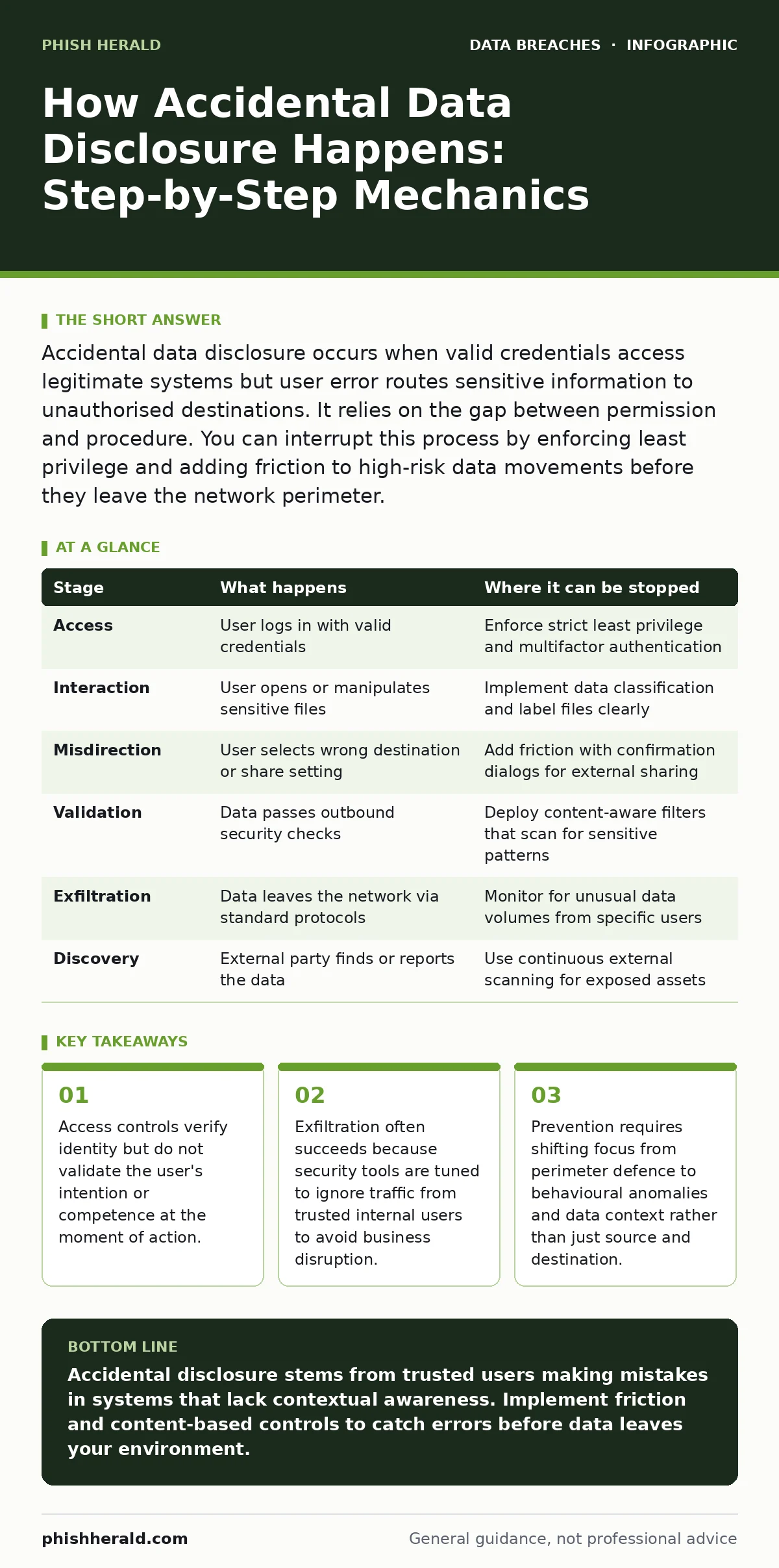
Accidental data disclosure occurs when valid credentials access legitimate systems but user error routes sensitive information to unauthorised destinations. It relies on the gap between permission and procedure. You can interrupt this process by enforcing least privilege and adding friction to high-risk data movements before they leave the network perimeter.
The Illusion of Secure Access
You likely assume that if a user has logged in successfully, their actions are authorised. This is a dangerous assumption. Access control lists grant permission to access resources, but they do not grant permission to handle those resources correctly. The system treats a legitimate login as a green light for all subsequent actions. This creates a blind spot where malicious actors who have stolen credentials, or honest users who make mistakes, operate with full trust. The security infrastructure sees valid tokens and correct IP addresses. It does not see the context of why data is moving.
Stage 1: The Privilege Boundary
The process begins with the acquisition of access. This is rarely a hack in the traditional sense. It is often a legitimate employee logging into a cloud storage platform or a database interface. The flaw relies on the principle of least privilege not being enforced tightly enough. Users are given broader permissions than necessary to perform their daily tasks. This excess permission creates a wider attack surface for error. If a user can only read files, they cannot accidentally delete or share them. When you grant edit and share rights to everyone in a department, you multiply the chances of a misstep.
Stage 2: The Context Blind Spot
Once access is established, the user interacts with the data. The system presents files as generic objects. It does not inherently understand that a spreadsheet contains protected health information or that a text file holds trade secrets. This lack of data classification means the software cannot warn the user when they are handling sensitive material. The user operates on visual cues and memory. If the file name is misleading or the folder structure is poor, confusion is inevitable. The security controls remain silent because the action itself—opening a file—is perfectly normal.
Stage 3: The Misdirection Mechanism
The critical moment of failure occurs when the user attempts to move or share the data. They might use a file-sharing service, send an email, or copy data to a removable drive. The mechanism here is the ambiguity of the destination. The user believes they are sending data to a colleague or a secure project folder. In reality, they are sending it to a public link or an external domain. The interface often makes these actions frictionless. One click can publish data to the open web. The system assumes the user knows exactly where the data is going. It does not check if the destination is appropriate for the data type.
Stage 4: The Validation Gap
Before the data leaves the environment, there is a brief window for validation. This is where the process can be interrupted. Most organisations lack deep packet inspection or content-aware filtering at the egress point. They rely on firewall rules that allow outbound traffic to known services. If the service is allowed, the data passes through. There is no secondary check to see if the payload contains sensitive patterns. The gap exists because organisations fear blocking legitimate business traffic. They prioritise availability over confidentiality. This trade-off allows accidental disclosures to slip through unnoticed.
See also: Full Disk Encryption Checklist: Verify Protection Against Physical Theft · Difference Between Broken Access Control and IDOR Explained
Stage 5: The Silent Exfiltration
The data exits the network. It lands on an external server or in an inbox outside the organisation. Because the traffic originated from a trusted user account, it does not trigger alerts for anomalous behaviour. The volume of data might be small, appearing as a normal work file. The protocol used is standard HTTPS, which is encrypted and expected. There is no signature for "accidental mistake". The attacker or the flaw relies on the assumption that not all outbound traffic needs scrutiny. The data is now in the wild, accessible to anyone with the link or the email address.
Stage 6: The Discovery Lag
The breach remains hidden until someone notices the data in the wrong place. This could be a recipient who realises they received too much information. Or it could be a researcher scanning the internet for exposed data. During this lag, the organisation has no visibility. They cannot revoke access to data that has already been sent. The damage is done. The length of this lag determines the severity of the impact. The longer the delay, the more copies of the data may exist. This highlights the need for proactive monitoring rather than reactive discovery.
| Stage | What happens | Where it can be stopped |
|---|---|---|
| Access | User logs in with valid credentials | Enforce strict least privilege and multifactor authentication |
| Interaction | User opens or manipulates sensitive files | Implement data classification and label files clearly |
| Misdirection | User selects wrong destination or share setting | Add friction with confirmation dialogs for external sharing |
| Validation | Data passes outbound security checks | Deploy content-aware filters that scan for sensitive patterns |
| Exfiltration | Data leaves the network via standard protocols | Monitor for unusual data volumes from specific users |
| Discovery | External party finds or reports the data | Use continuous external scanning for exposed assets |
Breaking the Chain
You can disrupt this sequence at multiple points. The most effective intervention is at the misdirection stage. By adding friction, you force the user to pause and confirm their action. A simple dialog box asking "Are you sure you want to share this sensitive file externally?" can prevent thousands of errors. This introduces a cognitive check that breaks the autopilot behaviour. It does not stop a determined attacker, but it stops the honest mistake.
Another powerful measure is data loss prevention that understands context. Instead of blocking all external transfers, it analyses the content. If it detects credit card numbers or health records, it blocks the transfer or requires managerial approval. This approach balances security with business needs. It allows normal work to proceed while catching the edge cases.
For organisations dealing with high-value data, consider implementing database activity monitoring to track access patterns in real-time. This provides visibility into who is looking at what, even before the data leaves the system. If you are managing sensitive sectors, understanding how public file share exposure occurs can help you tailor your controls. Additionally, ensuring proper password hashing and salting protects your credentials if a breach does occur, preventing the initial access that makes accidental disclosure possible.
Key takeaways
- Access controls verify identity but do not validate the user's intention or competence at the moment of action.
- Exfiltration often succeeds because security tools are tuned to ignore traffic from trusted internal users to avoid business disruption.
- Prevention requires shifting focus from perimeter defence to behavioural anomalies and data context rather than just source and destination.
Accidental disclosure stems from trusted users making mistakes in systems that lack contextual awareness. Implement friction and content-based controls to catch errors before data leaves your environment.
Frequently asked questions
How do I distinguish between an accidental share and a malicious leak?
Accidental shares usually involve small amounts of data sent to unexpected but plausible recipients. Malicious leaks often involve large volumes of data sent to unknown external addresses at unusual times.
Can software automatically stop all accidental disclosures?
No software can stop every error without blocking legitimate work. The goal is to reduce the frequency by adding confirmation steps and blocking known sensitive patterns.
Should I remove external sharing capabilities entirely?
Removing external sharing often drives users to find less secure workarounds. It is better to enable it with strict controls and monitoring than to ban it and lose visibility.
What is the first step if I discover an accidental disclosure?
Immediately revoke access to the shared resource and notify the affected individuals. Then, investigate how the error occurred to prevent recurrence.
How this guide was produced: written by the Phish Herald editorial team with AI assistance, checked against the public references listed below, and reviewed when the facts change. See our editorial policy or report an error.