Least Privilege Access: Hidden Costs and Real Security Gains
Restricting permissions reduces your attack surface but creates operational friction that can slow incident response and break automated workflows if not managed correctly.
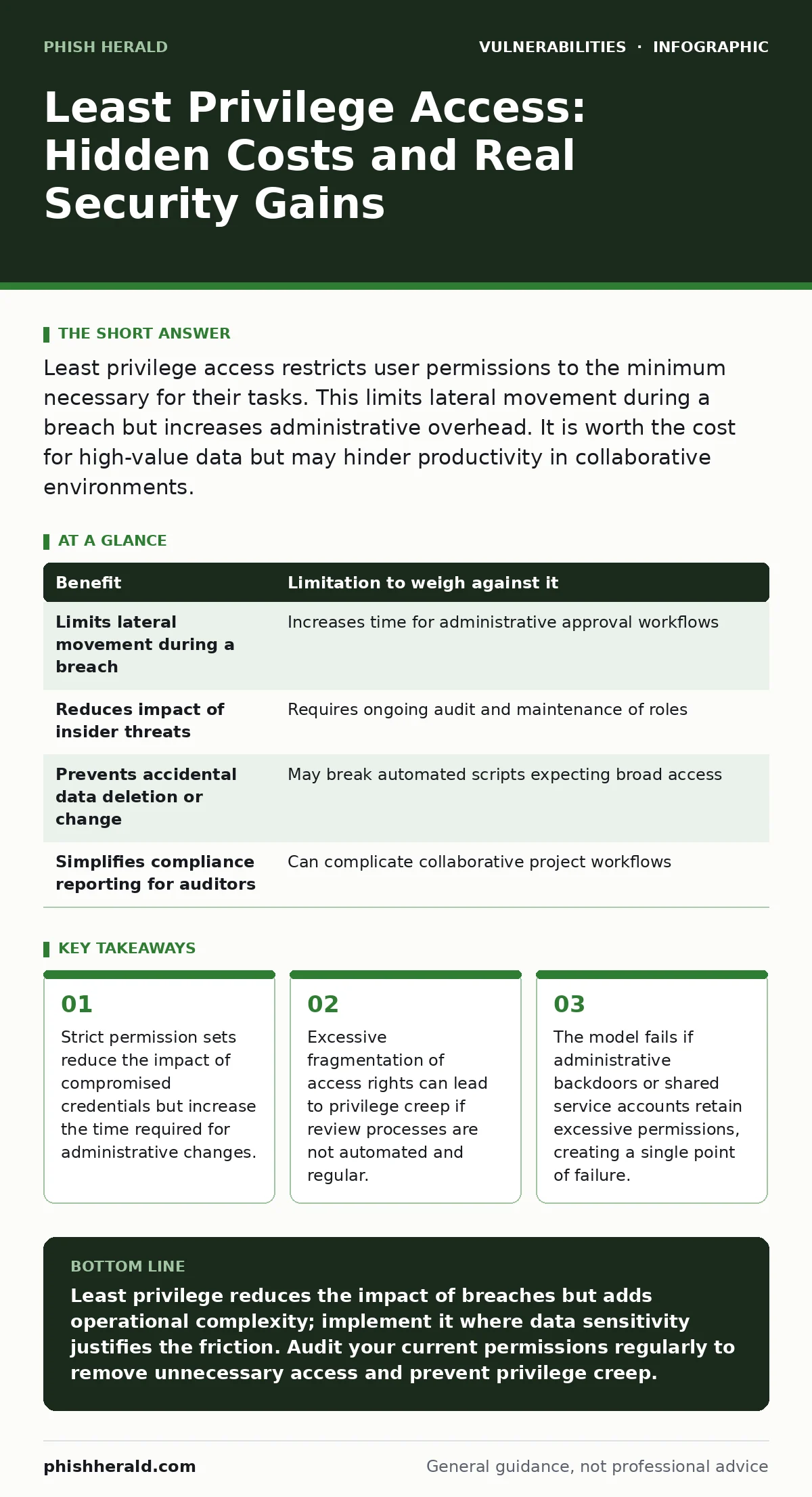
Least privilege access restricts user permissions to the minimum necessary for their tasks. This limits lateral movement during a breach but increases administrative overhead. It is worth the cost for high-value data but may hinder productivity in collaborative environments.
The Mechanics of Constraint
Least privilege access operates on the principle that a user or process should only have the permissions required to perform its specific function, nothing more. This is not merely a security preference but a structural necessity for containing damage. When you restrict access, you define the boundaries of what an attacker can do after they breach a perimeter.
Imagine a database administrator who only needs to run backups. If that account has full write access to production tables, a compromised credential allows data manipulation. If the account is restricted to read-only backup routines, the attacker hits a wall. The constraint is the security control.
This approach shifts the security burden from the perimeter to the internal architecture. You are no longer relying solely on firewalls to stop entry. You are designing systems where successful entry does not guarantee success. This requires a fundamental change in how applications and users interact with resources.
Operational Friction as a Cost
The primary limitation of least privilege is the friction it introduces into daily operations. Every time a user needs to perform a task outside their predefined scope, they must request elevated access. This request must be reviewed, approved, and often timed to expire. This process slows down legitimate work.
Administrators spend significant time managing these exceptions. The cognitive load of determining the exact minimum permission for a complex workflow is high. Errors in this determination lead to either security gaps or blocked productivity. You are trading speed for safety.
This friction is not a bug; it is a feature. The effort required to escalate privileges acts as a barrier to casual misuse and automated scripts. However, if the barrier is too high, users will seek workarounds, such as saving credentials in plain text or using shared accounts. These workarounds defeat the purpose of the control.
The Trade-Off Matrix
To evaluate whether least privilege is suitable for your environment, you must weigh the security benefits against the operational costs. The following table outlines the primary considerations.
| Benefit | Limitation to weigh against it |
|---|---|
| Limits lateral movement during a breach | Increases time for administrative approval workflows |
| Reduces impact of insider threats | Requires ongoing audit and maintenance of roles |
| Prevents accidental data deletion or change | May break automated scripts expecting broad access |
| Simplifies compliance reporting for auditors | Can complicate collaborative project workflows |
The benefit of limiting lateral movement is clear. If an attacker compromises a low-privilege account, they cannot easily move to critical systems. However, the limitation is that every access request becomes a potential bottleneck. If your incident response team needs immediate access to investigate a threat, strict least privilege may delay their actions. You must balance containment with responsiveness.
When Strict Constraint Is Worth It
Least privilege is most valuable in environments where the cost of a single error or breach is catastrophic. This includes systems holding sensitive personal data, financial records, or intellectual property. Here, the operational friction is a small price to pay for the assurance that a breach will not cascade.
Consider a system handling payment processing. The risk of fraud or data theft is high. Restricting access ensures that even if a developer’s account is stolen, the attacker cannot modify transaction logs or steal customer data. The strict control is justified by the asset value.
It is also worth it for automated systems and service accounts. These accounts often run continuously and interact with multiple systems. If a service account is compromised, an attacker has persistent access. Restricting what that account can do limits the attacker’s ability to pivot to other parts of the network.
When It Hinders More Than It Helps
Least privilege is less effective in environments that require high levels of collaboration and rapid iteration. In creative teams or research departments, the need to share files and access resources frequently can make strict controls cumbersome. The time spent requesting access may exceed the time spent working.
Imagine a software development team working on a rapid prototype. If every change to the testing environment requires a formal access request, development slows. In this case, the security benefit is marginal because the data is not yet sensitive. The operational cost, however, is high.
It is also not worth it if the implementation is poorly supported by tooling. If users must call a helpdesk for every permission change, the system will fail. Automation is required to make least privilege sustainable. Without automation, the friction becomes unmanageable.
See also: How Accidental Data Disclosure Happens: Step-by-Step Mechanics · Prevent Third-Party Data Breaches: The Vendor Risk Framework
Integration with Other Controls
Least privilege does not exist in isolation. It works best when combined with other security measures. For example, input validation ensures that data entering your systems is safe, while least privilege ensures that compromised systems cannot do harm with that data. These controls address different parts of the attack chain.
Consider the relationship with automatic software updates. If a system is compromised, an attacker may try to disable updates to maintain persistence. If the user account running the system has least privilege, it may not have the permission to disable updates. This layering of controls increases resilience.
You should also consider file upload vulnerabilities. If a user can upload a malicious file, least privilege limits what that file can do. If the web server account has no execution rights, the uploaded file remains inert. This demonstrates how permission restrictions mitigate specific vulnerability types.
Managing the Human Factor
The greatest challenge in least privilege is human behaviour. Users expect ease of access. When that access is restricted, they may become frustrated. This frustration can lead to shadow IT, where users create their own, unsecured solutions to bypass restrictions.
To mitigate this, provide clear communication about why restrictions are in place. Explain that the friction is there to protect them and the organisation. Offer alternative ways to accomplish tasks that do not require elevated privileges. For example, provide self-service tools for common administrative tasks.
Regular training helps users understand the risks of privilege creep. They should know that adding permissions "just in case" weakens the security posture. Culture plays a significant role in the success of least privilege. If security is seen as an obstacle, the controls will be circumvented.
Sustaining the Model
Maintaining least privilege requires continuous effort. Permissions must be reviewed regularly to ensure they are still necessary. This is often done through access reviews, where managers confirm that their team members still need their current levels of access.
Automation is key here. Manual reviews are prone to error and fatigue. Automated systems can flag unused permissions or permissions that have not been used for a long time. This helps keep the permission sets tight and relevant.
You must also monitor for anomalies. If a user suddenly accesses a resource they rarely use, it may indicate a compromised account or a change in their role. Alerting on these anomalies allows you to respond quickly. Least privilege is not a one-time configuration; it is an ongoing process of verification and adjustment.
Key takeaways
- Strict permission sets reduce the impact of compromised credentials but increase the time required for administrative changes.
- Excessive fragmentation of access rights can lead to privilege creep if review processes are not automated and regular.
- The model fails if administrative backdoors or shared service accounts retain excessive permissions, creating a single point of failure.
Least privilege reduces the impact of breaches but adds operational complexity; implement it where data sensitivity justifies the friction. Audit your current permissions regularly to remove unnecessary access and prevent privilege creep.
Frequently asked questions
How do I handle emergency access for incident responders?
Use break-glass accounts with pre-approved, temporary elevated privileges that are heavily monitored and audited. Ensure these accounts are only used in genuine emergencies.
Does least privilege protect against zero-day vulnerabilities?
It does not prevent the exploit from working, but it limits what the exploited code can do. If the process has minimal permissions, the attacker cannot escalate or move laterally easily.
How often should access reviews be conducted?
Reviews should be frequent enough to catch changes quickly, typically quarterly or when role changes occur. Continuous monitoring with automated alerts is more effective than periodic manual reviews.
Can least privilege slow down business growth?
It can slow down initial setup and onboarding, but it prevents costly security incidents that can halt business entirely. The short-term friction is an investment in long-term stability and trust.
How this guide was produced: written by the Phish Herald editorial team with AI assistance, checked against the public references listed below, and reviewed when the facts change. See our editorial policy or report an error.