How Tax Identity Theft Works: The Step-by-Step Attack Chain
Attackers rarely break into tax systems directly; they steal credentials from unrelated breaches and use them to file returns before the legitimate taxpayer notices.

Tax identity theft begins with credential harvesting from unrelated data leaks. Attackers use these details to file fraudulent returns early in the season, intercepting refunds. You can interrupt this by monitoring for early filings and securing digital identities beyond simple passwords.
The Foundation of Stolen Identities
Tax identity theft rarely begins with a hack of the tax authority’s servers. Instead, it starts with the quiet accumulation of personal data from unrelated sources. Attackers gather fragments of information—names, addresses, and partial identification numbers—from various leaks. This process is known as data aggregation.
They combine these fragments to create a complete profile of a target. This profile does not need to be perfect; it only needs to pass automated validation checks. The attacker now possesses a digital shadow of you, ready for exploitation.
Credential Harvesting and Validation
With a profile assembled, the attacker tests its validity. They often use these credentials on services unrelated to taxation, such as banking or utility providers, to confirm the data is current. If the credentials work elsewhere, they are likely valid for tax purposes too.
This step relies on the fact that people reuse digital identities across platforms. A password or security question answer used for a shopping site is often the same as that used for government portals. The attacker validates the identity without ever touching the tax system directly.
This phase can be interrupted by monitoring for unusual login attempts on financial accounts. If you see failed login attempts from unfamiliar locations, your credentials may be in circulation. Securing these primary accounts reduces the attack surface for subsequent stages.
The Pre-Filing Window
Tax authorities typically open filing windows months before the deadline. This early access is designed for convenience, but it creates a vulnerability. Attackers monitor these windows closely, preparing to file fraudulent returns as soon as the system opens.
They act quickly because speed is their advantage. If they file first, the system registers their return as the primary one. Any subsequent attempt by the legitimate taxpayer to file will be rejected, citing a duplicate submission. This lockout is the core of the theft.
Filing the Fraudulent Return
The attacker submits the fraudulent return using the stolen identity. They direct the refund to a method they control, such as a prepaid debit card or a bank account opened with synthetic identity details. Modern tax systems often allow electronic filing, which accelerates this process.
The system processes the return automatically, assuming the identity verification passed. At this stage, the flaw lies in the reliance on static data. The system checks if the name matches the identification number, but it cannot verify if the person submitting the form is the actual owner of that data.
This stage exploits the trust placed in digital identity markers. The attacker does not need to bypass complex encryption; they simply present valid credentials that the system recognises as authentic. The theft is complete once the refund is issued.
The Legitimate Taxpayer Discovers the Breach
You attempt to file your return and receive an error message. The system informs you that a return has already been filed using your identification number. This moment of discovery is often delayed, as many people do not file immediately.
The delay allows the attacker to cash the refund and disappear. By the time you contact the tax authority, the funds may have been moved through multiple accounts or converted into cryptocurrency. This latency is a significant challenge in recovery.
Interrupting the damage here requires immediate action. You must file an identity theft report with the relevant authorities and contact the tax agency to place a freeze on your account. This prevents further fraudulent activity but does not recover lost funds.
Recovery and Remediation
Recovering from tax identity theft is a bureaucratic process. You must prove your identity and dispute the fraudulent return. This involves submitting forms and waiting for manual review, which can take months. The tax authority must verify that you are the legitimate taxpayer.
During this period, your ability to file future returns may be restricted. The system flags your account as compromised, requiring additional verification steps for future interactions. This friction is a side effect of the security measures designed to prevent further theft.
Preventive Measures and Systemic Weaknesses
Prevention focuses on reducing the availability of your personal data. Limiting the amount of personal information shared online reduces the material attackers can aggregate. Using unique passwords for each service prevents credential stuffing attacks.
Monitoring services can alert you if your data appears in new breaches. These services scan the dark web for stolen credentials and notify you of exposure. While they cannot stop theft, they provide early warning signs that allow you to take defensive action.
The systemic weakness lies in the reliance on static identifiers. Until identity verification incorporates dynamic factors, such as behavioural biometrics or continuous authentication, the risk remains. Addressing this requires a shift in how digital identity is managed and verified.
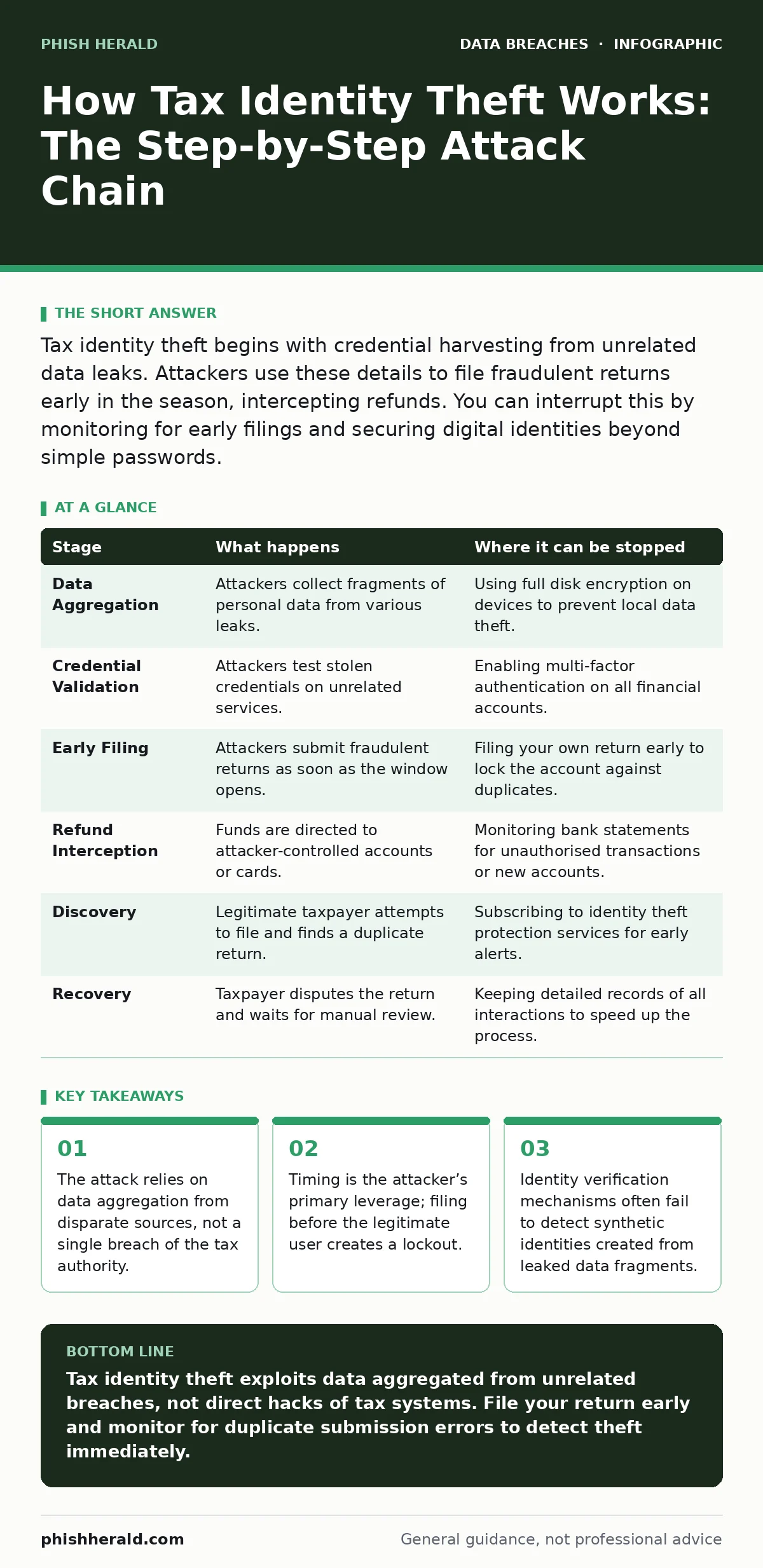
| Stage | What happens | Where it can be stopped |
|---|---|---|
| Data Aggregation | Attackers collect fragments of personal data from various leaks. | Using full disk encryption on devices to prevent local data theft. |
| Credential Validation | Attackers test stolen credentials on unrelated services. | Enabling multi-factor authentication on all financial accounts. |
| Early Filing | Attackers submit fraudulent returns as soon as the window opens. | Filing your own return early to lock the account against duplicates. |
| Refund Interception | Funds are directed to attacker-controlled accounts or cards. | Monitoring bank statements for unauthorised transactions or new accounts. |
| Discovery | Legitimate taxpayer attempts to file and finds a duplicate return. | Subscribing to identity theft protection services for early alerts. |
| Recovery | Taxpayer disputes the return and waits for manual review. | Keeping detailed records of all interactions to speed up the process. |
The Role of Third-Party Exposure
The initial data loss often occurs outside the tax ecosystem. Retailers, healthcare providers, and social media platforms are frequent targets. When these organisations suffer breaches, your personal data becomes available to attackers.
This is why third-party data breaches are a primary vector for tax identity theft. The tax authority is not the weakest link; the organisations that hold your personal details are. Securing your digital footprint across all services is therefore critical.
Long-Term Identity Security
Protecting against tax identity theft is part of broader identity security. It requires a proactive approach to managing your digital presence. This includes regularly reviewing privacy settings on social media and limiting the personal information you share publicly.
It also involves staying informed about public file share exposure. Misconfigured cloud storage accounts can leak sensitive documents, providing attackers with the detailed information they need. Ensuring your files are properly secured reduces this risk.
While password hashing and salting protects stored passwords on servers, it does not help if the data is already in the wild. The focus must shift to detecting and responding to exposure after it occurs. This is where continuous monitoring and rapid response become vital.
Conclusion of the Attack Chain
The cycle of tax identity theft is driven by the value of stolen identities. Attackers persist because the rewards are high and the barriers to entry are low. The reliance on static data for verification makes the process efficient for them.
Breaking this cycle requires a multi-layered defence. You must protect your data at the source, monitor for exposure, and act quickly when signs of theft appear. There is no single solution, but a combination of practices significantly reduces risk.
Remember that data extortion is a related threat. Attackers may threaten to release stolen data unless a ransom is paid. While tax theft is primarily about financial gain, the underlying mechanism of data misuse is similar. Understanding this connection helps in developing a holistic security strategy.
Key takeaways
- The attack relies on data aggregation from disparate sources, not a single breach of the tax authority.
- Timing is the attacker’s primary leverage; filing before the legitimate user creates a lockout.
- Identity verification mechanisms often fail to detect synthetic identities created from leaked data fragments.
Tax identity theft exploits data aggregated from unrelated breaches, not direct hacks of tax systems. File your return early and monitor for duplicate submission errors to detect theft immediately.
Frequently asked questions
Can I stop a fraudulent tax return once it has been filed?
You can dispute the return by contacting the tax authority and filing an identity theft report, but you cannot directly cancel the fraudulent filing. The authority must manually review and reverse the transaction.
Does two-factor authentication prevent tax identity theft?
Two-factor authentication protects your accounts from unauthorised access, but it does not prevent attackers from using stolen static data to file returns. It reduces the risk of account takeover but not the theft of identity details themselves.
How long does it take to recover from tax identity theft?
Recovery can take several months, as it involves manual review by the tax authority and dispute resolution processes. The timeline depends on the complexity of the case and the responsiveness of the relevant agencies.
Should I freeze my credit to prevent tax identity theft?
Credit freezes prevent new accounts from being opened in your name, but they do not stop attackers from using your existing identity to file tax returns. It is a useful layer of defence but not a complete solution.
How this guide was produced: written by the Phish Herald editorial team with AI assistance, checked against the public references listed below, and reviewed when the facts change. See our editorial policy or report an error.