Dark Web Intelligence: Decisions, Risks and Team Usage
Monitoring hidden networks shifts security from reactive incident response to proactive threat containment before data leaves your perimeter.

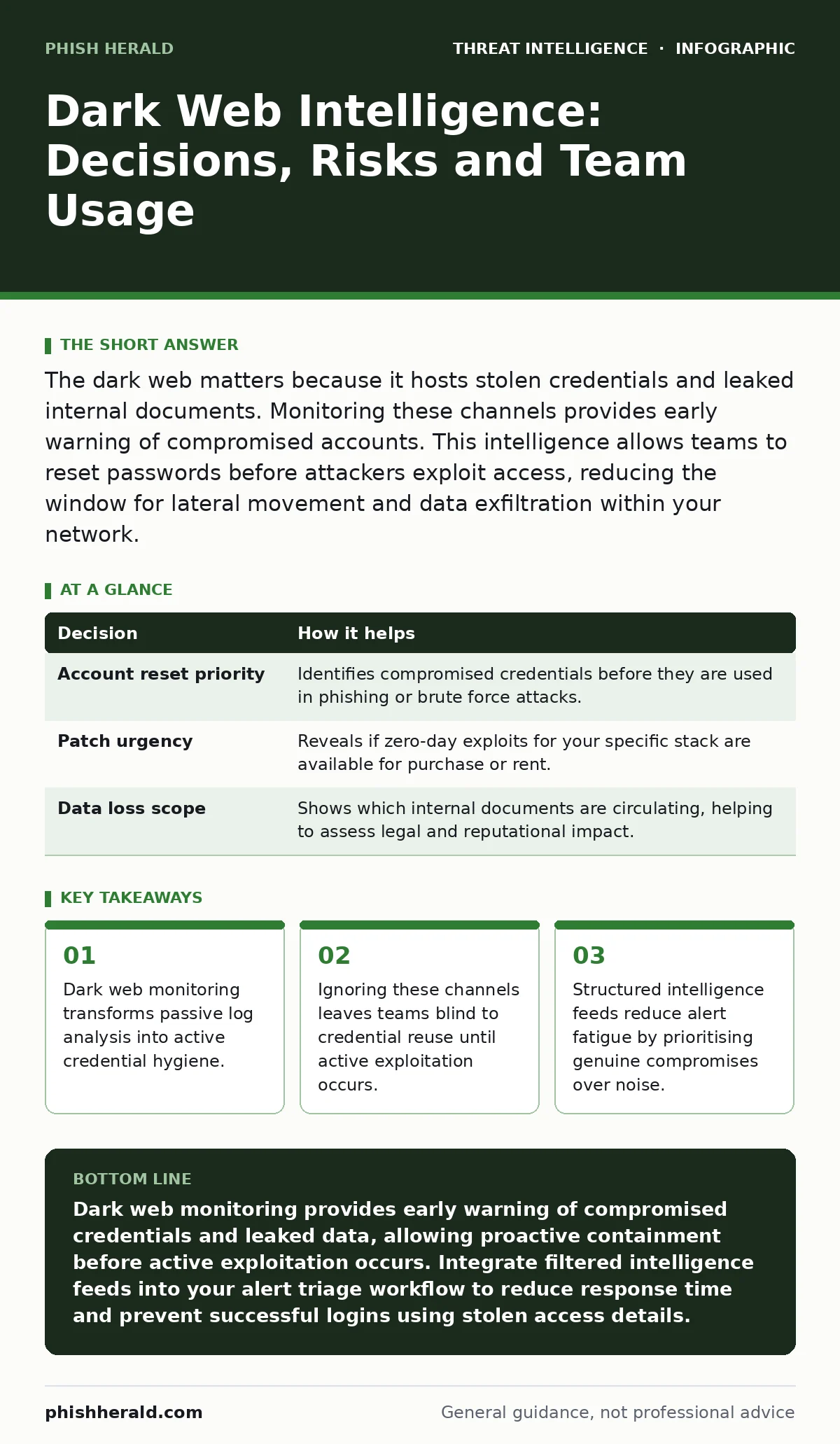
The dark web matters because it hosts stolen credentials and leaked internal documents. Monitoring these channels provides early warning of compromised accounts. This intelligence allows teams to reset passwords before attackers exploit access, reducing the window for lateral movement and data exfiltration within your network.
How Hidden Networks Change Security Decisions
Dark web monitoring informs three specific operational decisions that standard log analysis cannot support. First, it determines which user accounts require immediate password resets before any internal login attempt occurs. Second, it identifies whether specific internal software versions are being targeted by exploit kits. Third, it reveals if sensitive corporate documents are being sold on public forums. These inputs change the priority of your incident response queue.
Without this external context, your detection systems only see activity that has already happened. You detect the breach when the attacker executes a command or exfiltrates data. With dark web intelligence, you detect the intent or the capability before the execution phase. This shifts your defence posture from containment to prevention.
| Decision | How it helps |
|---|---|
| Account reset priority | Identifies compromised credentials before they are used in phishing or brute force attacks. |
| Patch urgency | Reveals if zero-day exploits for your specific stack are available for purchase or rent. |
| Data loss scope | Shows which internal documents are circulating, helping to assess legal and reputational impact. |
The Cost of Ignoring External Signals
Imagine a team that relies solely on endpoint telemetry for threat detection. They have excellent visibility into processes running on their servers. They catch malware when it executes. They catch suspicious scripts when they run. But they miss the period where attackers test stolen credentials against their web portals. This testing phase generates minimal noise. It does not trigger endpoint alerts. It does not trigger network detection and response rules because the traffic looks like normal HTTPS.
Without external intelligence, this team assumes their perimeter is secure until the first successful login. By then, the attacker has established persistence. The team must now respond to an active intrusion. They spend hours containing the threat. They spend days investigating the scope. The damage is already done. The cost is not just technical. It includes brand reputation and regulatory fines.
How Teams Structure Intelligence Consumption
Effective teams do not manually browse dark web forums. The volume is too high. The risk to analysts is too great. Instead, they use automated feeds that normalise data into a common format. These feeds provide structured alerts about specific indicators. Teams integrate these feeds into their security information and event management platforms. This allows correlation with internal logs.
An analyst receives an alert that a CEO’s email domain is associated with a credential dump. The system checks if this account has logged in recently. If yes, it triggers a high-priority ticket. If no, it triggers a routine password reset request. This process removes guesswork. It ensures that every alert has a clear action path. The team focuses on validation and containment, not data gathering.
The Trap of Indicator Fatigue
Not all dark web data is useful. Many indicators of compromise are stale. A password leak from three years ago may no longer be relevant. Sending every historical leak to your security operations centre creates noise. Analysts become desensitised to alerts. They begin to ignore them. This leads to missed threats.
Teams must filter data by recency and relevance. They should only alert on indicators that match active user accounts or currently deployed software. They should discard historical data that has no current application. This requires constant tuning. It requires a feedback loop between the intelligence team and the analysts. If an alert does not lead to an action, it should be suppressed.
Integrating with Existing Security Controls
Dark web intelligence works best when combined with other security controls. It enhances alert triage by providing context. When an unusual login occurs, the system checks if the credentials were recently seen on the dark web. If so, the alert priority increases. This reduces the time to respond.
It also supports breach and attack simulation efforts. Teams can simulate attacks using known leaked credentials. This tests whether their detection rules catch these specific scenarios. If the simulation fails to trigger an alert, the team knows their rules are incomplete. They can then adjust their configurations. This creates a continuous improvement cycle.
See also: Tor Browser Privacy Risks: How to Neutralise Them · Tactics, Techniques and Procedures (TTPs) for Security Decisions
The Hidden Complexity of Attribution
Attribution on the dark web is often misleading. Criminals use fake identities. They sell access to servers that have already been compromised. They may sell the same data to multiple buyers. Assuming a specific nation-state cyber attacks vector based on forum chatter is risky. The data may be fabricated to create confusion.
Teams should treat attribution as secondary. The primary value is the technical indicator. The fact that credentials are leaked matters more than who sold them. Focusing on attribution distracts from the immediate need to secure accounts. It leads to wasted investigation time. Stick to the technical facts. Reset the password. Block the access.
Measuring the Value of Monitoring
You need security metrics that show the impact of dark web monitoring. Track the time between data leak and password reset. Track the number of blocked login attempts using leaked credentials. Track the reduction in successful phishing campaigns. These metrics prove the value.
If you cannot measure the impact, you cannot justify the cost. Teams often struggle to explain why they need external intelligence. These metrics provide the answer. They show that monitoring prevents incidents. They show that it reduces response time. They show that it protects the organisation from financial loss.
The Limits of External Intelligence
Dark web monitoring does not replace internal security. It complements it. It cannot detect malware that is not leaked. It cannot detect insider threats who do not steal data. It cannot detect configuration errors. It is one layer of defence.
Teams must maintain strong internal controls. Multi-factor authentication remains critical. Network segmentation remains critical. Patch management remains critical. Dark web intelligence adds an early warning layer. It does not fix underlying weaknesses. It highlights them. You must still address the root causes.
Key takeaways
- Dark web monitoring transforms passive log analysis into active credential hygiene.
- Ignoring these channels leaves teams blind to credential reuse until active exploitation occurs.
- Structured intelligence feeds reduce alert fatigue by prioritising genuine compromises over noise.
Dark web monitoring provides early warning of compromised credentials and leaked data, allowing proactive containment before active exploitation occurs. Integrate filtered intelligence feeds into your alert triage workflow to reduce response time and prevent successful logins using stolen access details.
Frequently asked questions
How do I start dark web monitoring without hiring experts?
Use commercial services that provide normalised feeds compatible with your existing security tools. Start with monitoring executive email domains and critical service accounts to establish baseline value.
Is dark web monitoring legal for organisations?
Yes, monitoring public forums and marketplaces for mentions of your organisation or credentials is legal. Avoid accessing illegal content directly. Use intermediaries that scrub illegal material before delivering intelligence.
What is the biggest risk of using dark web intelligence?
The biggest risk is alert fatigue. Ingesting too much unfiltered data overwhelms analysts. Filter for recency and relevance to ensure every alert triggers a meaningful response action.
How this guide was produced: written by the Phish Herald editorial team with AI assistance, checked against the public references listed below, and reviewed when the facts change. See our editorial policy or report an error.