What is breach and attack simulation: a practical defence test
Breach and attack simulation automates controlled cyber intrusions to prove your security stack blocks real threats, not just theoretical ones.

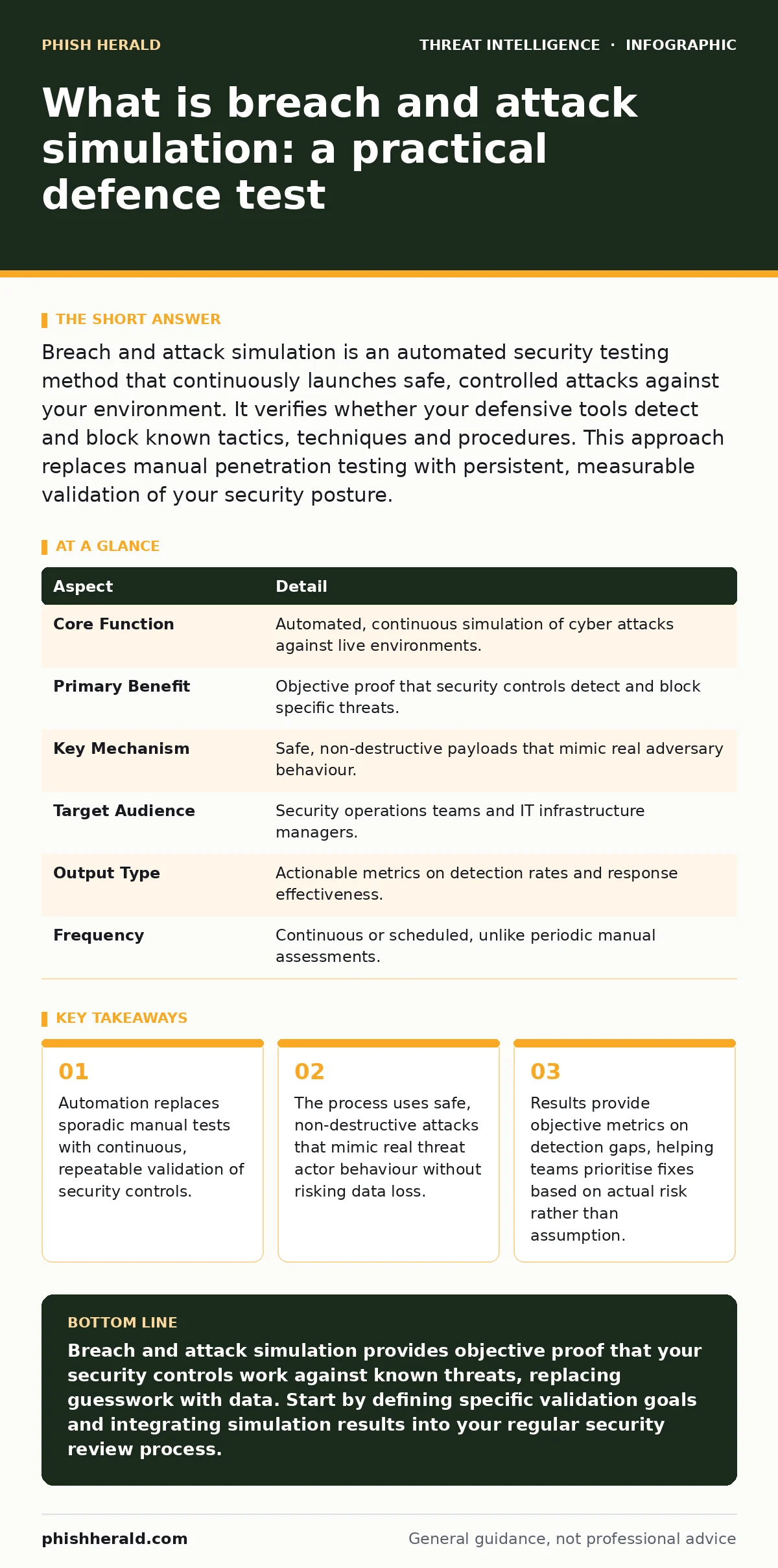
Breach and attack simulation is an automated security testing method that continuously launches safe, controlled attacks against your environment. It verifies whether your defensive tools detect and block known tactics, techniques and procedures. This approach replaces manual penetration testing with persistent, measurable validation of your security posture.
The Locksmith Analogy
Imagine you hire a locksmith to check your home’s security. A traditional audit involves the locksmith writing a report on what might go wrong. Breach and attack simulation involves the locksmith actually trying to open your doors and windows, every day, to prove they stay locked. You do not want a theory about security; you want evidence that the mechanism works. This shift from theoretical assessment to practical verification changes how organisations manage risk. It moves the focus from buying tools to proving those tools function correctly under pressure. The goal is not to break in, but to confirm that your defences hold when tested.
At a Glance
| Aspect | Detail |
|---|---|
| Core Function | Automated, continuous simulation of cyber attacks against live environments. |
| Primary Benefit | Objective proof that security controls detect and block specific threats. |
| Key Mechanism | Safe, non-destructive payloads that mimic real adversary behaviour. |
| Target Audience | Security operations teams and IT infrastructure managers. |
| Output Type | Actionable metrics on detection rates and response effectiveness. |
| Frequency | Continuous or scheduled, unlike periodic manual assessments. |
What is breach and attack simulation
What is breach and attack simulation? It is a technology that automates the process of testing an organisation’s security defences by simulating real-world cyber attacks. The system executes predefined attack scenarios that mirror known threat actor behaviour. These scenarios cover various stages of an intrusion, from initial access to lateral movement and data exfiltration.
The simulation runs safely within the existing environment, ensuring no actual damage occurs. It checks whether security tools such as firewalls, endpoint detection systems and intrusion prevention systems trigger the correct responses. This method provides a clear view of gaps in the security posture. It answers the critical question of whether current controls are effective against known tactics, techniques and procedures (TTPs).
How the Mechanism Works
The simulation engine operates by deploying lightweight agents or using cloud-based connections to interact with the target environment. It follows structured attack paths based on established frameworks like the Unified Kill Chain. Each step of the simulation is designed to trigger specific security alerts. For example, the system might attempt a phishing simulation to test email filtering rules. If the email passes through, the simulation proceeds to test endpoint detection capabilities.
The platform records every interaction, noting which controls detected the activity and which ones failed. This data creates a baseline for security effectiveness. The system then repeats these tests regularly to monitor changes in the environment. It adapts to new configurations and updates, ensuring the validation remains relevant. This continuous loop provides real-time feedback on the health of the security stack.
Who Affected by Simulation Gaps
Organisations that rely on static security configurations often suffer from silent failures. These are gaps where security tools are installed but not functioning as intended. Breach and attack simulation reveals these hidden weaknesses. It affects IT teams responsible for maintaining network integrity and data protection. Without continuous testing, teams may believe they are secure while significant vulnerabilities remain.
This false sense of security can lead to delayed response times during an actual incident. The simulation highlights areas where staff training or tool configuration needs improvement. It also identifies outdated software or misconfigured devices that pose a risk. By exposing these issues, the process helps prioritise remediation efforts. It ensures that resources are spent on fixing actual weaknesses rather than perceived ones.
See also: Tactics, Techniques and Procedures (TTPs) for Security Decisions · Attacker Reconnaissance Myths: What Your Defenders Actually See
Common Misconceptions
Many organisations confuse breach and attack simulation with penetration testing. Penetration testing is a manual, periodic assessment performed by human experts. It provides a snapshot of security at a specific moment. Breach and attack simulation is automated and continuous. It provides ongoing validation of security controls. Another common mistake is assuming that simulation replaces the need for security monitoring.
The simulation tests the tools, but it does not replace the need for human analysis of alerts. Teams must still review and respond to findings. Additionally, some believe that simulation covers all possible threats. It focuses on known tactics, techniques and procedures (TTPs) and standard attack paths. It may not cover novel, zero-day exploits or highly customised attacks. Understanding these limitations helps set realistic expectations for the technology.
Integration with Security Metrics
To derive value from simulation, organisations must integrate results into their broader security metrics. This involves tracking detection rates over time and correlating them with incident response performance. The data helps answer questions about the effectiveness of specific security tools. It allows teams to compare performance across different network segments.
This quantitative approach supports data-driven decision-making. It helps justify budget allocations for security upgrades or staff training. By linking simulation results to operational outcomes, organisations can demonstrate the return on investment for their security programmes. This alignment ensures that security efforts support business objectives rather than operating in isolation.
Next Steps for Implementation
Start by defining clear objectives for the simulation programme. Identify which security controls need validation and which attack paths are most relevant to the organisation. Select a simulation platform that integrates with existing security tools. Begin with a limited scope to understand the baseline performance. Gradually expand the scope to cover more complex attack scenarios.
Regularly review the results and adjust security configurations accordingly. Train staff on how to interpret simulation findings and prioritise remediation. This structured approach ensures that the simulation process delivers tangible improvements to the security posture. It transforms security from a static state into a dynamic, continuously improving function.
Key takeaways
- Automation replaces sporadic manual tests with continuous, repeatable validation of security controls.
- The process uses safe, non-destructive attacks that mimic real threat actor behaviour without risking data loss.
- Results provide objective metrics on detection gaps, helping teams prioritise fixes based on actual risk rather than assumption.
Breach and attack simulation provides objective proof that your security controls work against known threats, replacing guesswork with data. Start by defining specific validation goals and integrating simulation results into your regular security review process.
Frequently asked questions
Does breach and attack simulation slow down the network?
Modern simulation platforms are designed to be lightweight and non-disruptive. They use minimal resources and do not generate excessive traffic. The impact on network performance is negligible when configured correctly.
Can simulation replace penetration testing?
No, simulation complements penetration testing. Simulation provides continuous validation of known threats, while penetration testing offers deep, manual assessment of complex vulnerabilities. Both are valuable for a comprehensive security strategy.
How often should simulations be run?
Simulations should run continuously or on a frequent scheduled basis. This ensures that changes in the environment, such as software updates or configuration changes, are immediately validated. Regular testing maintains confidence in the security posture.
Is breach and attack simulation safe for production environments?
Yes, when configured correctly. The simulations use safe, non-destructive payloads that mimic attack behaviour without causing harm. They are designed to interact with security controls without impacting business operations or data integrity.
How this guide was produced: written by the Phish Herald editorial team with AI assistance, checked against the public references listed below, and reviewed when the facts change. See our editorial policy or report an error.