Endpoint Protection for Small Business: Budget Strategies That Work
Small teams face the same attack surface as giants, yet can secure devices through automated policies rather than hiring dedicated security staff.

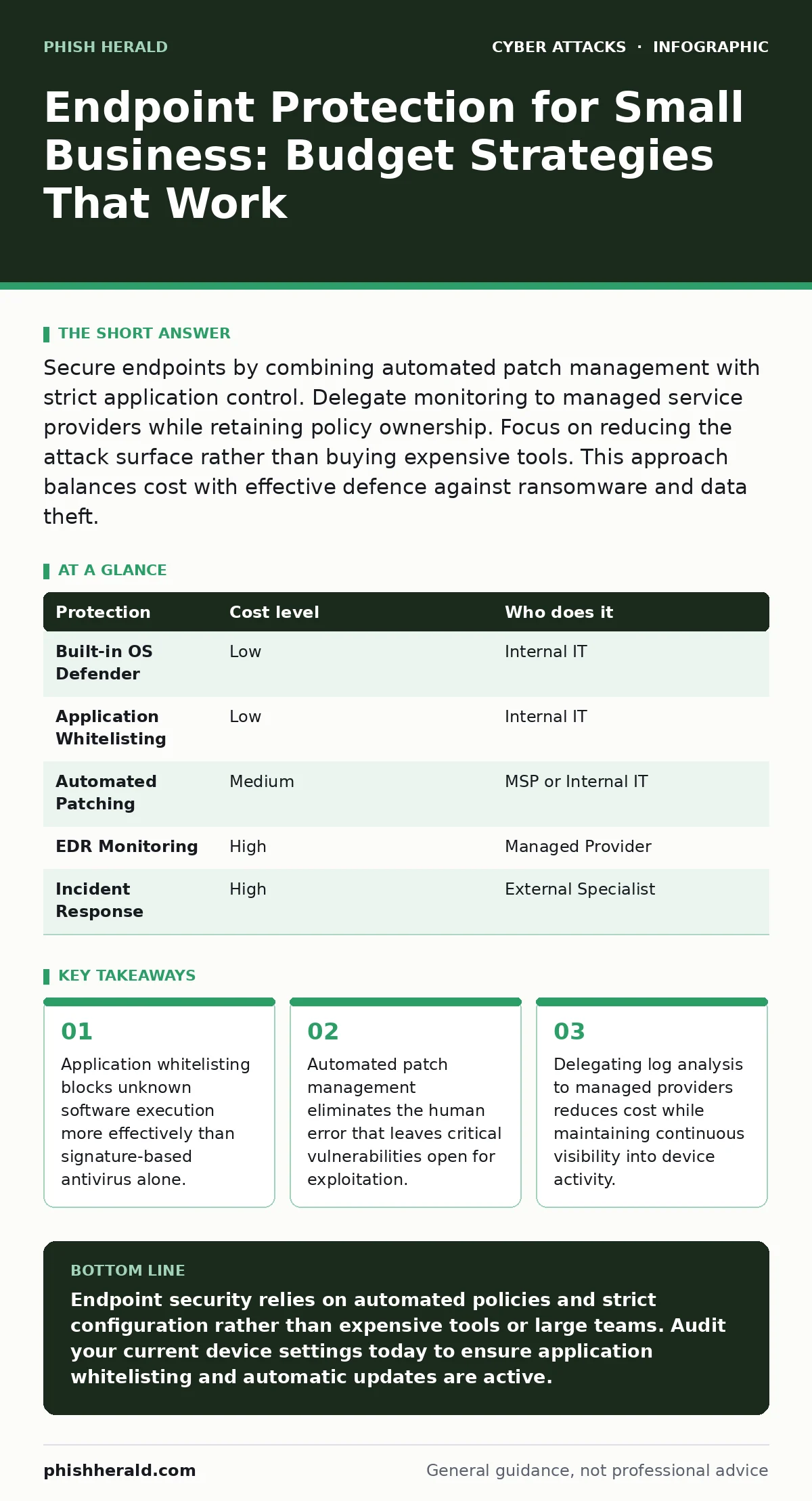
Secure endpoints by combining automated patch management with strict application control. Delegate monitoring to managed service providers while retaining policy ownership. Focus on reducing the attack surface rather than buying expensive tools. This approach balances cost with effective defence against ransomware and data theft.
The Hidden Risk in Small Teams
Small organisations often believe their size offers camouflage against cyber threats. This assumption fails because attackers use automated scanning tools that do not discriminate by company revenue or employee count. A small business with unpatched endpoints presents an easy entry point for ransomware groups. These groups seek quick returns and target systems with known vulnerabilities. The lack of dedicated security staff means that a single successful breach can halt operations entirely.
The risk is not just financial. It involves reputation damage and data loss that can take years to recover from. Small teams must treat endpoint security with the same rigour as large enterprises. The difference lies in the method. You cannot rely on manual processes or large security teams. Instead, you must rely on automation and strict configuration standards.
Why Endpoints Matter at Scale
Every device that connects to your network is a potential entry point. Laptops, desktops, and mobile devices often access sensitive data outside the secure office environment. This mobility increases the risk of theft, loss, and infection. Attackers exploit this by targeting the weakest link in the chain.
Traditional antivirus software is no longer sufficient. Modern malware uses polymorphic code that changes its signature with each infection. Signature-based detection misses these variants. You need behaviour-based detection that monitors what programs do, not just what they are called. This shift requires a change in mindset from reactive scanning to proactive monitoring.
Small businesses often overlook the internal threat. Misconfigured devices can leak data just as easily as hacked ones. Endpoint protection must enforce security policies regardless of user intent. This ensures that even well-meaning employees do not accidentally expose the network to danger.
Affordable Protection Strategies
Cost constraints do not have to mean weak security. Open-source tools and built-in operating system features provide strong baseline protection. Windows Defender, for instance, offers robust detection when configured correctly. Linux systems have native security modules that can restrict process execution.
Application whitelisting is a powerful, low-cost defence. This mechanism allows only approved software to run on a device. All other executables are blocked by default. This prevents ransomware from launching even if a user clicks a malicious link. It reduces the attack surface significantly.
Another affordable step is disabling unnecessary services. Many operating systems run background processes that are rarely used. These services can be exploited by attackers. Disabling them reduces the number of potential entry points. This simple configuration change costs nothing but time.
| Protection | Cost level | Who does it |
|---|---|---|
| Built-in OS Defender | Low | Internal IT |
| Application Whitelisting | Low | Internal IT |
| Automated Patching | Medium | MSP or Internal IT |
| EDR Monitoring | High | Managed Provider |
| Incident Response | High | External Specialist |
What to Delegate Effectively
Not every task requires internal expertise. Log analysis and threat hunting are time-intensive activities. Small teams rarely have the bandwidth to review thousands of security events daily. Delegating this to a managed security service provider (MSSP) is often the most efficient choice.
These providers use specialised tools to correlate events across multiple devices. They can identify patterns that a single team member might miss. You retain control over security policies, but they handle the monitoring. This separation of duties ensures that your staff can focus on core business operations.
Do not delegate policy creation. You know your business processes better than any external provider. If you hand over policy decisions, you risk configurations that hinder productivity or fail to address specific risks. Clear communication of your requirements is vital for the provider to act effectively.
Configuring for Resilience
Configuration is often more important than the tool itself. A poorly configured security suite provides a false sense of safety. You must ensure that automatic updates are enabled for all security software. Delayed updates leave systems vulnerable to newly discovered exploits.
Enable remote wipe capabilities for mobile devices. If a laptop or phone is lost, you can erase data remotely. This prevents sensitive information from falling into the wrong hands. Ensure that this feature is tested regularly to confirm it works when needed.
Restrict user privileges. Standard users should not have administrator rights. This limits the damage that malware can do if it executes on a device. Administrative tasks should be performed through a separate, privileged account. This principle of least privilege is fundamental to endpoint security.
See also: Signature Based Detection in Cyber Security: Mechanisms and Blind Spots · Endpoint Detection and Response: Answers to Ten Critical Questions
Integrating with Broader Security
Endpoint protection does not exist in isolation. It must work with other security measures. For example, strong authentication prevents attackers from using stolen credentials to access endpoints. Consider using password managers to ensure that complex, unique passwords are used for every account.
Network segmentation limits the spread of an infection. If one endpoint is compromised, the attacker cannot easily move laterally to other systems. This containment strategy reduces the overall impact of a breach. It also simplifies incident response by isolating the affected area.
Be aware of initial access vectors. Phishing emails remain a primary method for attackers to gain a foothold. Training users to recognise suspicious messages complements technical controls. However, do not rely on training alone. Technical barriers like email filtering are necessary to catch threats that users might miss.
Common Implementation Mistakes
One common error is assuming that more tools mean better security. Layering incompatible security products can lead to system instability. Each tool consumes resources and may interfere with others. Stick to a single, well-configured endpoint protection platform.
Another mistake is ignoring mobile devices. Many small businesses focus on desktops and laptops while neglecting smartphones and tablets. These devices often contain the same sensitive data. They require the same level of protection, including encryption and remote wipe capabilities.
Finally, do not neglect offline backups. Ransomware can encrypt connected drives. Offline backups provide a recovery option that does not depend on the network. Ensure that these backups are tested and accessible when needed.
Maintaining Long-Term Security
Security is a continuous process, not a one-time setup. Threats evolve, and so must your defences. Regularly review your security policies and update them as needed. This includes reviewing user access rights and application whitelists.
Stay informed about emerging threats. While you do not need to follow every news report, understanding trends helps you prioritise risks. For instance, zero-click attacks require no user interaction, making traditional awareness training less effective. Technical controls become even more critical in these scenarios.
Engage with your security provider regularly. Ask for reports on detected threats and blocked attempts. This data helps you understand your risk profile and adjust your strategy. Continuous improvement is key to maintaining a strong security posture.
Key takeaways
- Application whitelisting blocks unknown software execution more effectively than signature-based antivirus alone.
- Automated patch management eliminates the human error that leaves critical vulnerabilities open for exploitation.
- Delegating log analysis to managed providers reduces cost while maintaining continuous visibility into device activity.
Endpoint security relies on automated policies and strict configuration rather than expensive tools or large teams. Audit your current device settings today to ensure application whitelisting and automatic updates are active.
Frequently asked questions
Can built-in antivirus protect a small business?
Yes, if configured correctly with automatic updates and behaviour monitoring. Built-in tools like Windows Defender provide strong baseline protection against known threats and many modern malware variants.
How often should endpoint policies be reviewed?
Review policies at least quarterly or after any significant change in business operations. Regular reviews ensure that security measures remain aligned with current risks and do not hinder productivity unnecessarily.
Is cloud-based endpoint protection better than on-premise?
Cloud-based solutions often offer easier management and lower upfront costs. They provide centralised visibility and automated updates, which are beneficial for small teams lacking dedicated security infrastructure.
What if an endpoint is already infected?
Isolate the device immediately from the network to prevent spread. Then, perform a full scan and remediation. If the infection is severe, wipe the device and restore from a clean backup to ensure complete removal.
How this guide was produced: written by the Phish Herald editorial team with AI assistance, checked against the public references listed below, and reviewed when the facts change. See our editorial policy or report an error.