Heuristic Detection for Small Business: Low Cost, High Impact
Behavioural analysis catches zero-day threats that signature databases miss, offering small teams a scalable defence against evolving malware without heavy infrastructure.

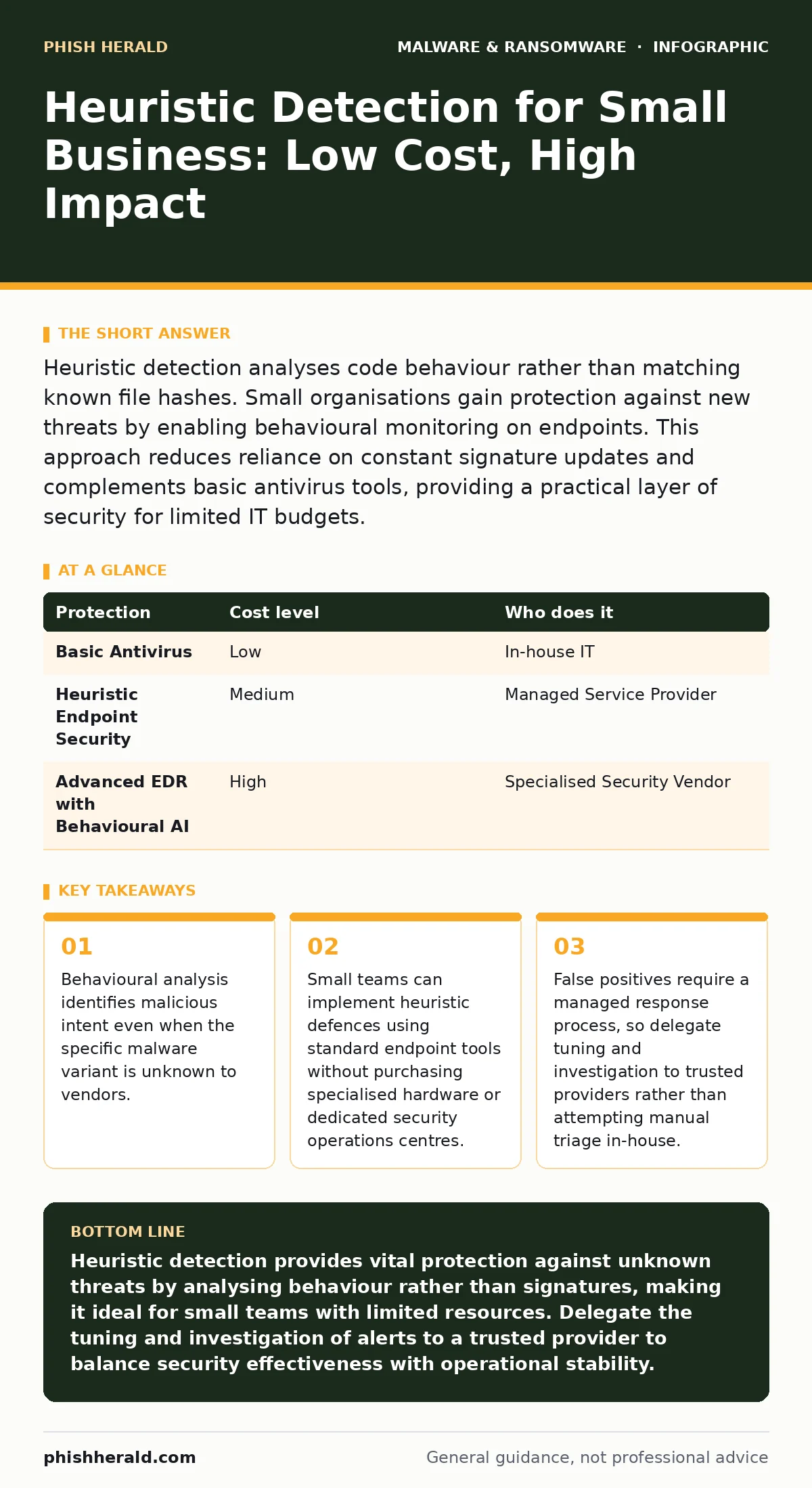
Heuristic detection analyses code behaviour rather than matching known file hashes. Small organisations gain protection against new threats by enabling behavioural monitoring on endpoints. This approach reduces reliance on constant signature updates and complements basic antivirus tools, providing a practical layer of security for limited IT budgets.
Why heuristic detection matters at small scale
Small organisations often rely on signature-based detection, which matches files against a database of known threats. This method fails against new malware variants, often called zero-day threats, because the signature does not yet exist. Heuristic detection solves this by analysing the behaviour of a program or file. It looks for suspicious actions, such as unexpected encryption or registry modifications, rather than matching a specific file hash.
This approach provides a critical advantage for teams with limited resources. You do not need to wait for a vendor to identify and distribute a new signature. The detection happens locally or in the cloud in real time. For a small business, this means protection against targeted attacks that have not yet been seen by the wider security community. The mechanism shifts the focus from "what is this file" to "what is this file doing".
The hidden cost of behavioural monitoring
Heuristic engines are not perfect. Because they rely on patterns of behaviour rather than exact matches, they can flag legitimate software as malicious. This is known as a false positive. For a small team, a false positive can be disruptive. Imagine a payroll application being blocked because it temporarily encrypts data for backup. The immediate consequence is operational downtime.
The hidden cost is not just the initial alert. It is the time spent investigating and resolving the false alarm. If your team lacks the expertise to distinguish between a benign process and a sophisticated threat, you risk either ignoring legitimate alerts or shutting down critical business processes. This trade-off requires a clear policy for handling exceptions. You must balance security sensitivity with business continuity.
Affordable ways to implement heuristic defence
You do not need expensive, dedicated hardware to run heuristic analysis. Modern endpoint security solutions include behavioural monitoring as a standard feature. Look for tools that offer endpoint detection and response (EDR) capabilities. EDR tools record detailed activity on endpoints, allowing you to detect anomalies that traditional antivirus might miss.
Cloud-based security platforms also offer heuristic scanning without local resource overhead. These services process data in the cloud, reducing the impact on your local devices. This is particularly useful for older hardware that cannot handle intensive local scanning. By offloading the analysis, you maintain performance while gaining advanced detection. Ensure the solution supports open standards for telemetry, allowing for easier integration with other tools if you scale later.
| Protection | Cost level | Who does it |
|---|---|---|
| Basic Antivirus | Low | In-house IT |
| Heuristic Endpoint Security | Medium | Managed Service Provider |
| Advanced EDR with Behavioural AI | High | Specialised Security Vendor |
Integrating with existing security layers
Heuristic detection works best when combined with other controls. It should not replace antivirus quarantine procedures but rather enhance them. When a heuristic engine flags a file, it should be isolated automatically. This prevents the file from executing while you or your provider investigates. Isolation is key to containing potential threats before they spread.
Consider how this fits with your broader strategy. If you use sandboxing for analysing suspicious downloads, heuristic detection can act as a first line of defence. The heuristic engine blocks immediate threats, while the sandbox provides deeper analysis for ambiguous files. This layered approach ensures that even if one method fails, another catches the threat. It creates a resilient defence without requiring a massive budget increase.
What to delegate to external experts
Investigating heuristic alerts requires specialised knowledge. Small teams often lack the bandwidth to analyse complex behavioural logs. Delegating this task to a managed service provider (MSP) or a managed detection and response (MDR) service is often the most efficient choice. These providers have analysts who can distinguish between false positives and genuine threats.
When choosing a provider, ask about their response time and expertise. Do they have experience with your industry? Can they explain why an alert was triggered? You should not just outsource the technology; you should outsource the interpretation. This allows your internal team to focus on business operations rather than security triage. Ensure the contract includes clear service level agreements for incident response.
- Define clear escalation paths for heuristic alerts.
- Ensure the provider can access necessary logs for investigation.
- Review false positive rates monthly to tune sensitivity.
Questions to ask your IT provider
Before engaging a provider for heuristic detection, you need to understand their capabilities. Do not assume that all "advanced" security tools are equal. Ask specific questions about how they handle behavioural analysis. This ensures you are getting the protection you need without unnecessary complexity.
- How do you tune heuristic sensitivity to reduce false positives?
- What is your process for investigating and resolving behavioural alerts?
- Do you provide regular reports on detected anomalies and blocked threats?
- How do you integrate heuristic detection with our existing potentially unwanted programs policies?
- Can you demonstrate how your tool detects fileless malware or script-based attacks?
Managing the long-term strategy
Heuristic detection is not a one-time setup. Threat actors constantly change their tactics to evade behavioural analysis. You must review your detection rules and policies regularly. This includes updating your understanding of what constitutes normal behaviour in your environment. As you adopt new software or change processes, the baseline for "normal" shifts.
Consider the evolution of threats like double extortion ransomware. These attacks not only encrypt data but also steal it. Heuristic detection can identify the data exfiltration attempts by monitoring unusual network traffic patterns. By focusing on behaviour, you catch the theft attempt, not just the encryption. This proactive stance is vital for protecting sensitive information, even against sophisticated adversaries who bypass traditional signature checks.
Key takeaways
- Behavioural analysis identifies malicious intent even when the specific malware variant is unknown to vendors.
- Small teams can implement heuristic defences using standard endpoint tools without purchasing specialised hardware or dedicated security operations centres.
- False positives require a managed response process, so delegate tuning and investigation to trusted providers rather than attempting manual triage in-house.
Heuristic detection provides vital protection against unknown threats by analysing behaviour rather than signatures, making it ideal for small teams with limited resources. Delegate the tuning and investigation of alerts to a trusted provider to balance security effectiveness with operational stability.
Frequently asked questions
Does heuristic detection replace the need for regular software updates?
No, heuristic detection complements updates. Patching vulnerabilities prevents exploitation, while heuristic detection catches malicious behaviour that may occur despite patches. Both are necessary for a layered defence.
Can heuristic detection stop all types of malware?
No measure guarantees complete protection. Heuristic detection is effective against many unknown threats, but sophisticated attacks may still evade detection. It should be part of a broader security strategy including user training and network segmentation.
How do I reduce false positives from heuristic alerts?
Tune the sensitivity of your heuristic engine based on your environment. Work with your provider to whitelist legitimate applications that trigger false alarms. Regular review of alerts helps refine the detection rules over time.
Is heuristic detection suitable for cloud-based environments?
Yes, many cloud security platforms include heuristic analysis. These tools monitor cloud workloads and storage for suspicious behaviour, providing protection without the need for local agents on every device.
How this guide was produced: written by the Phish Herald editorial team with AI assistance, checked against the public references listed below, and reviewed when the facts change. See our editorial policy or report an error.