Prevent GraphQL Vulnerabilities: Priority Controls for Your API
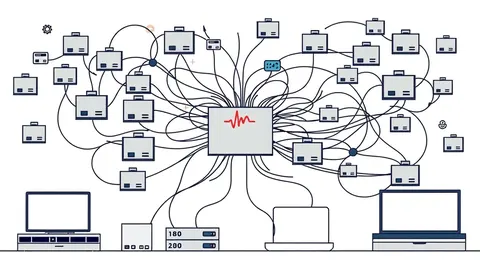
Default GraphQL servers expose your entire schema and allow deep nesting, turning every query into a potential denial-of-service vector before you write a single line of validation code.

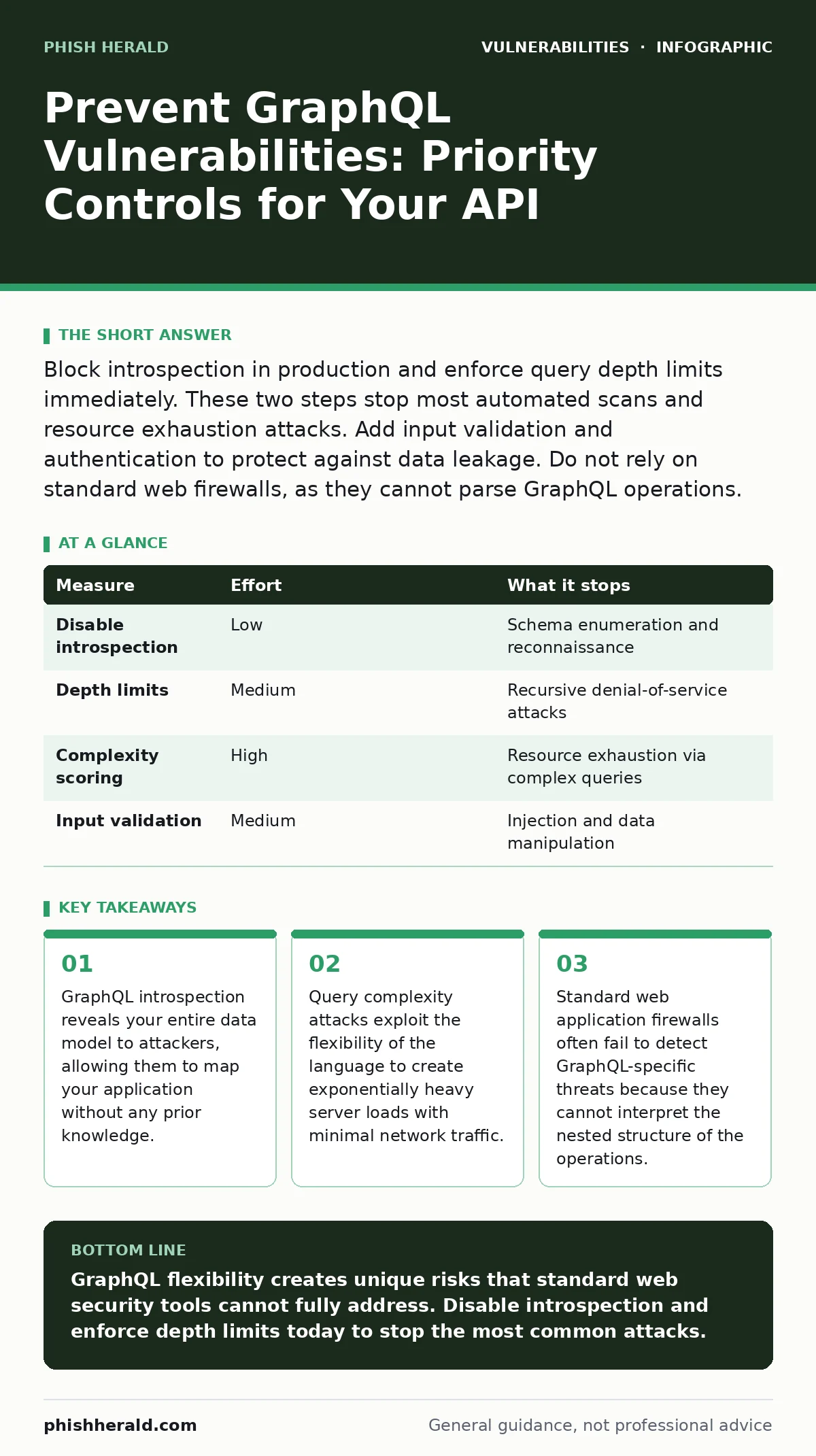
Block introspection in production and enforce query depth limits immediately. These two steps stop most automated scans and resource exhaustion attacks. Add input validation and authentication to protect against data leakage. Do not rely on standard web firewalls, as they cannot parse GraphQL operations.
Disable Introspection in Production Environments
GraphQL introspection allows clients to query the server for its schema, types and fields. This feature is invaluable during development but dangerous in production. An attacker uses introspection to map your entire data model, identifying sensitive fields and relationships. You must disable this feature for all non-development environments. This removes the map that attackers use to plan their intrusion. Without the schema, they must guess your structure, which significantly raises the barrier to entry.
Enforce Query Depth and Complexity Limits
GraphQL allows clients to request nested data structures. A single query can ask for a user, their posts, the comments on those posts and the users who wrote those comments. This recursive nesting creates exponential load on your server. Attackers exploit this by crafting deep or complex queries that consume excessive CPU and memory. You must implement depth limiting to restrict how many levels of nesting are allowed. Complexity scoring assigns a cost to each field and rejects queries that exceed a threshold. This prevents denial-of-service attacks that target your database or application logic.
| Measure | Effort | What it stops |
|---|---|---|
| Disable introspection | Low | Schema enumeration and reconnaissance |
| Depth limits | Medium | Recursive denial-of-service attacks |
| Complexity scoring | High | Resource exhaustion via complex queries |
| Input validation | Medium | Injection and data manipulation |
Validate All Input and Output Data
GraphQL queries often include variables that are merged into the final request. If you do not validate these variables, attackers can inject malicious content. This is similar to SQL injection but occurs at the application logic layer. You must validate every variable against expected types, lengths and formats. Sanitise output data before sending it to the client. This prevents stored cross-site scripting and other injection attacks. Do not trust the structure of the incoming query. Assume every value is hostile until proven otherwise.
Implement Strict Authentication and Authorisation
GraphQL endpoints often serve as a single entry point for multiple features. This centralisation means that a single authentication failure can expose vast amounts of data. You must enforce authentication on every request. More importantly, you must implement field-level authorisation. Standard role-based access control might allow a user to see a resource but not specific fields within it. Check permissions at the resolver level. This ensures that users only access data they are explicitly allowed to see. This aligns with principles of least privilege access to minimise the impact of compromised accounts.
Rate Limiting and Throttling Mechanisms
GraphQL servers are susceptible to brute-force attacks and credential stuffing. Because the API is flexible, attackers can automate queries to test thousands of credentials or tokens per minute. You must implement rate limiting based on the client identifier or IP address. Throttling slows down the rate of requests to prevent abuse. Combine this with account lockout policies after failed attempts. This adds friction to automated attacks. Monitor for unusual patterns in query frequency. Sudden spikes in request volume often indicate an ongoing attack or a misconfigured client application.
See also: Patch Prioritization Logic: How to Rank Fixes by True Risk · Hardcoded Secrets Myths: Why Common Beliefs About Source Code Risks Are Wrong
Monitor for Anomalous Query Patterns
Static controls are necessary but insufficient. You need dynamic monitoring to detect attacks that slip through your rules. Log all GraphQL queries and their variables. Analyse these logs for anomalies such as unusual depth, high complexity scores or rapid iteration over IDs. Anomalous patterns often reveal attackers probing for vulnerabilities or extracting data. Integrate this monitoring into your broader security operations. This helps you identify threats that do not match known signatures. Regular review of these logs reveals blind spots in your defence strategy.
Secure Your Deployment Configuration
How you deploy your GraphQL server affects its security posture. Misconfigurations in your hosting environment can expose the API to unintended audiences. Ensure that your server runs in a secure container or virtual machine. Keep your runtime environment updated to patch known vulnerabilities. This relates to broader concerns about Kubernetes misconfigurations where exposed services become easy targets. Review your network policies to restrict access to the GraphQL endpoint. Only allow traffic from authorised origins. This reduces the attack surface by limiting who can reach your API.
What Does Not Work for GraphQL
Many teams assume that existing web security measures are sufficient for GraphQL. This assumption is dangerous. Standard input validation libraries often fail to parse GraphQL syntax. They see the query as a single string and miss the nested logic. Similarly, caching strategies designed for REST APIs may not work well with GraphQL. Caching individual fields requires different mechanisms than caching entire resources. Understanding the difference helps you avoid false confidence. You must tailor your defence to the specific mechanics of the protocol.
Immediate Action Checklist
You need to act quickly to reduce your exposure. These three steps provide the most significant risk reduction with minimal effort. Start with these before implementing more complex solutions. They address the most common and damaging attack vectors.
- Disable introspection in all production and staging environments.
- Implement depth limits to restrict nested query structures.
- Audit your authentication and authorisation logic for field-level checks.
Key takeaways
- GraphQL introspection reveals your entire data model to attackers, allowing them to map your application without any prior knowledge.
- Query complexity attacks exploit the flexibility of the language to create exponentially heavy server loads with minimal network traffic.
- Standard web application firewalls often fail to detect GraphQL-specific threats because they cannot interpret the nested structure of the operations.
GraphQL flexibility creates unique risks that standard web security tools cannot fully address. Disable introspection and enforce depth limits today to stop the most common attacks.
Frequently asked questions
Does GraphQL eliminate the need for REST APIs?
No, GraphQL complements REST by offering flexible data fetching. You should choose based on your application's needs, not security alone. Both require specific security controls.
Can I use a standard WAF for GraphQL?
Standard WAFs often fail to parse GraphQL operations. You need a WAF with specific GraphQL support or custom rules to detect nested injection and complexity attacks.
How do I prevent data leakage in GraphQL?
Implement field-level authorisation to ensure users only access permitted data. Validate all inputs and monitor queries for anomalous patterns that indicate data exfiltration.
Is GraphQL slower than REST?
GraphQL can be more efficient by reducing over-fetching. However, complex queries can increase server load. Proper caching and complexity limits are required to maintain performance.
How this guide was produced: written by the Phish Herald editorial team with AI assistance, checked against the public references listed below, and reviewed when the facts change. See our editorial policy or report an error.