Hardcoded Secrets Myths: Why Common Beliefs About Source Code Risks Are Wrong
Obfuscation does not secure secrets, and build-time injection fails when infrastructure pipelines lack strict isolation controls.

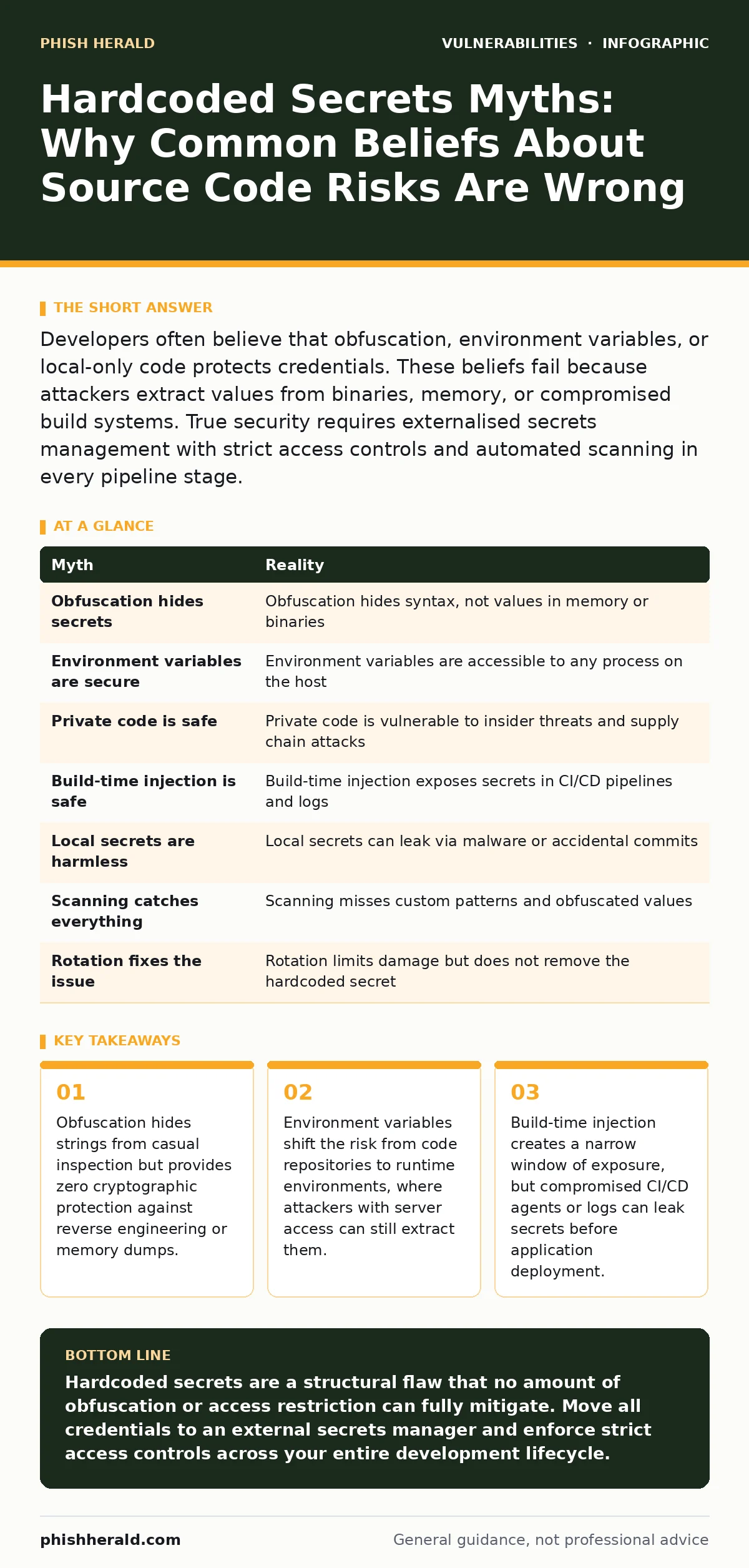
Developers often believe that obfuscation, environment variables, or local-only code protects credentials. These beliefs fail because attackers extract values from binaries, memory, or compromised build systems. True security requires externalised secrets management with strict access controls and automated scanning in every pipeline stage.
Myth: Obfuscation Hides Secrets From Attackers
Reality: Obfuscation transforms code into a difficult-to-read format, but it does not encrypt data. An attacker with access to the compiled binary can still extract the secret. Modern reverse engineering tools automate the process of finding string literals and constant values within memory or binary files. You might rename variables or split strings to confuse static analysis, but dynamic analysis reveals the value when the application runs.
The secret exists in plaintext in the process memory at some point. If an attacker gains execution privileges on the host, they can dump the memory and read the credential directly. Obfuscation adds friction, not security. It slows down manual review but fails against automated extraction scripts. Relying on obscurity as a primary control is a fundamental architectural error. You must assume the binary is fully visible to the adversary.
Myth: Environment Variables Are Secure Enough
Reality: Environment variables store secrets outside the source code repository, which is an improvement over hardcoding. However, they remain accessible to any process running on the same host with sufficient privileges. An attacker who exploits a vulnerability in your application can often read the process environment. This technique bypasses file system permissions entirely.
If your application runs on a shared server or a compromised container, the attacker can list environment variables and retrieve API keys, database passwords, or tokens. The secret is still in the runtime environment, just not in the Git history. You need to restrict access to the runtime environment itself. Isolation mechanisms like containers help, but they do not stop an attacker who has already breached the application logic. Environment variables are a transport mechanism, not a vault.
Myth: Secrets Are Safe If Code Is Not Public
Reality: Private repositories do not prevent insider threats or supply chain compromises. Developers with access to the codebase can copy secrets, and their local machines may be infected with malware that exfiltrates files. Third-party libraries or build tools with access to the repository can also leak credentials. If a contractor leaves with a laptop containing the source code, the secrets go with them.
Furthermore, private repositories are not immune to accidental exposure through error logs, support tickets, or version control mishaps. The assumption that "private" means "secure" ignores the human element and the complexity of modern development workflows. You must treat all code as potentially exposed. Secrets management should not depend on repository visibility settings. Externalise secrets to a dedicated service that enforces access controls regardless of who holds the code.
Myth: Build-Time Injection Eliminates Exposure
Reality: Injecting secrets during the build process keeps them out of the source code. The build system retrieves the secret and embeds it into the application artifact. This method fails if the build environment is compromised. Attackers targeting CI/CD pipelines can intercept secrets during the injection phase. They can also access build logs, which often contain sensitive data if not carefully sanitised.
If the build agent is shared or misconfigured, secrets from one project can leak into another. The window of exposure shifts from the repository to the pipeline. You must secure the build infrastructure with the same rigor as the runtime. Use ephemeral build agents that are destroyed after each run. Ensure that logs are scrubbed of sensitive values. Build-time injection is a step forward, but it introduces new attack surfaces that require dedicated monitoring and hardening.
Myth: Local Development Secrets Are Insignificant
Reality: Developers often use dummy or test credentials in local environments, believing they pose no risk. These secrets often mirror production structures or share naming conventions. If a developer accidentally commits a local configuration file, it may contain pointers to real services or reusable patterns. More critically, local development environments are frequently less secured than production servers. Malware on a developer's machine can harvest these secrets.
If the local secret grants access to a staging environment that connects to production data, the impact is severe. You must enforce the same secrets management standards in development as in production. Use local secret managers that store credentials in encrypted local storage, not in plain text files. Treat every environment as a potential breach vector. Consistency in security practices prevents gaps that attackers exploit to move laterally.
See also: Apache Struts Vulnerabilities: Real Questions Answered for Secure Infrastructure · VPN Appliance Vulnerabilities: 7 Mistakes That Leave You Exposed
Myth: Scanning Tools Catch All Hardcoded Secrets
Reality: Static analysis tools detect known patterns of secrets, such as AWS keys or generic password strings. They miss custom encryption keys, obfuscated values, or secrets generated at runtime. False negatives leave gaps in your defence. False positives create alert fatigue, causing engineers to ignore warnings. Relying solely on automated scanning is insufficient.
You must combine scanning with manual code reviews and threat modeling. Developers need to understand why certain patterns are dangerous. Training reduces the likelihood of introducing secrets in the first place. Integrating scans into the pull request process stops bad code from merging, but it does not fix existing code in older branches. Regular audits of legacy code are necessary. Tools are aids, not replacements for disciplined development practices.
Myth: Rotating Secrets Fixes the Root Cause
Reality: Rotating secrets invalidates old credentials, limiting the duration of an attack. It does not remove the secret from the codebase. If the secret is still hardcoded, the next rotation cycle repeats the exposure. Attackers can capture the new secret before rotation takes effect. Frequent rotation increases operational overhead and risk of misconfiguration. It treats the symptom, not the disease.
You must remove the secret from the code entirely. Use a secrets manager that provides dynamic credentials or short-lived tokens. This approach ensures that secrets are never stored in static configuration. Rotation is a mitigation strategy, not a solution. Integrating with a secrets manager allows for automatic rotation without code changes. This reduces the attack surface and simplifies compliance.
| Myth | Reality |
|---|---|
| Obfuscation hides secrets | Obfuscation hides syntax, not values in memory or binaries |
| Environment variables are secure | Environment variables are accessible to any process on the host |
| Private code is safe | Private code is vulnerable to insider threats and supply chain attacks |
| Build-time injection is safe | Build-time injection exposes secrets in CI/CD pipelines and logs |
| Local secrets are harmless | Local secrets can leak via malware or accidental commits |
| Scanning catches everything | Scanning misses custom patterns and obfuscated values |
| Rotation fixes the issue | Rotation limits damage but does not remove the hardcoded secret |
Key takeaways
- Obfuscation hides strings from casual inspection but provides zero cryptographic protection against reverse engineering or memory dumps.
- Environment variables shift the risk from code repositories to runtime environments, where attackers with server access can still extract them.
- Build-time injection creates a narrow window of exposure, but compromised CI/CD agents or logs can leak secrets before application deployment.
Hardcoded secrets are a structural flaw that no amount of obfuscation or access restriction can fully mitigate. Move all credentials to an external secrets manager and enforce strict access controls across your entire development lifecycle.
Frequently asked questions
How do I find hardcoded secrets in legacy code?
Use static application security testing tools configured to scan your entire repository history. Combine automated scans with manual reviews of configuration files and deployment scripts.
Can I use a database to store secrets?
Storing secrets in a database is better than hardcoding, but the database must be heavily secured. Use encryption at rest and in transit. A dedicated secrets manager is generally more secure and easier to manage.
What is the best way to handle secrets in containerised applications?
Inject secrets into containers at runtime using orchestrator features. Avoid baking secrets into container images. Use environment variables or mounted volumes with strict permissions.
How does least privilege access help with secrets?
Least privilege access ensures that only the necessary components can access specific secrets. This limits the blast radius if a component is compromised. It prevents lateral movement by restricting access rights.
How this guide was produced: written by the Phish Herald editorial team with AI assistance, checked against the public references listed below, and reviewed when the facts change. See our editorial policy or report an error.