Apache Struts Vulnerabilities: Real Questions Answered for Secure Infrastructure
Remote code execution flaws in Apache Struts often bypass perimeter defences because the framework processes malicious data before standard input validation occurs.

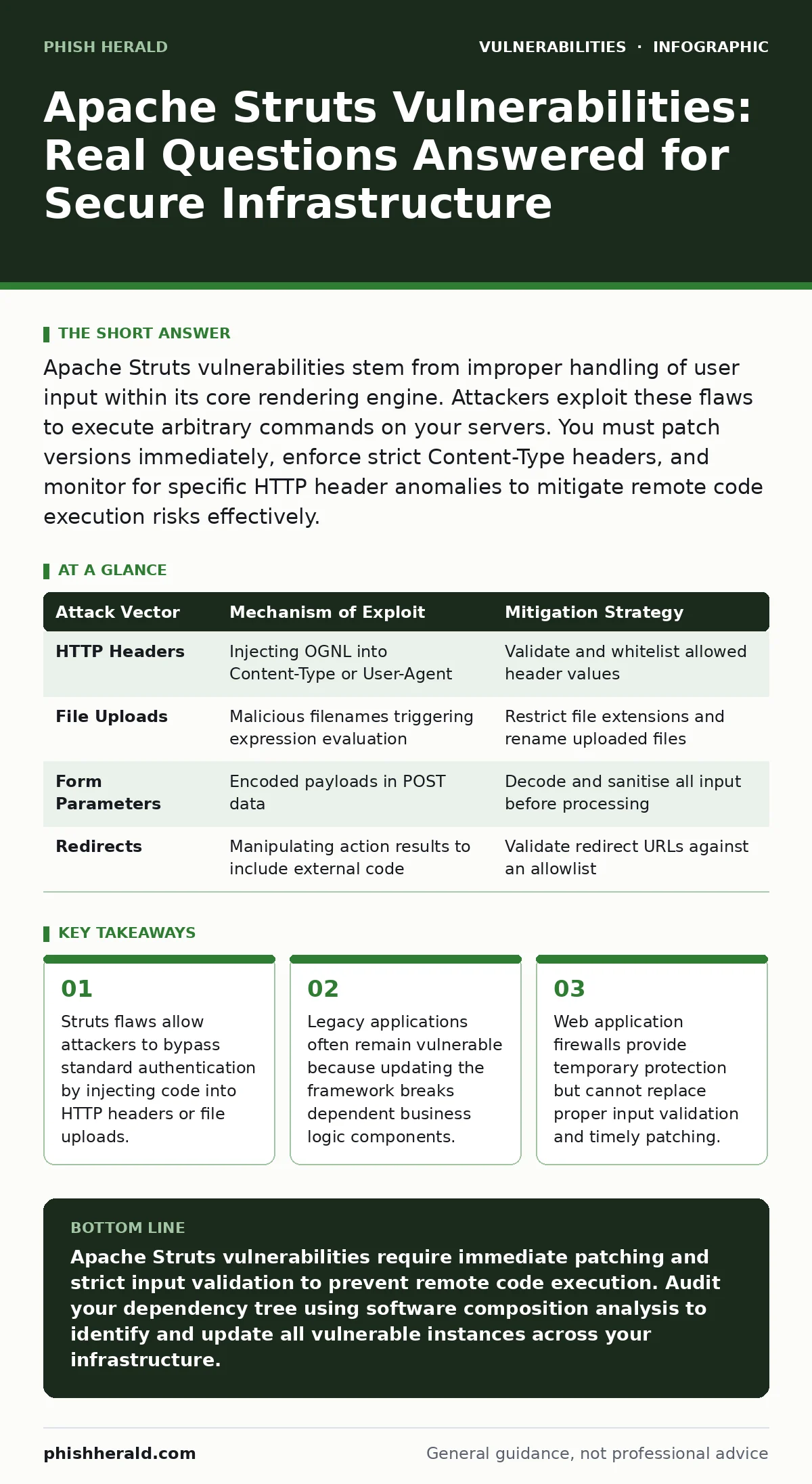
Apache Struts vulnerabilities stem from improper handling of user input within its core rendering engine. Attackers exploit these flaws to execute arbitrary commands on your servers. You must patch versions immediately, enforce strict Content-Type headers, and monitor for specific HTTP header anomalies to mitigate remote code execution risks effectively.
What makes Apache Struts vulnerable to remote code execution?
Apache Struts vulnerabilities arise because the framework processes user-supplied data using powerful expression languages before sanitising that input. The core issue is not just bad coding practices within your application, but a fundamental trust in data received from the network. When the framework evaluates expressions to render views or handle requests, it executes logic that can access system resources. This design allows an attacker to inject malicious commands that the server treats as legitimate instructions. The vulnerability exists at the library level, meaning every application using that version inherits the risk regardless of your own security measures.
How do attackers exploit these flaws without user interaction?
Attackers exploit these flaws by crafting HTTP requests that contain malicious payloads in specific headers or parameters. Unlike phishing attacks that require a user to click a link, these exploits target the server directly. The attacker sends a request with an OGNL expression embedded in a Content-Type header or a file upload field. The server processes this header to determine how to handle the request body, triggering the execution of the injected code before any user session is established. This means the attack succeeds purely through network interaction with the vulnerable endpoint.
Why does patching Apache Struts break existing applications?
Patching Apache Struts often breaks existing applications because the framework undergoes significant changes between major versions that alter how it handles request mapping and result rendering. Developers frequently rely on undocumented behaviours or deprecated features that newer patches remove for security reasons. When you upgrade the library, your application’s configuration files may no longer align with the new expectations of the framework. This creates a hidden maintenance cost where IT teams must refactor code to ensure compatibility. The risk of downtime often leads organisations to delay updates, leaving them exposed to known exploits for extended periods.
Can web application firewalls stop Struts attacks?
Web application firewalls can stop Struts attacks by identifying and blocking requests that match known exploit signatures, but they are not a permanent solution. These devices inspect incoming traffic for patterns associated with OGNL injection, such as specific character sequences or unusual header structures. However, attackers can obfuscate their payloads to evade signature-based detection. A firewall provides a temporary shield while you work on patching, but it cannot interpret the context of your application’s logic. Relying solely on this layer creates a false sense of security against sophisticated, customised attacks that bypass static rules.
| Attack Vector | Mechanism of Exploit | Mitigation Strategy |
|---|---|---|
| HTTP Headers | Injecting OGNL into Content-Type or User-Agent | Validate and whitelist allowed header values |
| File Uploads | Malicious filenames triggering expression evaluation | Restrict file extensions and rename uploaded files |
| Form Parameters | Encoded payloads in POST data | Decode and sanitise all input before processing |
| Redirects | Manipulating action results to include external code | Validate redirect URLs against an allowlist |
What is the role of input validation in preventing these exploits?
Input validation serves as the primary defence by ensuring that only expected data formats reach the Struts framework. You must validate data at the boundary where it enters your application, not after the framework has processed it. This involves checking length, type, format, and range of all user inputs. If an attacker sends a string where a number is expected, the validation layer rejects it immediately. This prevents the malicious payload from ever reaching the expression language evaluator. Proper validation reduces the attack surface by eliminating the possibility of unexpected data structures triggering unintended code paths.
How do open redirect vulnerabilities relate to Struts security?
Open redirect vulnerabilities often coexist with Struts misconfigurations because the framework’s result type can redirect users to arbitrary URLs if not properly constrained. An attacker can manipulate the redirect parameter to send users to a malicious site, which is often a precursor to credential harvesting or session hijacking. While this does not directly execute code on the server, it undermines the trust model of your application. You must validate that redirect targets are internal or belong to a predefined whitelist of external domains. This prevents attackers from using your server as a trusted launchpad for further social engineering campaigns.
Why is threat modeling critical for Struts-based architectures?
Threat modeling is critical for Struts-based architectures because it helps you identify where untrusted data enters the system and how it flows through the framework. By mapping the data flow, you can spot weak points where OGNL evaluation occurs without sufficient sanitisation. This process reveals dependencies on legacy components that may no longer receive security updates. It also highlights the need for defence-in-depth strategies, such as combining input validation with output encoding. Without a structured approach to understanding your application’s data handling, you cannot effectively prioritise which fixes will reduce the most significant risks.
How does software composition analysis help manage Struts risks?
Software composition analysis helps manage Struts risks by continuously monitoring the open-source libraries your application depends on for known vulnerabilities. This tool scans your project’s dependency tree to identify if you are using a vulnerable version of Struts or other components. It provides alerts when new patches are released, allowing you to plan updates before an exploit becomes widespread. This proactive approach reduces the mean time to remediation by automating the discovery process. You gain visibility into the entire software supply chain, ensuring that no hidden vulnerable library remains in your production environment.
What is the hidden cost of delaying Struts updates?
The hidden cost of delaying Struts updates is the accumulation of technical debt that makes future patches more difficult and risky to implement. As your application evolves, it becomes more tightly coupled with the specific version of the framework you are running. This coupling means that when you finally decide to update, you must rewrite significant portions of your code to accommodate changes in the new version. The longer you wait, the more complex the refactoring becomes, increasing the likelihood of introducing new bugs during the update process. This delay also exposes your organisation to a growing number of known exploits that are actively used by automated scanning tools.
How do these vulnerabilities differ from WordPress plugin issues?
These vulnerabilities differ from WordPress plugin issues because Struts flaws reside in the core framework used to build enterprise applications, whereas WordPress vulnerabilities often stem from third-party plugins developed by external authors. Struts issues require a deeper understanding of Java and request processing pipelines, making them harder to patch without professional expertise.
WordPress vulnerabilities are more numerous but often easier to mitigate by disabling unused plugins. The impact of a Struts exploit is typically more severe, granting full server control, while a plugin flaw might only compromise the web interface. Understanding this distinction helps you allocate resources appropriately for different types of web applications.
Key takeaways
- Struts flaws allow attackers to bypass standard authentication by injecting code into HTTP headers or file uploads.
- Legacy applications often remain vulnerable because updating the framework breaks dependent business logic components.
- Web application firewalls provide temporary protection but cannot replace proper input validation and timely patching.
Apache Struts vulnerabilities require immediate patching and strict input validation to prevent remote code execution. Audit your dependency tree using software composition analysis to identify and update all vulnerable instances across your infrastructure.
Frequently asked questions
How do I know if my Struts version is vulnerable?
Check the version number against the official Apache Struts security advisories. Any version prior to the latest stable release may contain known remote code execution flaws that require immediate attention.
Can I mitigate Struts risks without updating the framework?
You can mitigate risks by enforcing strict input validation, limiting HTTP methods, and using web application firewalls to block known exploit patterns. However, these measures are temporary and do not eliminate the underlying vulnerability.
What is OGNL and why is it dangerous?
OGNL is the Object-Graph Navigation Language used by Struts to evaluate expressions. It is dangerous because it allows code execution within the context of the application, enabling attackers to run arbitrary commands on the server.
Do these vulnerabilities affect mobile applications?
These vulnerabilities affect the server-side backend that mobile applications connect to. If your mobile app communicates with a Struts-based API, the server is vulnerable regardless of the client device or platform used.
How this guide was produced: written by the Phish Herald editorial team with AI assistance, checked against the public references listed below, and reviewed when the facts change. See our editorial policy or report an error.