Warning Signs of Insecure Cloud APIs for Secure Architecture
API security failures often hide in silent authentication gaps and overly permissive data endpoints rather than loud intrusion alerts.
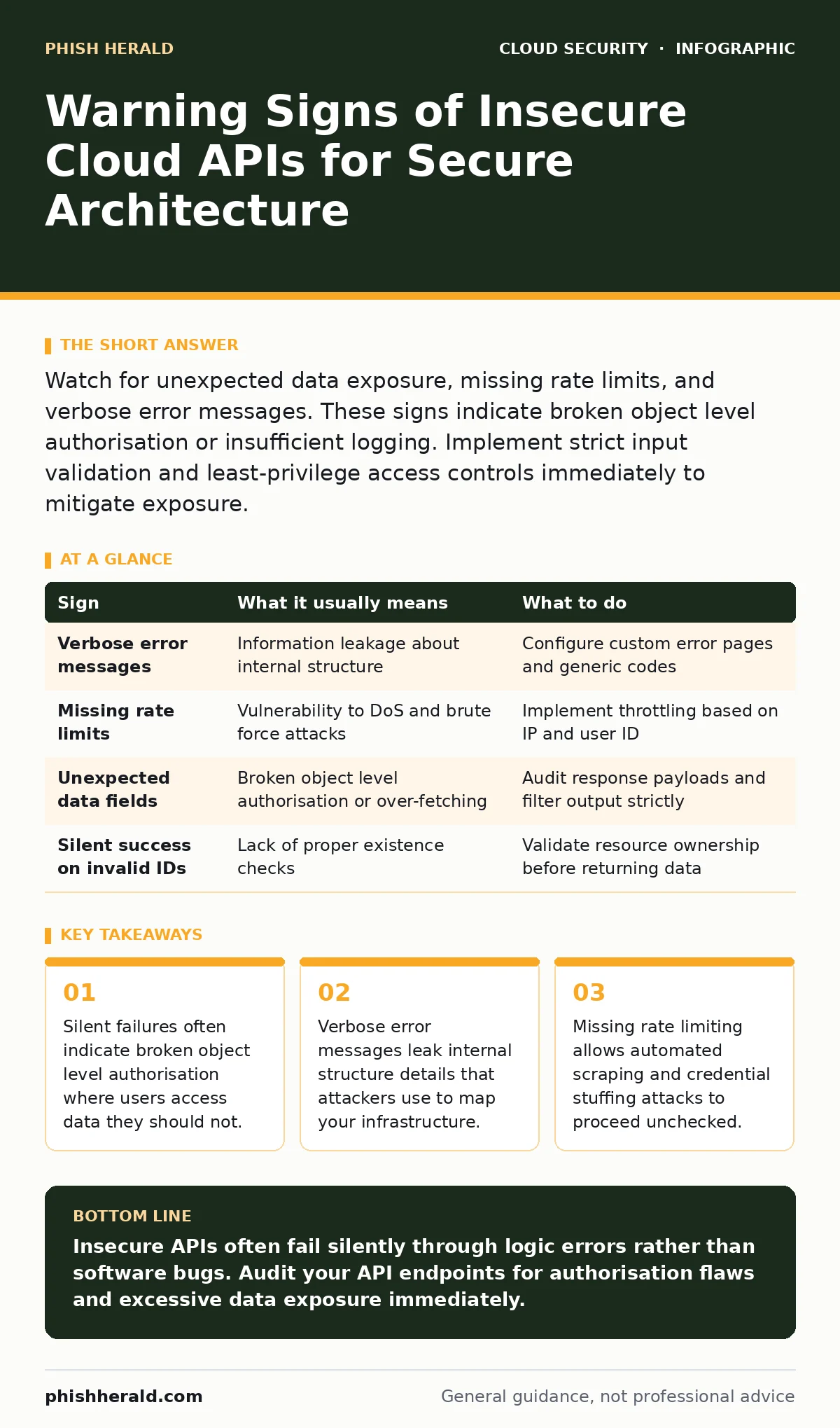
Watch for unexpected data exposure, missing rate limits, and verbose error messages. These signs indicate broken object level authorisation or insufficient logging. Implement strict input validation and least-privilege access controls immediately to mitigate exposure.
The Illusion of Secure Endpoints
Cloud APIs are the primary interface for your infrastructure. They allow applications to communicate with cloud services and each other. Many teams assume that because the cloud provider secures the underlying hardware, the API layer is safe. This assumption is dangerous. The API logic you write or configure determines who sees what data. A breach here often bypasses traditional perimeter defences entirely.
Obvious Indicators of Weakness
Some signs of insecurity are visible during routine testing or monitoring. If an API returns full database records when only a summary was requested, you have a mass assignment vulnerability. This occurs when the API accepts more data fields than intended during an update or creation request. Another clear sign is the absence of rate limiting. If you can make thousands of requests per second without triggering a block, your system is vulnerable to denial of service attacks.
Verbose error messages are another red flag. If an API returns stack traces or internal variable names when a request fails, it reveals your technology stack. Attackers use this information to tailor their exploits. You should see generic error codes like "Bad Request" or "Internal Server Error" in production environments. Detailed debugging information belongs only in development logs.
Subtle Signs That Slip Past Audits
Not all vulnerabilities are loud. Some hide in plain sight within normal operations. Broken object level authorisation is particularly insidious. This happens when an API endpoint checks if a user is logged in but fails to check if that user owns the specific resource they are requesting. Imagine a user changing their ID parameter from 101 to 102 and successfully viewing another user's profile. This often goes unnoticed because the application functions correctly for authorised users.
Another subtle issue is excessive data exposure. APIs often return entire database objects to the client. The client-side application may only display a few fields, but the JSON response contains everything. This includes internal IDs, timestamps, and sometimes sensitive metadata. Attackers can harvest this data to understand your data model. You might also see signs of improper assets management. Old API versions remain active because decommissioning them requires coordination across multiple teams. These legacy endpoints often lack modern security patches.
Understanding the Root Causes
These issues stem from a misunderstanding of trust boundaries. Developers often treat the API client as trusted. They assume that if a user has a valid session token, they can access any resource. This ignores the principle of least privilege. The API must verify ownership for every single request. Additionally, teams often prioritise functionality over security during initial development. Security controls are added later, sometimes as an afterthought. This leads to gaps in input validation and output encoding.
The complexity of cloud environments exacerbates these problems. With microservices, an API call might traverse several internal services. Each hop is a potential point of failure. If one service fails to validate input, the entire chain is compromised. This is why understanding your architecture is critical. You cannot secure what you do not fully map. For deeper insights into access control issues, review our guide on misconfigured IAM roles.
Immediate Remediation Steps
When you identify a potential vulnerability, act quickly. First, isolate the affected endpoint if possible. Disable it or restrict access to known IP addresses while you investigate. Do not ignore the issue hoping it will resolve itself. Next, review the code handling the request. Look for where input is accepted and where authorisation checks occur. Ensure that every input is validated against a strict schema. Reject any data that does not match expected formats.
Implement strict output filtering. Only send the data fields that the client explicitly needs. Use data transformation layers to strip away unnecessary information. Add rate limiting to all public-facing endpoints. This prevents abuse even if other vulnerabilities exist. Finally, update your logging. Ensure that all API requests, including failed ones, are recorded with sufficient detail for forensic analysis. This helps you detect attacks in progress.
| Sign | What it usually means | What to do |
|---|---|---|
| Verbose error messages | Information leakage about internal structure | Configure custom error pages and generic codes |
| Missing rate limits | Vulnerability to DoS and brute force attacks | Implement throttling based on IP and user ID |
| Unexpected data fields | Broken object level authorisation or over-fetching | Audit response payloads and filter output strictly |
| Silent success on invalid IDs | Lack of proper existence checks | Validate resource ownership before returning data |
See also: Stop Exposed Storage Buckets: 3 Cloud Security Fixes That Work · Cloud Data Exfiltration: 6 Myths That Leave Your Assets Vulnerable
Long-Term Prevention Strategies
Preventing insecure APIs requires a shift in development culture. Security must be integrated into the design phase. Use automated tools to scan for common API vulnerabilities during continuous integration. These tools can detect issues like missing authentication or insecure transport layers. However, tools cannot replace human judgment. Regular code reviews focused on security logic are necessary.
Consider adopting a zero-trust model for your APIs. Never trust a request, even if it comes from within your network. Verify every request independently. This approach reduces the blast radius of a compromised component. For organisations managing complex encryption requirements, our guide on bring your own key encryption offers further context on data protection.
Monitoring and Continuous Improvement
Security is not a one-time task. You must continuously monitor your API traffic. Look for anomalies in request patterns. Sudden spikes in traffic or unusual data access patterns may indicate an active attack. Set up alerts for these events. Regularly test your APIs with penetration testing. This helps identify new vulnerabilities as your application evolves.
Remember that third-party dependencies also pose risks. If your API relies on external services, ensure they meet your security standards. Review their security documentation and incident response plans. For broader infrastructure security, consider reading about cloud-native application protection platforms (CNAPP) to see how holistic monitoring works.
Key takeaways
- Silent failures often indicate broken object level authorisation where users access data they should not.
- Verbose error messages leak internal structure details that attackers use to map your infrastructure.
- Missing rate limiting allows automated scraping and credential stuffing attacks to proceed unchecked.
Insecure APIs often fail silently through logic errors rather than software bugs. Audit your API endpoints for authorisation flaws and excessive data exposure immediately.
Frequently asked questions
How do I detect broken object level authorisation?
Test by accessing resources with different user accounts and IDs. If a user can access data they do not own, the authorisation logic is flawed.
Is rate limiting enough to secure an API?
No. Rate limiting prevents abuse but does not fix logic errors like missing authentication or data leakage. You need layered security controls.
Should I disable old API versions?
Yes. Legacy versions often lack security updates. Plan a migration strategy to move users to the latest secure version and decommission old endpoints.
What is the first step in securing a new API?
Define a clear security policy. Identify what data is sensitive, who should access it, and how authentication and authorisation will be enforced before writing code.
How this guide was produced: written by the Phish Herald editorial team with AI assistance, checked against the public references listed below, and reviewed when the facts change. See our editorial policy or report an error.