Service Mesh Security Checklist for Secure Microservices
Misconfigured sidecars often expose internal traffic to the internet, turning your service mesh into an unauthorised data exfiltration channel rather than a security boundary.
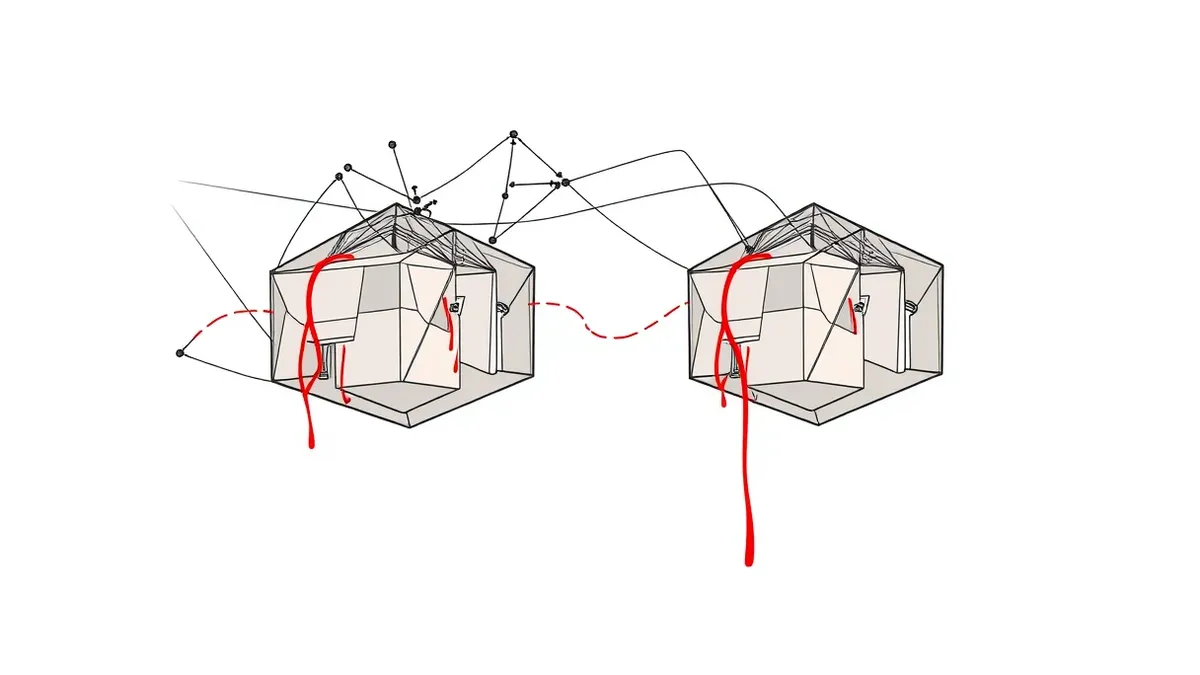
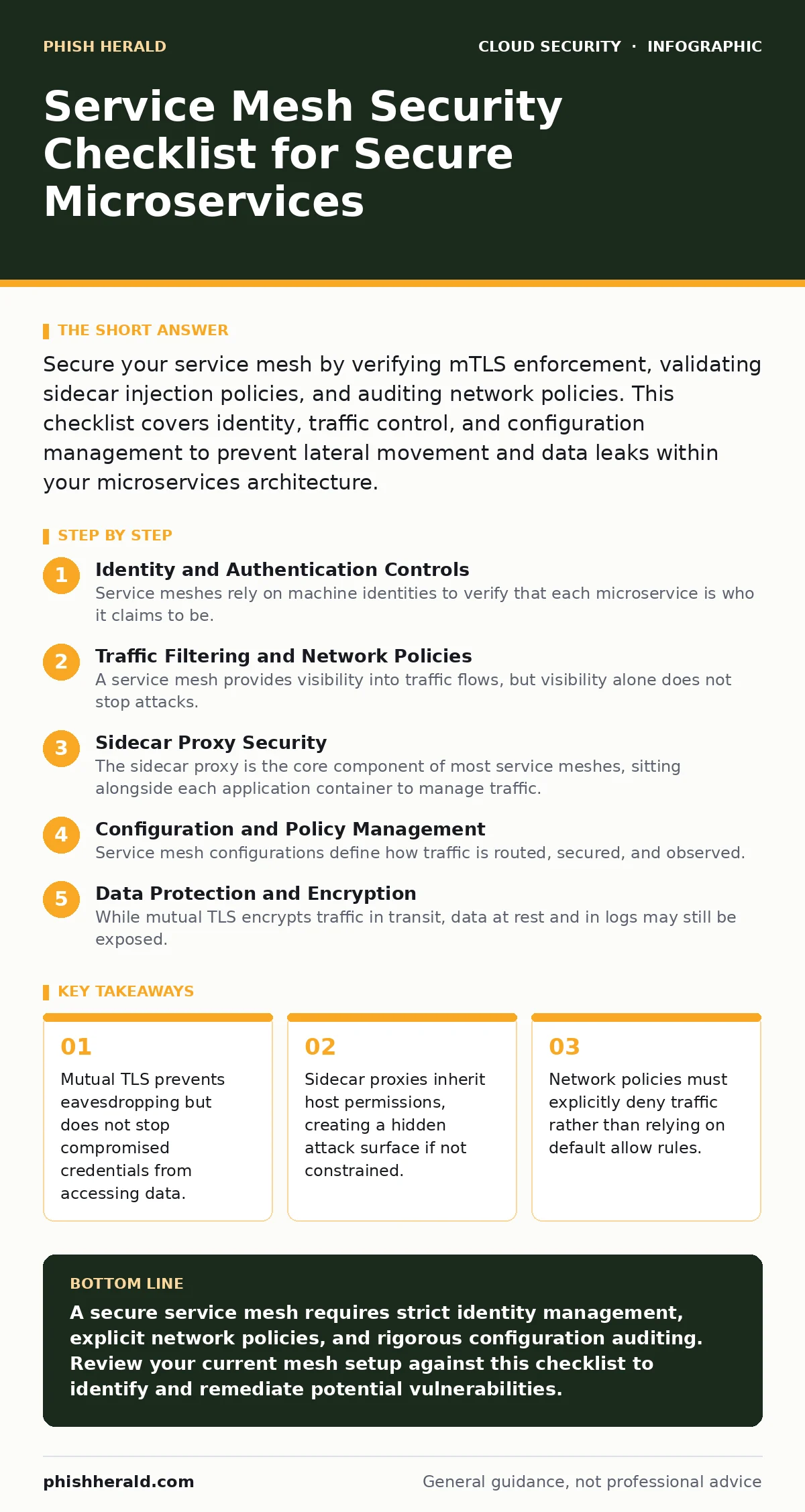
Secure your service mesh by verifying mTLS enforcement, validating sidecar injection policies, and auditing network policies. This checklist covers identity, traffic control, and configuration management to prevent lateral movement and data leaks within your microservices architecture.
Identity and Authentication Controls
Service meshes rely on machine identities to verify that each microservice is who it claims to be. Without strict identity management, an attacker who compromises one service can impersonate others to access sensitive data. You must ensure that every workload possesses a unique, short-lived credential. These credentials should rotate automatically to limit the window of exposure if a secret is stolen.
- Enforce mutual TLS (mTLS) for all east-west traffic: Mutual TLS requires both client and server to present certificates, preventing man-in-the-middle attacks where an attacker intercepts data between services.
- Validate certificate transparency logs: Monitoring transparency logs helps you detect if a rogue certificate authority has issued a certificate for your domain, allowing you to revoke it before an attacker uses it.
- Bind identities to workloads, not hosts: Tying security credentials to the specific application instance rather than the underlying server ensures that compromised servers cannot reuse old identities to access other services.
Imagine a scenario where a developer accidentally deploys a debug container with elevated privileges. If that container inherits the host’s identity, it can bypass service-level restrictions. This is why binding identities to workloads is critical. For deeper insights on managing these permissions, review our guide on least privilege in the cloud.
Traffic Filtering and Network Policies
A service mesh provides visibility into traffic flows, but visibility alone does not stop attacks. You must actively filter traffic to ensure that only authorised communications occur between services. Default allow policies are dangerous because they permit any service to talk to any other service by default. You must implement explicit deny rules for all traffic that is not explicitly required.
- Define strict network policies for each namespace: Explicitly listing allowed ingress and egress connections prevents lateral movement when an attacker compromises a single service within your cluster.
- Restrict external ingress to authorised endpoints: Limiting which services can receive traffic from outside the mesh reduces the attack surface exposed to the public internet and minimises opportunities for exploitation.
- Monitor and alert on unexpected traffic patterns: Detecting sudden spikes in traffic or connections to unknown IPs helps you identify compromised services before they cause significant damage or data loss.
Sidecar Proxy Security
The sidecar proxy is the core component of most service meshes, sitting alongside each application container to manage traffic. Because it handles all network communication, it becomes a high-value target for attackers. If a sidecar is misconfigured or compromised, it can intercept, modify, or block traffic between services. You must treat the sidecar with the same security scrutiny as the application it supports.
- Limit sidecar resource quotas: Restricting CPU and memory usage prevents a compromised sidecar from consuming excessive resources and causing a denial of service for other critical applications in the cluster.
- Disable unused sidecar features: Turning off features like access logging or tracing in production environments reduces the attack surface and prevents sensitive data from being exposed in logs or metrics.
- Regularly update sidecar images: Keeping proxy software up to date ensures you have the latest security patches, protecting against known vulnerabilities that could allow remote code execution or privilege escalation.
For more on managing the risks associated with containerised components, see our guide on insecure container images.
Configuration and Policy Management
Service mesh configurations define how traffic is routed, secured, and observed. Incorrect configurations can lead to data leaks, service outages, or security bypasses. You must treat configuration files as code, subjecting them to the same review and testing processes as application code. Automated validation tools can help catch errors before they reach production.
- Audit mesh control plane permissions: Ensuring that only authorised users can modify mesh configurations prevents malicious actors from altering routing rules or disabling security features like mutual TLS.
- Validate virtual service definitions: Checking that virtual services correctly map to intended backends prevents traffic from being routed to unintended or unsecured destinations, which could expose sensitive data.
- Implement policy-as-code workflows: Using infrastructure-as-code tools to manage mesh policies ensures consistency, traceability, and reproducibility, reducing the risk of manual configuration errors that could compromise security.
See also: Cloud Data Exfiltration: 6 Myths That Leave Your Assets Vulnerable · Cloud Least Privilege: Answers to 8 Critical Implementation Questions
Data Protection and Encryption
While mutual TLS encrypts traffic in transit, data at rest and in logs may still be exposed. You must ensure that sensitive data is protected throughout its lifecycle. Encryption keys must be managed securely, and logging practices must prevent the accidental exposure of credentials or personal information.
- Use external key management for encryption keys: Storing encryption keys outside the mesh control plane reduces the risk of key compromise if the control plane is attacked, ensuring that data remains protected.
- Mask sensitive data in access logs: Preventing credentials, tokens, or personal information from appearing in logs reduces the risk of data leaks if log files are accessed by unauthorised users.
- Enable end-to-end encryption for sensitive payloads: Encrypting application data before it reaches the mesh ensures that even if the mesh is compromised, the underlying data remains unreadable to attackers.
For best practices on managing encryption keys, refer to our guide on bring your own key encryption.
Key takeaways
- Mutual TLS prevents eavesdropping but does not stop compromised credentials from accessing data.
- Sidecar proxies inherit host permissions, creating a hidden attack surface if not constrained.
- Network policies must explicitly deny traffic rather than relying on default allow rules.
A secure service mesh requires strict identity management, explicit network policies, and rigorous configuration auditing. Review your current mesh setup against this checklist to identify and remediate potential vulnerabilities.
Frequently asked questions
Does a service mesh replace a firewall?
No, a service mesh secures communication between services within a cluster, while a firewall controls traffic at the network perimeter. Both are needed for a defence-in-depth strategy.
How often should I rotate service mesh certificates?
Certificates should rotate frequently, ideally every few hours or days, to limit the impact of a compromised credential. Automated rotation is recommended to avoid service disruptions.
Can a service mesh protect against application-layer attacks?
Service meshes primarily secure transport-layer communications. They do not inspect application payloads for vulnerabilities like SQL injection. You need web application firewalls for that protection.
What is the risk of disabling mutual TLS?
Disabling mutual TLS allows unencrypted traffic between services, making it easy for attackers to intercept data or impersonate services. It significantly increases the risk of data breaches and lateral movement.
How this guide was produced: written by the Phish Herald editorial team with AI assistance, checked against the public references listed below, and reviewed when the facts change. See our editorial policy or report an error.