HTTP Request Smuggling Recovery: Immediate Steps to Stabilise and Secure
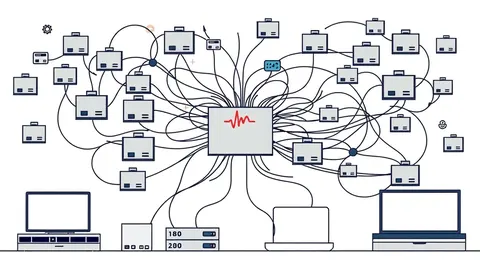
Misinterpreted delimiters can desynchronise proxy queues, allowing attackers to bypass security controls and access data belonging to other users.
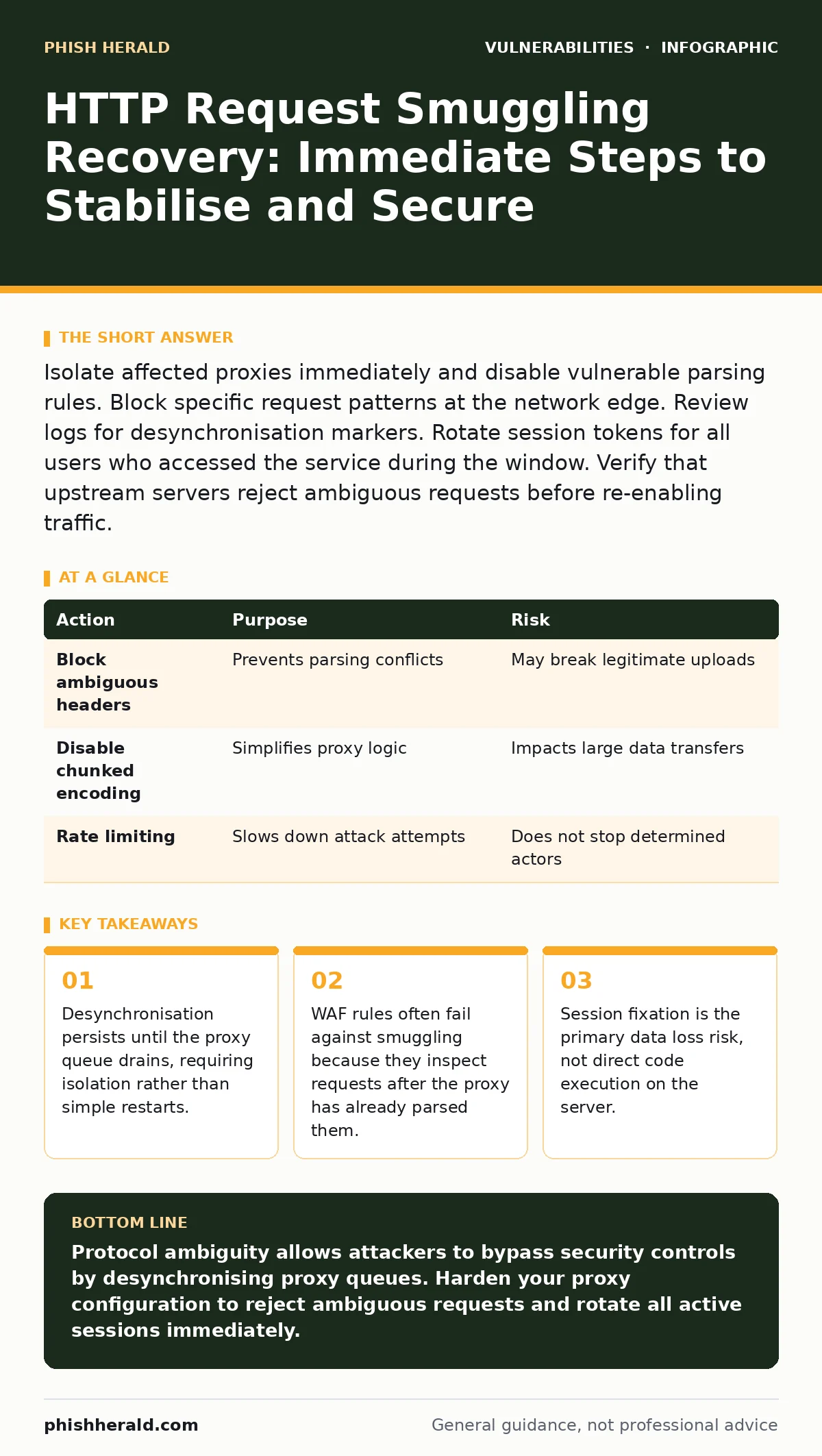
Isolate affected proxies immediately and disable vulnerable parsing rules. Block specific request patterns at the network edge. Review logs for desynchronisation markers. Rotate session tokens for all users who accessed the service during the window. Verify that upstream servers reject ambiguous requests before re-enabling traffic.
First hour
The clock starts when you detect the anomaly. HTTP request smuggling occurs when different components of your infrastructure parse the same HTTP request differently. One component may see one request, while the next sees two. This difference breaks the sequence of user interactions.
Your first priority is to stop new requests from entering the desynchronised queue. You must isolate the affected edge devices. If you use a web application firewall, ensure it is not bypassed by the smuggling technique. Many firewalls inspect traffic after the proxy has parsed it, meaning they see the "clean" view, not the malicious one.
- Identify the specific proxy or reverse proxy handling the traffic.
- Enable a temporary block for requests containing ambiguous delimiters.
- Check for signs of queue desynchronisation in access logs.
- Notify the incident response team and legal counsel.
- Preserve raw packet captures for forensic analysis.
You need to look for patterns in the logs that indicate multiple responses for a single request ID. This is a hallmark of the attack. If you see a request followed by an unexpected response from a different user's session, you have confirmed the exploit. Do not assume the attack is finished. The attacker may be waiting for the queue to desynchronise further.
Containment strategies
Containment requires more than blocking an IP address. The attack relies on protocol ambiguity, not just a single source. You must prevent the proxy from accepting requests that can be parsed in multiple ways. This often means tightening the configuration of the reverse proxy itself.
Look for settings that allow chunked transfer encoding and content-length headers to coexist. This combination is a common vector for smuggling. Disable one of these methods at the edge if your application does not strictly require it. If both are required, enforce strict validation that rejects any request where both headers are present.
| Action | Purpose | Risk |
|---|---|---|
| Block ambiguous headers | Prevents parsing conflicts | May break legitimate uploads |
| Disable chunked encoding | Simplifies proxy logic | Impacts large data transfers |
| Rate limiting | Slows down attack attempts | Does not stop determined actors |
Consider the impact on your users. Strict validation may reject legitimate requests if your clients are poorly implemented. You must balance security with availability. If you block too much, you cause a denial of service for your own users. If you block too little, the attacker continues to exploit the gap.
Recovery and sanitisation
Once the immediate threat is contained, you must clean the environment. This involves clearing any stuck requests in the proxy queue. You may need to drain the connections gently rather than cutting them off. This ensures that no lingering malicious requests are processed after you think you are safe.
You must also address the data exposure. HTTP request smuggling can lead to cache poisoning and session hijacking. An attacker can insert their own request into the queue, causing the server to process it as if it came from a different user. This allows them to access other users' data.
Rotate session tokens for all users who were active during the attack window. This is not optional. Even if you did not see direct evidence of data theft, the desynchronisation makes it impossible to prove that no session was compromised. You must also clear any caches that may have stored poisoned responses.
Who to tell
Communication is critical during the recovery phase. You must inform internal stakeholders immediately. The security team needs to monitor for related attacks. The development team needs to understand the technical root cause. Legal and compliance teams need to assess the data breach implications.
External communication depends on the scope. If you confirmed data access, you must notify affected users and regulators. Be honest about the nature of the vulnerability. Explain that it was a protocol parsing issue, not a simple coding error. This builds trust, even in a difficult situation.
If you use third-party services, check if they are affected. The vulnerability often lies in the interaction between your infrastructure and theirs. If a cloud provider manages the edge proxy, you need their support to fix the configuration. Do not assume they will fix it automatically.
Preventing recurrence
To stop this from happening again, you must harden your protocol handling. Relying on application-level fixes is insufficient. The proxy must be the first line of defence. Configure it to reject any request that does not conform strictly to the expected format.
Consider implementing strict mode for HTTP parsing. This mode often enforces that only one transfer method is used per request. It also rejects requests with unusual header combinations. This reduces the attack surface significantly.
You should also audit your use of automatic software updates. Outdated proxy software may contain known parsing bugs. Ensure that your infrastructure components are patched regularly. This is not just about fixing code errors; it is about fixing protocol handling logic.
See also: Hardcoded Secrets Myths: Why Common Beliefs About Source Code Risks Are Wrong · Apache Struts Vulnerabilities: Real Questions Answered for Secure Infrastructure
Monitoring and detection
Detection is difficult because the attack looks like normal traffic to many tools. You need to implement specific monitoring for desynchronisation. Look for requests that result in multiple responses or responses that do not match the expected request ID.
Integrate these checks into your security information and event management system. Create alerts for unusual patterns in header usage. For instance, a sudden increase in requests with both content-length and transfer-encoding headers is a red flag.
You must also review your logging configuration. Ensure that you log raw request headers, not just the parsed ones. This allows you to reconstruct the attack after the fact. Without raw logs, you may never understand how the attack succeeded.
Long-term resilience
Building long-term resilience requires a shift in how you view protocol security. You must treat protocol parsing as a security boundary. This means applying least privilege access to the proxy itself. It should have only the permissions it needs to forward traffic.
Regularly test your infrastructure with fuzzing tools. These tools can identify ambiguous parsing paths that you may have missed. Combine this with software composition analysis to ensure that your proxy components do not have known vulnerabilities.
Remember that security is a process, not a product. You will face new variants of this attack. Stay informed about emerging techniques and update your defences accordingly. The goal is to make the attack difficult enough that the attacker moves on to easier targets.
Key takeaways
- Desynchronisation persists until the proxy queue drains, requiring isolation rather than simple restarts.
- WAF rules often fail against smuggling because they inspect requests after the proxy has already parsed them.
- Session fixation is the primary data loss risk, not direct code execution on the server.
Protocol ambiguity allows attackers to bypass security controls by desynchronising proxy queues. Harden your proxy configuration to reject ambiguous requests and rotate all active sessions immediately.
Frequently asked questions
Can a web application firewall stop HTTP request smuggling?
Often no, because many firewalls inspect traffic after the proxy has already parsed the request, seeing only the clean view.
How long does desynchronisation last?
It persists until the proxy queue drains or is manually cleared, which can take hours depending on traffic volume.
Is disabling chunked encoding a viable fix?
Yes, if your application does not strictly require it, as this removes one of the two parsing methods needed for the attack.
Do I need to rotate passwords?
No, but you must rotate session tokens to prevent session hijacking, which is the primary risk of this vulnerability.
How this guide was produced: written by the Phish Herald editorial team with AI assistance, checked against the public references listed below, and reviewed when the facts change. See our editorial policy or report an error.