Account Takeover Fraud Detection: Signals That Beat Automated Attacks
Most account takeover fraud detection fails because teams monitor login success rates while attackers rely on credential stuffing to bypass standard alarms.

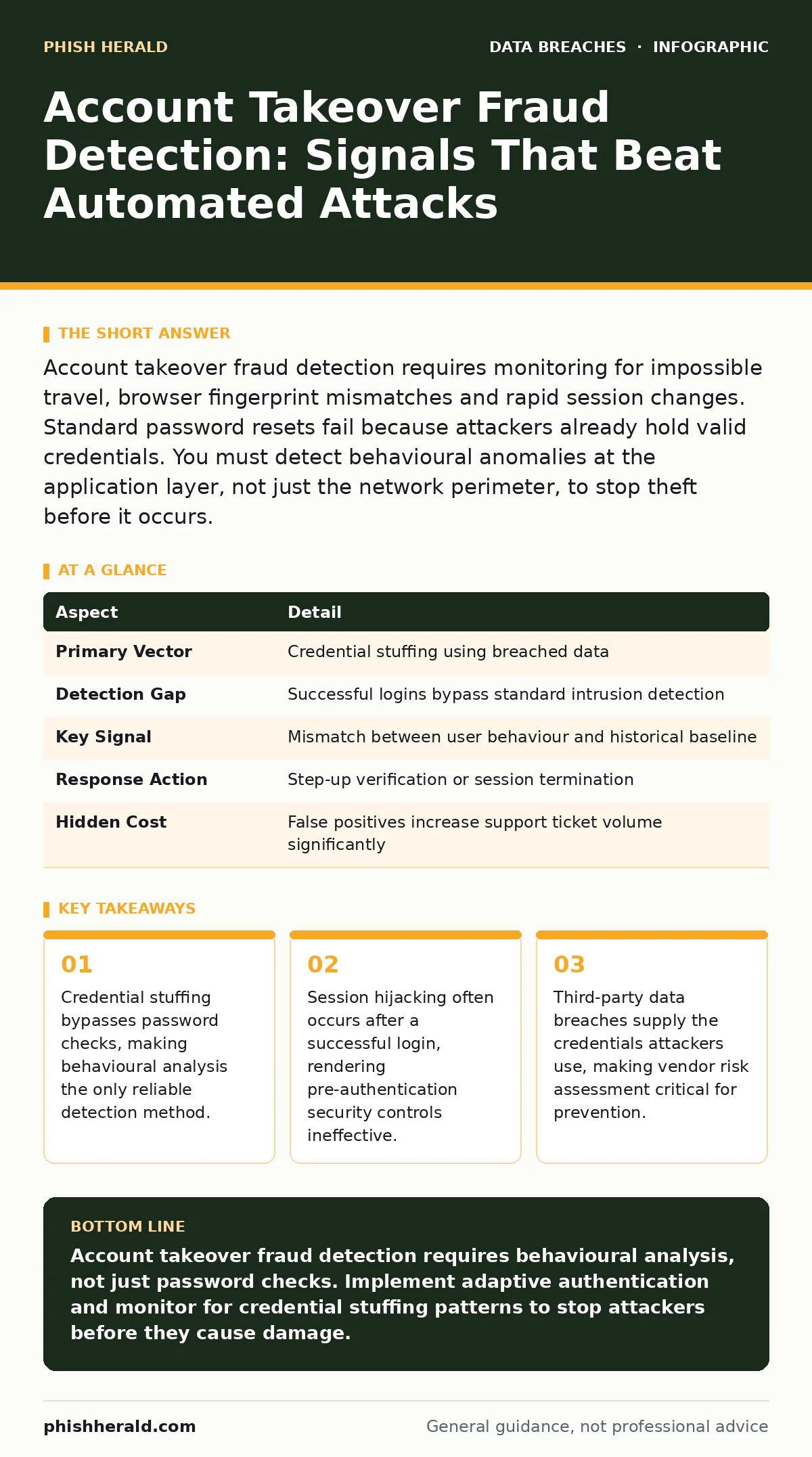
Account takeover fraud detection requires monitoring for impossible travel, browser fingerprint mismatches and rapid session changes. Standard password resets fail because attackers already hold valid credentials. You must detect behavioural anomalies at the application layer, not just the network perimeter, to stop theft before it occurs.
The Key in the Lock
Imagine leaving your house keys in the front door lock. A thief does not need to break the window or pick the lock. They simply turn the key and walk in. This is how account takeover fraud operates. The attacker already possesses the correct credentials. They are not guessing. They are using keys they stole from a previous breach.
This fraud involves an adversary gaining unauthorised access to a user account by using stolen authentication details. The attacker impersonates the legitimate owner to perform transactions, steal data or pivot to other systems. It is not a hacking attack in the traditional sense of exploiting software vulnerabilities. It is an identity attack. The system behaves exactly as designed. It grants access to the person who presents the correct key. The problem is that the key belongs to someone else.
How Account Takeover Fraud Detection Works
Standard security tools watch for failed login attempts. They lock accounts after 3 or 5 wrong passwords. This fails against account takeover fraud detection because the attacker uses the correct password. The login succeeds. The system sees a valid user. No alarm sounds.
Effective detection shifts focus from authentication to authorisation and behaviour. You must verify that the person logging in is the same person who created the account. This requires comparing current session data against historical baselines. If a user logs in from a new device, a new location or at an unusual time, the system must flag this. It does not block the user immediately. It challenges them. This challenge step is where the fraud is caught.
The mechanism relies on machine learning models that score risk. Each action adds to the score. A new IP address adds 10 points. A password change adds 20. A transfer to a new bank account adds 50. When the score crosses a threshold, the system intervenes. This intervention might require multi-factor authentication or step-up verification. Without this behavioural layer, you are blind to stolen credentials.
| Aspect | Detail |
|---|---|
| Primary Vector | Credential stuffing using breached data |
| Detection Gap | Successful logins bypass standard intrusion detection |
| Key Signal | Mismatch between user behaviour and historical baseline |
| Response Action | Step-up verification or session termination |
| Hidden Cost | False positives increase support ticket volume significantly |
Who Is Most at Risk
Every digital service with user accounts is a target. However, some sectors face higher pressure. Financial services, retail and healthcare are primary targets. Attackers seek accounts with monetary value or sensitive data. If you hold protected health information, the stakes are higher. The data is valuable on dark markets and harder for victims to detect immediately.
Small to medium businesses are often easier targets than large enterprises. Large companies invest heavily in security teams and advanced tools. Smaller organisations may lack the resources for continuous monitoring. They rely on basic firewalls and antivirus software. These tools do not stop account takeover fraud. They stop malware and network intrusions. They do not stop a valid login from a stolen credential.
Individuals are also affected. Personal accounts on email, social media and banking platforms are common entry points. Once an attacker controls a personal email account, they can reset passwords for other services. This cascade effect amplifies the damage. The initial breach might be minor, but the follow-up attacks are severe.
Common Misconceptions in Defence
Many security leaders believe that strong passwords stop account takeover fraud. This is incorrect. If an attacker has the password, strength is irrelevant. The password is the key. If the key is stolen, the door opens. You must assume passwords will be compromised. Your defence must exist beyond the password.
Another mistake is relying solely on multi-factor authentication. While MFA adds a layer, it is not perfect. Attackers use SIM swapping to intercept SMS codes. They use session hijacking to bypass MFA after the initial login. If you rely only on SMS-based MFA, you leave a gap. Authenticator apps or hardware keys are stronger, but they do not stop all attacks. You still need behavioural monitoring.
A third error is ignoring third-party data breaches. Attackers do not always target your systems directly. They target your vendors. If a vendor suffers a third-party data breach, your customers' credentials may be exposed. You might not know this until the attacks begin. You must monitor for breaches involving your supply chain. This proactive step allows you to force password resets before the attacks start.
What People Usually Get Wrong
Teams often focus on stopping the initial login. They miss the lateral movement. An attacker might gain access but not steal data immediately. They wait. They observe. They learn the user's habits. Then they act. This slow-and-low approach avoids detection. Standard rules look for sudden spikes in activity. They miss the quiet infiltration.
Another error is treating all users equally. A junior employee logging in from a new laptop is low risk. A finance director logging in from a new device is high risk. Context matters. Your detection rules must account for user role and sensitivity of data. Without this nuance, you generate too many false alarms. Security teams become desensitised to alerts. They start ignoring them. This fatigue creates a blind spot.
Finally, organisations neglect the aftermath. They block the attacker and reset the password. They do not review what the attacker did. Did they download files? Did they change settings? Did they add a new payment method? Forensic analysis is necessary. You must understand the scope of the compromise. This review improves your detection models for next time.
See also: Rootkits Explained: How Hidden Code Persists on Your System
Strengthening Your Detection Posture
To improve account takeover fraud detection, you must implement adaptive authentication. This means the system adjusts its requirements based on risk. Low-risk actions require nothing. High-risk actions require proof. This balances security and user experience. Users do not face friction every time they log in. They only face it when something looks wrong.
You must also monitor for credential stuffing patterns. Attackers use bots to try millions of password combinations. These attempts come from many IP addresses but share the same user agent or fingerprint. Detecting this pattern allows you to block the source before they succeed. This is a network-level defence that complements behavioural analysis.
Integrate your security tools. Your firewall, intrusion detection system and application logs must talk to each other. Siloed data prevents a full view of the attack. When you combine signals, you see the story. You see the failed logins, the successful logins and the subsequent data access. This holistic view is essential for accurate detection.
The Role of Data Hygiene
Clean data improves detection accuracy. If your user profiles are outdated, your baselines are wrong. A user who moved cities last year but has an old address in the system will trigger false alarms. Keep user data current. Allow users to update their profiles easily. This reduces noise in your detection system.
Regularly review dormant accounts. Accounts that have not been used in 6 months are likely abandoned. Attackers target these accounts because the owners do not notice the breach. Disable or delete dormant accounts. This reduces your attack surface. It also makes your monitoring more manageable. You focus on active users who matter.
Consider the impact of data scraping. Attackers harvest public data to build profiles. They use this information to answer security questions or verify identity. Limit the amount of personal data you expose publicly. Reduce the fuel available for these attacks. This does not stop the attack, but it raises the cost for the attacker.
Looking Beyond the Login
Account takeover fraud detection is not a one-time fix. It is a continuous process. Attackers adapt. They use residential proxies to hide their location. They mimic human behaviour to avoid bot detection. You must keep your models updated. Train them on new attack patterns. Review false positives regularly. Tune your thresholds to balance security and usability.
Collaborate with other organisations. Share threat intelligence. If one company sees a new tactic, others can prepare. Industry groups facilitate this sharing. Participation helps you stay ahead of emerging threats. Isolation makes you vulnerable. Connection makes you resilient.
Remember that technology is only part of the solution. User education matters. Teach users to recognise phishing attempts. They should not click suspicious links. They should not share their credentials. A user who falls for a phishing email hands over the key voluntarily. No amount of detection can stop that easily. Prevention starts with the user.
Key takeaways
- Credential stuffing bypasses password checks, making behavioural analysis the only reliable detection method.
- Session hijacking often occurs after a successful login, rendering pre-authentication security controls ineffective.
- Third-party data breaches supply the credentials attackers use, making vendor risk assessment critical for prevention.
Account takeover fraud detection requires behavioural analysis, not just password checks. Implement adaptive authentication and monitor for credential stuffing patterns to stop attackers before they cause damage.
Frequently asked questions
Can multi-factor authentication stop account takeover fraud?
Multi-factor authentication adds a strong layer of defence but does not stop all attacks. Attackers can bypass MFA through session hijacking, SIM swapping or by waiting for the user to log in and steal the active session token.
How do I detect account takeover without blocking legitimate users?
Use risk-based authentication that scores actions based on context. Factors like device fingerprint, location history and behaviour patterns determine the risk level. High-risk actions trigger step-up verification, while low-risk actions proceed normally.
What is the difference between account takeover and identity theft?
Identity theft involves creating new accounts or assuming a new identity using stolen personal information. Account takeover involves gaining access to an existing account using stolen credentials. Both require identity theft protection strategies but differ in execution.
Should I monitor for database activity to prevent this?
Database activity monitoring helps detect unauthorised data access after an account takeover has occurred. It does not prevent the initial login. Use it as a secondary control to limit damage if an attacker gains access and attempts to exfiltrate sensitive data.
How this guide was produced: written by the Phish Herald editorial team with AI assistance, checked against the public references listed below, and reviewed when the facts change. See our editorial policy or report an error.