Zero-Click Attacks: Dispel Myths and Secure Your Infrastructure
Zero-click exploits bypass user interaction entirely, making traditional user training ineffective and requiring continuous automated defence monitoring.

Zero-click attacks require no user action, exploiting software vulnerabilities directly. They are not rare anomalies but persistent threats targeting high-value assets. Understanding their mechanics reveals why user training fails and why automated detection is necessary for defence.
Myth: The user must click something for the attack to succeed
Reality: The term "zero-click" explicitly denotes the absence of user interaction. The exploitation occurs silently in the background.
Many security professionals assume that if a user does not click a link or open an attachment, they are safe. This belief is dangerously incorrect for this specific threat class.
The exploit code executes within the application’s memory space as soon as the malicious data is processed. This processing happens automatically when the application receives a message, an image, or a packet.
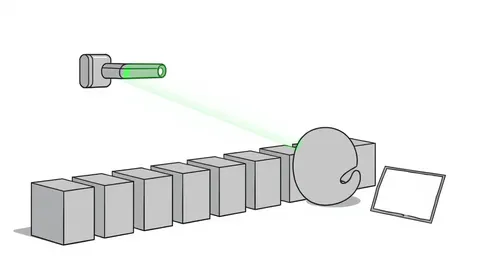
Consider how messaging apps preview media. The app decodes the image data to display a thumbnail. If the decoder contains a flaw, the exploit triggers during this decoding process.
The user never sees the malicious payload. They may not even see the message if the app crashes or if the exploit clears the evidence.
This mechanism differs entirely from phishing. Phishing relies on social engineering to trick the user. Zero-click relies on software engineering to trick the machine.
Myth: These attacks are rare and only target intelligence agencies
Reality: While highly sophisticated, the infrastructure and methods are increasingly accessible to advanced criminal groups.
The perception that only nation-states possess these capabilities is outdated. The cost of developing such exploits has decreased relative to their value.
Criminal organisations now trade access to these vulnerabilities on underground markets. They target high-net-worth individuals and corporate executives.
The goal is often financial gain or corporate espionage rather than geopolitical intelligence. Ransomware groups may use initial access brokers who employ these techniques.
If you protect sensitive intellectual property, you are a viable target. The attacker does not need to breach your firewall if they can compromise an endpoint directly.
The rarity of public disclosure creates an illusion of scarcity. Many incidents go unreported because the victim is unaware of the compromise.
Myth: Employee training can prevent zero-click attacks
Reality: Training teaches users to recognise social engineering cues. It cannot teach them to recognise flawed software code.
You cannot train a human to avoid a vulnerability in a video codec. The exploit runs before the user is aware of the threat.
Security awareness programmes are vital for reducing click-based phishing. They are completely ineffective against automated exploitation of software bugs.
Investing heavily in training while neglecting endpoint detection is a misallocation of resources. The attacker does not need the user to make a mistake.
The user is not the vector in this scenario. The software is the vector. The user is merely the recipient of the compromised state.
Shifting blame to employees for zero-click breaches is factually incorrect. It undermines trust and ignores the technical root cause.
Myth: Firewalls and perimeter security stop these attacks
Reality: Zero-click attacks often travel over legitimate, encrypted channels that firewalls allow.
Modern communication apps use end-to-end encryption. The firewall sees only encrypted traffic between authorised servers.
The malicious payload is hidden inside the encrypted stream. It is indistinguishable from normal data packets at the network level.
Perimeter defences are designed to block unauthorised access from the outside. They do not inspect the content of authorised, encrypted communications.
Once the data reaches the endpoint, the firewall’s jurisdiction ends. The exploitation happens locally on the device.
You must assume that the perimeter has been bypassed. Focus your detection efforts on the endpoint behaviour rather than network ingress.
Myth: Antivirus software will detect and block the exploit
Reality: Traditional antivirus relies on known signatures. Zero-click exploits are often unique and unknown.
Each zero-click attack may use a custom-written exploit tailored to a specific vulnerability. There is no existing signature for it.
Heuristic analysis can catch some suspicious behaviour, but it often misses subtle memory corruption. The exploit is designed to evade behavioural detection.
By the time an antivirus vendor analyses the sample and creates a signature, the attack may have already succeeded. The window of exposure is narrow.
Endpoint Detection and Response solutions are more effective than traditional antivirus. They monitor system calls and memory access patterns.
However, even advanced EDR can struggle with sophisticated fileless attacks. The exploit may never touch the disk.
See also: Endpoint Protection for Small Business: Budget Strategies That Work · Endpoint Detection and Response: Answers to Ten Critical Questions
Myth: If I have no known vulnerabilities, I am safe
Reality: Unknown vulnerabilities, known as zero-days, exist in all complex software.
You cannot patch a flaw you do not know exists. Vendors discover vulnerabilities continuously after release.
The time between a vulnerability’s discovery and its public disclosure is the window of risk. Attackers exploit this window aggressively.
Even if you patch immediately, you are vulnerable to zero-days. These are flaws that the vendor has not yet addressed.
Mitigation strategies must account for this gap. Application whitelisting and strict least-privilege models reduce the impact.
Assuming your software is secure because it is updated is a false sense of security. No software is free of hidden flaws.
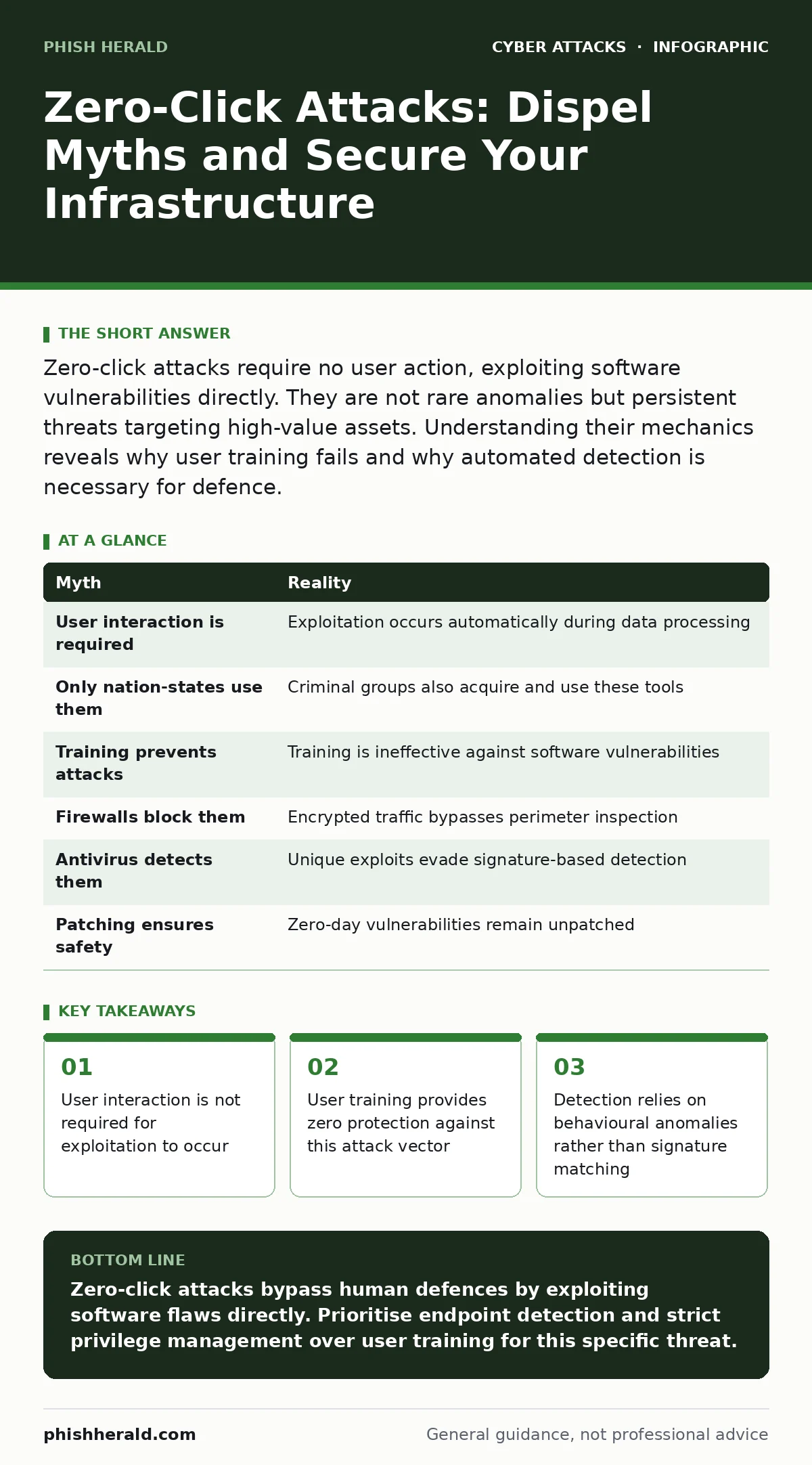
| Myth | Reality |
|---|---|
| User interaction is required | Exploitation occurs automatically during data processing |
| Only nation-states use them | Criminal groups also acquire and use these tools |
| Training prevents attacks | Training is ineffective against software vulnerabilities |
| Firewalls block them | Encrypted traffic bypasses perimeter inspection |
| Antivirus detects them | Unique exploits evade signature-based detection |
| Patching ensures safety | Zero-day vulnerabilities remain unpatched |
Key takeaways
- User interaction is not required for exploitation to occur
- User training provides zero protection against this attack vector
- Detection relies on behavioural anomalies rather than signature matching
- Patching is the only reliable mitigation for known vulnerabilities
Zero-click attacks bypass human defences by exploiting software flaws directly. Prioritise endpoint detection and strict privilege management over user training for this specific threat.
Frequently asked questions
How do I detect a zero-click attack if no file is downloaded?
Monitor for unusual process behaviour, such as an app accessing memory regions it normally does not use or attempting to elevate privileges silently.
Are mobile devices more vulnerable than desktops?
Mobile operating systems have stricter sandboxing, but messaging apps on phones are common targets due to their constant connectivity and media processing capabilities.
Does using a password manager help against zero-click attacks?
No, password managers protect credentials, but they do not prevent software exploitation. If the device is compromised, the stored passwords may be exposed.
What is the best way to reduce risk from zero-day exploits?
Reduce the attack surface by disabling unnecessary features, such as automatic media preview, and ensure your endpoint detection tools are tuned for behavioural anomalies.
How this guide was produced: written by the Phish Herald editorial team with AI assistance, checked against the public references listed below, and reviewed when the facts change. See our editorial policy or report an error.