Mistakes That Leave You Open to DCSync Attacks
DCSync attacks often succeed because administrators grant excessive replication rights to service accounts that should only hold limited permissions.
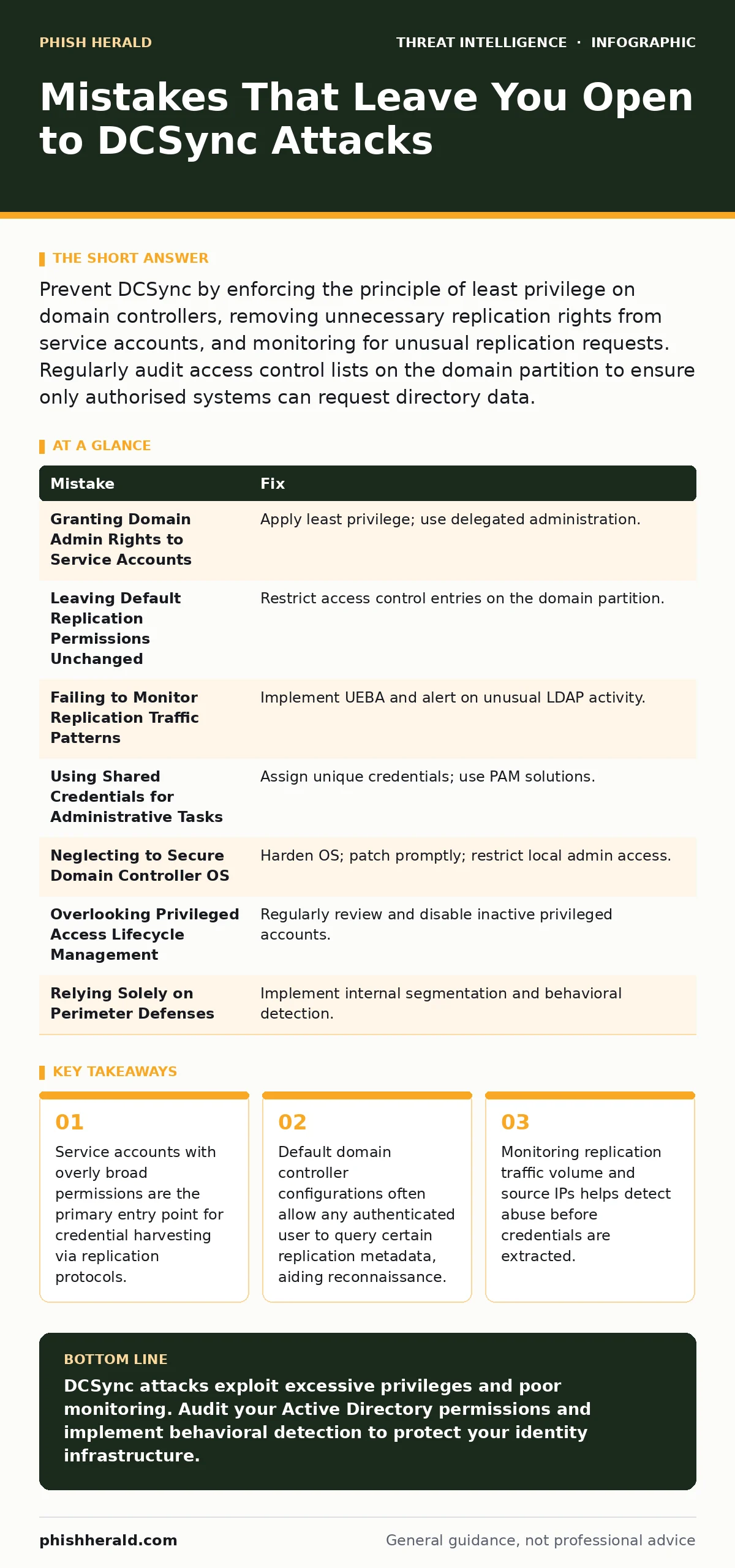
Prevent DCSync by enforcing the principle of least privilege on domain controllers, removing unnecessary replication rights from service accounts, and monitoring for unusual replication requests. Regularly audit access control lists on the domain partition to ensure only authorised systems can request directory data.
Mistake 1: Granting Domain Admin Rights to Service Accounts
Service accounts often require elevated privileges to perform automated tasks across the network. Administrators frequently assign Domain Admin rights to these accounts to simplify permission management. This decision creates a severe security risk. If an attacker compromises the service account, they immediately gain the ability to replicate the entire Active Directory database.
Why it hurts:
Domain Admin rights include the "Replicating Directory Changes" permission. An attacker uses this right to initiate a Directory Synchronization (DCSync) attack. The attacker tricks a domain controller into sending a full copy of the directory, including password hashes. You lose the security boundary between a specific service and the core identity infrastructure.
The fix:
Apply the principle of least privilege. Remove Domain Admin rights from all service accounts. Use delegated administration models instead. Assign specific permissions only to the objects the service needs to manage. Document every permission change to maintain an accurate audit trail.
Mistake 2: Leaving Default Replication Permissions Unchanged
Active Directory ships with default access control lists that allow any authenticated user to read certain replication metadata. While this does not directly expose password hashes, it provides attackers with a map of the directory structure. They use this map to identify high-value targets and plan their next moves.
Why it hurts:
Attackers use tools to enumerate domain controllers and replication topology. This reconnaissance step is silent and often goes undetected by standard monitoring. It allows threat actors to tailor their DCSync attempts to specific controllers, increasing the success rate and reducing the noise generated during the attack phase.
The fix:
Review and restrict default access control entries on the domain partition. Limit the "Read" permission on replication metadata to only those accounts that strictly require it. Use Group Policy to enforce these restrictions across all domain controllers. Regular audits ensure that new objects do not inherit overly permissive settings.
Mistake 3: Failing to Monitor Replication Traffic Patterns
Replication is a normal function of Active Directory. However, DCSync attacks generate distinct traffic patterns. Administrators often fail to configure alerts for unusual replication volumes or sources. Without specific monitoring, these attacks blend in with background noise, allowing attackers to extract credentials unnoticed.
Why it hurts:
DCSync requests involve large data transfers and specific LDAP operations. If you do not monitor for these patterns, you rely on perimeter defenses that the attacker has already bypassed. The attack completes successfully, and you only discover the breach when the stolen credentials are used elsewhere in the network.
The fix:
Implement user and entity behavior analytics to establish a baseline for normal replication activity. Configure alerts for replication requests from non-domain controller IPs. Monitor for high-volume LDAP queries that do not match scheduled maintenance windows. Investigate any anomaly immediately to prevent credential theft.
Mistake 4: Using Shared Credentials for Administrative Tasks
Organisations often create shared accounts for administrative tasks to simplify logging and accountability. This practice creates a single point of failure. If the shared credentials are compromised, the attacker gains access to all systems and services that use those credentials.
Why it hurts:
Shared credentials cannot be traced to a specific individual. This lack of accountability makes it difficult to detect insider threats or compromised accounts. Attackers exploit this by using the shared account to perform DCSync, knowing that the activity will not raise immediate suspicion due to the account's normal usage patterns.
The fix:
Eliminate shared administrative accounts. Assign unique credentials to each administrator. Use Privileged Access Management solutions to manage and audit privileged sessions. Ensure that all administrative actions are logged with the individual user's identity, not a generic service account.
Mistake 5: Neglecting to Secure Domain Controller Operating Systems
Domain controllers run the operating system that hosts Active Directory. If the underlying OS is not hardened, attackers can exploit vulnerabilities to gain local administrative access. Once local access is achieved, they can manipulate directory services to facilitate credential theft.
Why it hurts:
Local administrative access allows an attacker to modify security descriptors and install malicious agents. These agents can intercept replication traffic or directly extract memory-resident credentials. The DCSync attack becomes just one of many options available to an attacker with local control, increasing the likelihood of a successful breach.
The fix:
Harden domain controller operating systems by disabling unnecessary services and applications. Apply security patches promptly to address known vulnerabilities. Restrict local administrative access to a small group of trusted administrators. Use application whitelisting to prevent the execution of unauthorised software.
See also: Tactics, Techniques and Procedures (TTPs) for Security Decisions
Mistake 6: Overlooking Privileged Access Lifecycle Management
Privileged accounts often remain active long after the user leaves the organisation or changes roles. This stale access provides attackers with persistent entry points. Without regular reviews, these accounts become invisible liabilities that can be exploited for DCSync attacks.
Why it hurts:
Inactive privileged accounts are rarely monitored. Attackers discover these accounts through directory enumeration and use them to perform DCSync. The lack of recent activity makes the attack appear legitimate, bypassing behavioral detection systems. The breach remains undetected until the stolen credentials are used for lateral movement.
The fix:
Implement a regular review process for all privileged accounts. Disable or remove accounts that are no longer needed. Use automated tools to enforce password complexity and expiration policies. Conduct periodic access certifications to ensure that permissions align with current job responsibilities.
Mistake 7: Relying Solely on Perimeter Defenses
Many organisations focus their security efforts on perimeter defenses like firewalls and intrusion detection systems. This approach assumes that threats originate from outside the network. It fails to account for insider threats or attackers who have already breached the perimeter.
Why it hurts:
DCSync attacks originate from within the network. Perimeter defenses cannot detect or prevent internal replication requests. Attackers use legitimate credentials to initiate the attack, making it appear as normal network traffic. You remain blind to the breach until the consequences manifest in data exfiltration or ransomware deployment.
The fix:
Adopt a defense-in-depth strategy. Implement internal network segmentation to limit the movement of attackers. Use breach and attack simulation to test your internal defenses regularly. Focus on detecting anomalous behaviour within the network rather than just blocking external threats.
| Mistake | Fix |
|---|---|
| Granting Domain Admin Rights to Service Accounts | Apply least privilege; use delegated administration. |
| Leaving Default Replication Permissions Unchanged | Restrict access control entries on the domain partition. |
| Failing to Monitor Replication Traffic Patterns | Implement UEBA and alert on unusual LDAP activity. |
| Using Shared Credentials for Administrative Tasks | Assign unique credentials; use PAM solutions. |
| Neglecting to Secure Domain Controller OS | Harden OS; patch promptly; restrict local admin access. |
| Overlooking Privileged Access Lifecycle Management | Regularly review and disable inactive privileged accounts. |
| Relying Solely on Perimeter Defenses | Implement internal segmentation and behavioral detection. |
Key takeaways
- Service accounts with overly broad permissions are the primary entry point for credential harvesting via replication protocols.
- Default domain controller configurations often allow any authenticated user to query certain replication metadata, aiding reconnaissance.
- Monitoring replication traffic volume and source IPs helps detect abuse before credentials are extracted.
DCSync attacks exploit excessive privileges and poor monitoring. Audit your Active Directory permissions and implement behavioral detection to protect your identity infrastructure.
Frequently asked questions
How do I know if I am under a DCSync attack?
Look for unusual LDAP replication requests from non-domain controller IPs or high-volume directory queries that do not match normal maintenance schedules.
Can DCSync be prevented without changing Active Directory permissions?
No. DCSync relies on replication permissions. You must restrict these permissions to prevent the attack. Monitoring alone is not sufficient for prevention.
Is DCSync a form of ransomware?
No. DCSync is a credential harvesting technique. Attackers use the stolen credentials to move laterally or deploy ransomware, but DCSync itself is not malware.
Do third-party security tools prevent DCSync?
Some tools can detect the traffic patterns associated with DCSync. However, prevention requires proper configuration of Active Directory permissions and least privilege practices.
How this guide was produced: written by the Phish Herald editorial team with AI assistance, checked against the public references listed below, and reviewed when the facts change. See our editorial policy or report an error.