Ransom Notes: Decoding Demands and Hidden Threat Indicators
The ransom note is rarely just a payment instruction; it often contains embedded metadata that reveals the attacker’s toolchain and operational security gaps.

Ransom notes are files left by attackers to prove encryption and demand payment. They vary from simple text to complex HTML. You should never read them on an infected machine. Isolate the system, capture the file safely, and analyse it offline to understand the threat scope before considering any response.
Does the ransom note prove the attacker encrypted my data?
The presence of a ransom note is strong evidence of encryption, but it does not guarantee every file is compromised. Attackers sometimes drop the note prematurely if their encryption routine fails or if they are interrupted. You must verify the file headers of critical documents to confirm they are actually encrypted and not just renamed. If the headers remain intact, the attacker may have failed to encrypt the data, rendering the demand void.
Why do some notes look like simple text while others are web pages?
The format reflects the attacker’s technical sophistication and their desire to appear legitimate. Simple text files are often generated by automated malware that lacks the resources to render complex interfaces. HTML-based notes mimic professional support portals, attempting to reduce victim anxiety and increase the likelihood of payment. This visual polish suggests a more organised operation, possibly one that engages in double extortion ransomware tactics where data theft accompanies encryption.
Is it safe to open the ransom note on the infected machine?
Opening the note on the compromised system poses significant risks beyond the initial infection. Many modern ransomware variants include secondary payloads that activate when specific files are accessed. Furthermore, if the note is an HTML file, it may contain JavaScript that communicates with the attacker’s command and control servers. This communication can leak your internal network topology or indicate that the system is still under active surveillance.
Can the ransom note reveal who is behind the attack?
The note often contains unique identifiers, such as case IDs or specific branding, that link the incident to a known threat actor. These markers allow security researchers to correlate the attack with previous campaigns and known toolsets. However, criminals frequently reuse templates or impersonate other groups to confuse attribution efforts. You should treat these identifiers as probabilistic indicators rather than definitive proof of the attacker’s identity.
What information should I extract from the note for analysis?
You need to preserve the raw file, any associated scripts, and the exact timestamp of its creation. If the note references a PGP key or a Tor hidden service, record these details without interacting with them. The file structure itself can reveal the encryption algorithm used, which informs your recovery strategy. Detailed examination often requires malware analysis techniques to uncover hidden strings or embedded commands within the file.
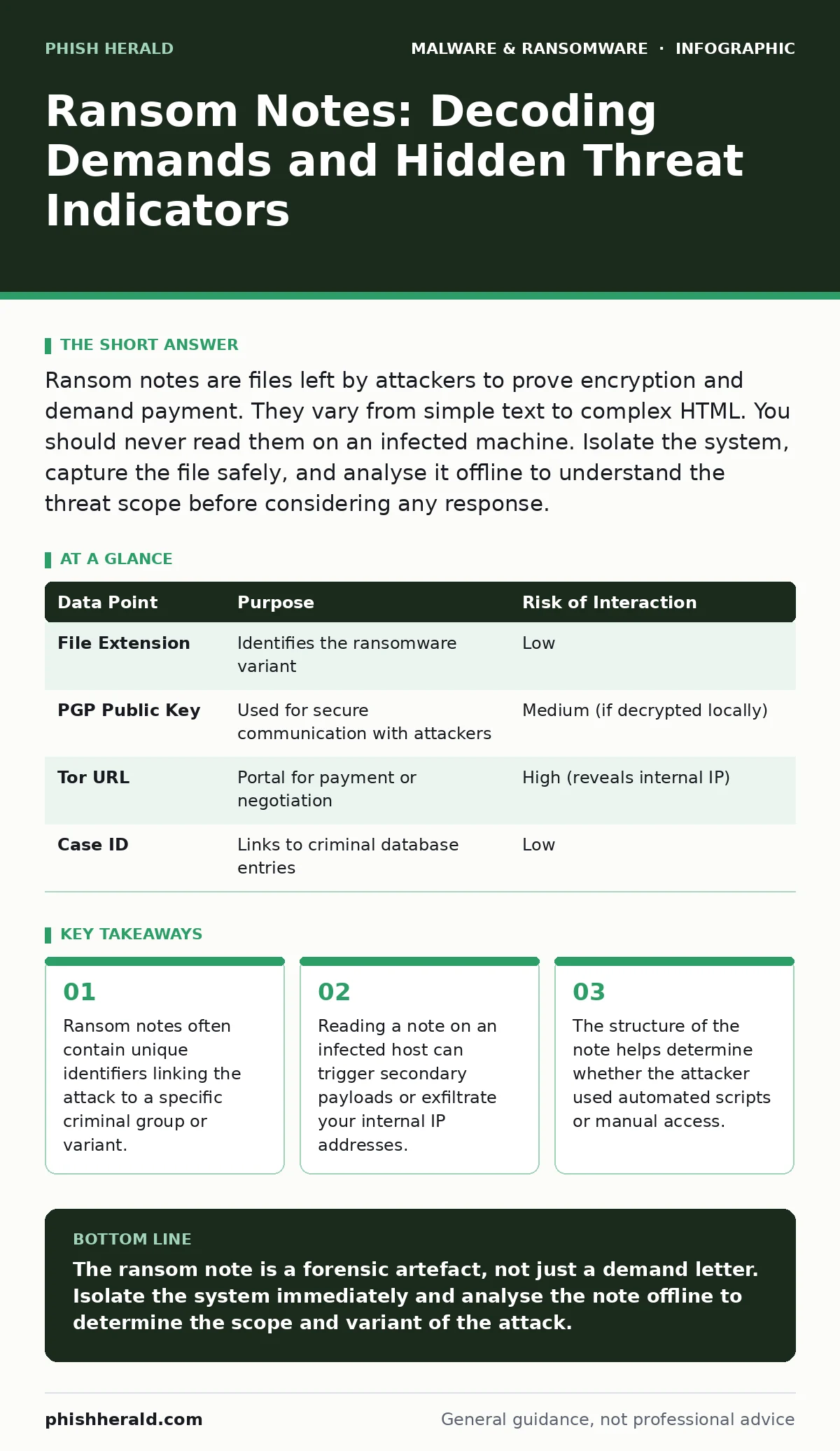
| Data Point | Purpose | Risk of Interaction |
|---|---|---|
| File Extension | Identifies the ransomware variant | Low |
| PGP Public Key | Used for secure communication with attackers | Medium (if decrypted locally) |
| Tor URL | Portal for payment or negotiation | High (reveals internal IP) |
| Case ID | Links to criminal database entries | Low |
How do attackers use the note to bypass security controls?
Some notes include instructions to disable security software or whitelist specific processes. These commands exploit the trust you place in the attacker’s technical guidance. Following these instructions can disable endpoint detection, allowing the malware to persist or spread laterally. Always assume any instruction in the note is designed to degrade your defensive posture further.
Can I use the note to negotiate or pay without losing data?
Negotiation is a high-risk strategy that rarely guarantees data recovery. Criminal operations are often structured to prevent individual negotiators from honouring promises. Payment does not always result in the decryption key, and it may mark your organisation as a target for future attacks. The financial and reputational costs usually outweigh the potential benefit of restored access.
What is the first step after finding a ransom note?
Isolate the affected system from the network immediately to prevent lateral movement. Do not shut down the machine, as this may destroy volatile memory containing encryption keys or attacker processes. Capture a forensic image if possible, then preserve the ransom note as evidence. This preservation supports both technical recovery efforts and potential law enforcement reporting.
Does the note indicate if backups were encrypted?
The note itself rarely confirms whether backups were targeted, but the attacker’s methodology provides clues. If the note appears on network shares or backup servers, the attacker likely had administrative access. Automated ransomware often targets accessible storage volumes, including mapped drives and cloud sync folders. You must verify the integrity of your offline backups independently, assuming the worst-case scenario.
How do I distinguish between a hoax and a real attack?
A hoax note usually lacks technical specificity, such as a valid PGP key or a consistent case ID. Real attacks involve actual file encryption, which you can verify by checking file sizes and headers. Hoaxes are often distributed via email to create panic and extract ransom through social engineering. If no files are encrypted, treat the incident as a phishing attempt and investigate the delivery mechanism.
Can the note help in recovering data without paying?
The encryption algorithm identified in the note may have known vulnerabilities or free decryption tools available. Security researchers frequently publish decryptors for older or poorly implemented ransomware variants. By identifying the specific strain, you can check if a public decryption tool exists. This approach depends on the attacker using standard cryptographic libraries rather than custom, unbreakable algorithms.
Key takeaways
- Ransom notes often contain unique identifiers linking the attack to a specific criminal group or variant.
- Reading a note on an infected host can trigger secondary payloads or exfiltrate your internal IP addresses.
- The structure of the note helps determine whether the attacker used automated scripts or manual access.
The ransom note is a forensic artefact, not just a demand letter. Isolate the system immediately and analyse the note offline to determine the scope and variant of the attack.
Frequently asked questions
Should I delete the ransom note immediately?
No, preserve the file for forensic analysis and potential law enforcement investigation. It contains critical evidence about the attack vector and malware variant.
Can I read the note on a different computer?
Yes, but ensure the file is transferred via a secure, isolated method to prevent any embedded scripts from executing on the clean machine.
Does the note contain the decryption key?
No, the key is held by the attacker. The note only provides instructions for communication and payment, which you should not follow.
What if the note is in a foreign language?
Use automated translation tools on an isolated system. The technical identifiers and file structures remain useful regardless of the language used.
How this guide was produced: written by the Phish Herald editorial team with AI assistance, checked against the public references listed below, and reviewed when the facts change. See our editorial policy or report an error.